


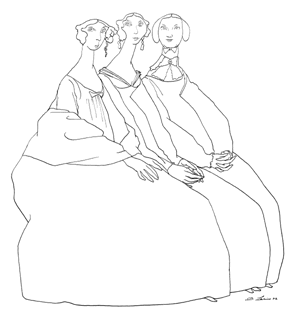
In the May 4, 1972, issue of The New York Review of Books, Elizabeth Hardwick wrote about the lives and work of the Brontë sisters on the occasion of Winifred Gérin’s then-new biography of Emily (preceded by Gérin’s biographies of Anne, Branwell, and Charlotte, and followed in 1973 by her group biography The Brontës). Below, we present Hardwick’s essay read by Kathleen Chalfant, an actress who has appeared in television, in film, and in stage productions on and off Broadway. She is currently performing in New York in the Playwrights Horizons production of Jacob Perkins’s The Dinosaurs, and she recently starred in Sarah Friedland’s film Familiar Touch (2024).
This reading serves as an accompaniment to the Private Life episode featuring Darryl Pinckney discussing his close friendship with Hardwick. You can also read an excerpt of “Working Girls: The Brontës” below.
The careers of the three Brontë sisters—Anne, Charlotte, and Emily—conferred a sort of perpetuity upon the whole family. The father's eccentricities, once brought under scrutiny by the fame of the daughters, proved to be rich enough in detail to provide a good store of anecdote. There is, as with all of the family, always some question about what was truth and what fancy.
The Reverend Brontë was a failed writer. He had published Cottage Poems and The Rural Minstrel, and he certainly had the sedentary habits and wide range of peculiarities that might have assisted a literary career, but perhaps the Reverend was not able to take in enough from the outside to nourish his art. He carried a pistol around with him and sometimes when he was angry found relief by shooting through the open door. It was rumored that he cut up one of his wife's silk dresses out of regard for his strict standards of simplicity and seriousness. For his own part the Reverend Brontë disowned claims to flamboyance and said: "I do not deny that I am somewhat eccentric…. Only don't set me on in my fury to burning hearthrugs, sawing the backs off chairs and tearing my wife's silk gowns."
There were five daughters and one son in the Brontë family, and the father unluckily placed his hopes in his son, Branwell. It is only by accident that we know about people like Branwell who seemed destined for the arts, unable to work at anything else, and yet have not the talent, the tenacity, or the discipline to make any kind of sustained creative effort. With great hopes and at bitter financial sacrifice, Branwell was sent up to London to study painting at the Academy Schools. The experience was wretched for him and he seemed to have sensed his lack of preparation, his uncertain dedication, his faltering will. He never went to the school, did not present his letters of introduction, and spent his money in taverns drinking gin. It finally became necessary to return home in humiliation and to pretend that he had been robbed.
One story has poor Branwell visiting the National Gallery and, in the presence of the great paintings there, despairing of his own talents. This is hard to credit, since the example of the great is seldom a deterrent to the mediocre. In any case, nothing leads us to think Branwell lacked vanity or expansive ideas of his own importance. Also, the deterrent of Branwell’s own nature made any further impediments unnecessary. His nature was hysterical, addictive, self-indulgent. Very early he fell under the spell of alcohol and opium; his ravings and miseries destroyed the family peace, absorbed their energies, and depressed their spirits. He had to be talked to, watched over, soothed, and protected—and nothing really availed. Branwell destroyed his life with drugs and drink and died of a bronchial infection at the age of thirty-one.
Perhaps the true legacy Branwell left the world is to be found in the extraordinary violence of feeling, the elaborate language of bitterness and frustration in Wuthering Heights. It is not unreasonable to see the origin of some of Heathcliff’s raging disappointment and disgust in Branwell’s own excited sense of injury and betrayal. Emily Brontë took toward her brother an attitude of stoical pity and protectiveness. Charlotte was, on the other hand, in despair at his deterioration, troubled by his weaknesses, and condemning of the pain he brought to the household. It is significant that Charlotte insisted Branwell did not know of the publication of his sisters’ poems, nor of the composition of Wuthering Heights, Jane Eyre, and Agnes Grey. She wrote, “My unhappy brother never knew what his sisters had done in literature—he was not aware that they had ever published a line. We could not tell him of our efforts for fear of causing him too deep a pang of remorse for his own time misspent, and talents misapplied.”
Still, in spite of every failure and vice, Branwell always interested people. The news of his promise and default seemed to have spread around quite early. Matthew Arnold included him in his poem “Haworth Churchyard,” written in 1855, the year of Charlotte Brontë’s death and two years before Mrs. Gaskell’s biography. About Branwell, Arnold wrote:
O boy, if here thou sleep’st, sleep well:
On thee too did the Muse
Bright in thy cradle smile;
But some dark shadow came
(I know not what) and interposed.
The emergence of the Brontë sisters is altogether a lucky circumstance and nothing is easier than to imagine all of them dying unknown, their works lost. The father lived to be eighty-four, but of the children Charlotte’s survival to thirty-nine seemed almost a miracle. Not even she, and certainly not the other two sisters, had the chance to do what they might have. This is especially distressing in the case of Emily. Wuthering Heights has a sustained brilliance and originality we hardly know how to account for. It is on a different level of inspiration from her poetry; the grandeur and complication of it always remind one of the leap she might have taken had she lived.
They are an odd group, the Brontës, beaten down by a steady experience of the catastrophic. The success of Jane Eyre, the fame that came to Charlotte, were fiercely, doggedly earned. She had struggled for independence not as an exhilaration dreamed of but as a necessity, a sort of grocery to sustain the everyday body and soul. Literary work and the presence of each other was the consolation at Haworth parsonage. There was certainly a family closeness because of the dangers they had passed through in the deaths of their mother and two older sisters. Haworth was a retreat; but part of its hold upon them was a kind of negative benevolence: it was at least better to have the freedom and familiarity of the family than the oppression of the life society offered to penniless, intellectual girls.
A study of the Brontë lives leaves one with a disorienting sense of the unexpected and the paradoxical in their existence. In them are combined simplicities and exaggerations, isolation and an attraction to scandalous situations. Victorian readers of the novels of these quiet, repressed spinsters were immediately aware of a disturbing undercurrent of intense sexual fantasy. Loneliness and melancholy seemed to alternate in their feelings with an unusual energy and ambition.
In the novels of Charlotte and Anne there is a firm grasp of social pressures and forces; they understood from their own experience that opportunities for independence were likely to be crushing to the essential spirit and the sense of self. The central figures in Wuthering Heights are struggling with an inner tyranny. Catherine is nihilistic, self-indulgent, bored, restless, nostalgic for childhood, unmanageable. She has the charm of a wayward schizophrenic girl, but she has little to give since she is self-absorbed, haughty, destructive. What is interesting and contemporary for us is that Emily Brontë should have given Catherine the center of the stage, to share it along with the rough, brutal Heathcliff. In a novel by Charlotte Brontë or Anne, Cathy would be a shallow beauty, analyzed and despaired of by a reasonable, clever, and deprived heroine. She would be fit only for the subplot.
Emily Brontë’s poetry is constricted by its hymn-tune rhythms and a rather narrow and provincial idea of the way to use her own peculiar visions. The novel form released in her a new and explosive spirit. The demands of the form, the setting, the multiplication of incidents, the need to surround the Byronic principals, Cathy and Heath-cliff, with the prosaic, the dogs, the husbands, the family servants, sisters, houses—the elements of fact lift up the dreamlike, compulsive figures, give them life. The plot of Wuthering Heights is immensely complicated and yet there is the most felicitous union of author and subject. There is nothing quite like this novel with its rage and ragings, its discontent and angry restlessness.
Wuthering Heights is a virgin’s story. The peculiarity of it lies in the harshness of the characters. Cathy is as hard, careless, and destructive as Heathcliff. She too has a sadistic nature. The love the two feel for each other is a longing for an impossible completion. Consolations do not appear; nothing in the domestic or even in the sexual life seems to the point in this book. Emily Brontë appears in every way indifferent to the need for love and companionship that tortured the lives of her sisters. We do not, in her biography, even look for a lover as we do with Emily Dickinson because it is impossible to join her with a man, with a secret, aching passion for a young curate or a schoolmaster. There is a spare, inviolate center, a harder resignation amounting finally to withdrawal.
The Brontë sisters had the concentration and energy that marked the great nineteenth-century literary careers. When The Professor was going the rounds of publishers, Charlotte was finishing Jane Eyre. The publication of the Poems by Currer, Ellis and Acton Bell was just barely a publication. A year later only two copies had been sold and the book received merely a few scattered, unimportant notices. Still, it was an emergence, an event, an excitement. Emily had at first resisted publication and was so guarded about the failure of the book that we cannot judge her true feelings. No discouragement prevented the sisters from starting to work, each one, on a novel. The practical side of publication, the proofs, the letters to editors, the seriousness of public authorship were an immensely significant break in the isolation and uncertainly of their lives.
The Brontës had always had a sense of performance, of home performance in their Angria and Gondal plots and characters. And some of them quite early felt their gifts could reasonably claim the attention of the world. Branwell wrote highhanded letters to the editor of Blackwood’s Magazine saying, “Do you think your magazine so perfect that no additions to its power would be either possible or desirable?” He sent off a note to Wordsworth suggesting, “Surely, in this day when there is not a writing poet worth a sixpence, the field must be open, if a better man can step forward.” Wordsworth noted the mixture of “gross flattery” and “plenty of abuse” and did not reply.
Charlotte posted a few poems to Southey. He was not discourteous but delivered the opinion, “Literature cannot be the business of a woman’s life, and it ought not to be. The more she is engaged in her proper duties, the less leisure will she have for it, even as an accomplishment and a recreation.”
Absolute need drove the Brontë sisters. They were poor, completely dependent upon their father’s continuation in his post, and without hopes of anything were he to die. They did receive a small legacy upon the death of Aunt Branwell and they looked upon the income with awe and intense gratitude. But it was not in any sense a living. The sisters were not beautiful, yet their appearance can hardly be thought a gross liability. Their natures, the scars of the deaths of their mother and sisters, their intellectuality, and their poverty were the obstacles to marriage.
There was also perhaps some disappointment in their father and brother that weighed on their spirits. Branwell’s imperfections were large and memorable; the father’s were less palpable. He was not a rock—at least not of the right kind. When Charlotte finally married his curate he refused to perform the ceremony and indeed gave up altogether the duty of marrying persons. The Brontë household was in fact a household of women, women living and dead. The sense of being on their own came very early. Each sister felt the weight of responsibility in an acute and thorough way.
The worries that afflicted genteel, impoverished women in the nineteenth century can scarcely be exaggerated. They were cut off from the natural community of the peasant classes. The world of Tess of the D’Urbervilles, for all its sorrow and injustice, is more open and warm and fresh than the cramped, anxious, fireside-sewing days of the respectable. Chaperones, fatuous rules of deportment and occupation drained the energy of intelligent, needy women. Worst of all was society’s contempt for the prodigious efforts they made to survive. Their condition was dishonorable, but no approval attached to their efforts to cope with it. The humiliations endured in the work of survival are a great part of the actual material in the fiction of Charlotte and Anne Brontë.
It seems likely that there was a steady downward plunge by alliances with the poorer classes on the part of the desperate daughters of impecunious gentlefolk. And some resolved to move upward, like Becky Sharp, the daughter of a dissolute painter and an opera-singer mother. Becky Sharp had “the dismal precocity of poverty” and the heedless shrewdness of the bohemian world. She spoke of herself as never having been a girl: “she had been a woman since she was eight years old.” Becky Sharp is the perfect contrast to Jane Eyre and Lucy Snowe, the heroine of Charlotte Brontë’s Villette, two girls with an almost extinguishing sense of determination and accountability. In the Brontë sisters there is a distinctly high tone and low spirit; they retained something of the Methodism of their mother and of the aunt who raised them. Even Branwell, with his flaming indulgences, is a sort of prototypical parson’s son who exchanged every prohibition for a license.
Charlotte Brontë wrote: “None but those who had been in a position of a governess could ever realize the dark side of respectable human nature; under no great temptation to crime, but daily giving way to selfishness and ill-temper, till its conduct toward those dependent on it sometimes amounts to a tyranny of which one would rather be the victim than the inflicter.” To be a ladies companion was even worse for a young woman; the caprice and idleness of the old fell down like a shroud upon the young.
Schools had always been traumatic and even murderous for the Brontë children. The two older daughters, Maria and Elizabeth, were sent to the Clergy Daughters’ School, an institution especially endowed for girls like themselves who could expect to have to make their own way. It was sponsored by such well-known people of the day as Wilberforce and Hannah More. But the school was, nevertheless, a cruel place—cold, with inadequate, dirty food, overworked, tyrannical teachers. The children took long, freezing walks to church and sat in their cold, damp clothes all day. There was tuberculosis throughout the school and the condition led to the death of Maria when she was twelve and Elizabeth when she was eleven. Emily and Charlotte were only six and a half and eight years old when they joined their older sisters at the school. They watched with horror and the deepest resentment as the older girls fell ill and were sent home to die.
The mother of the Brontës had died of cancer after bearing six children in seven years. All of these griefs and losses formed the character of the survivors: the religious earnestness of Anne, the withdrawn, peculiar nature of Emily, the stoical determination of Charlotte.
For the sisters, and even for Branwell after his failure as a painter, life seemed to offer nothing except the position of governess or tutor in a private family. This was a hard destiny. The children exploit and torment; the parents exploit and ignore. The social and family position of a governess was ambiguous and led to painful feelings of resentment, envy, or bitter acceptance. The young women who went to work in the houses of the well-to-do were clever and unprotected; one quality seemed to vex their charges and employers as much as the other.
The teacher-governess in fiction is likely, because of the intimate family setting in which she is living her lonely life, to fall into an almost hysterical, repressed eroticism. Henry James noticed the tendency of the governess to be “easily carried away.” Both Jane Eyre and Lucy Snowe are superior, gifted girls, very much like Charlotte Brontë herself. They are bookish, forthright, skeptical, inclined to moralizing and to making wearisome, patient efforts to maintain self-esteem and independence. They are defenseless, cast adrift, and yet of an obviously fine quality that shows itself in a tart talent for down-putting retorts. Under the correcting surface they are deeply romantic, full of dreams, and visited by nightmares. They feel a pressing, hurting need for love and yet they work hard to build up resignation to the likelihood that they will have to live bereft of the affections so much wanted. Need and sublimation play back and forth like a waving light over their troubled consciousness. By these pains they grew into sharp observers, ever anxious to control and manage a threatening despair.
Read the full article on the Review’s website here.
How is this essay not in either "The Collected Essays" or "The Uncollected Essays"? Heck of an ommission!
I hope my books get good reviews.