


In the Review’s April 23 issue, Trevor Jackson writes about the state of retirement in America:
Of Americans aged 62–70, only 10 percent are retired and financially stable. Another 11 percent could retire comfortably but choose not to. A full 51 percent are retired, but their living standards have diminished significantly since they stopped working, and 28 percent are still working and cannot afford to stop.… Policy elites and other economists…believe that the solution is for those 79 percent of older Americans who cannot retire comfortably to work longer and retire later.
This is a far cry from the vision of the Social Security Act, which, Jackson notes, quoting the historian James Chappel, is “the greatest poverty-reduction program in American history.” But the kinds of policies necessary to reverse the trend toward ceaseless work—increasing minimum wage, lowering the qualifying age for Medicare—depend “on a set of political conditions that themselves require a powerful, organized, militant working class able to confront and defeat capital, corporations, and employers.” In the meantime, the Trump administration is encouraging retirement plan administrators to invest in cryptocurrency.
Below, alongside Jackson’s essay, are five articles and one letter from our archives about retirement.
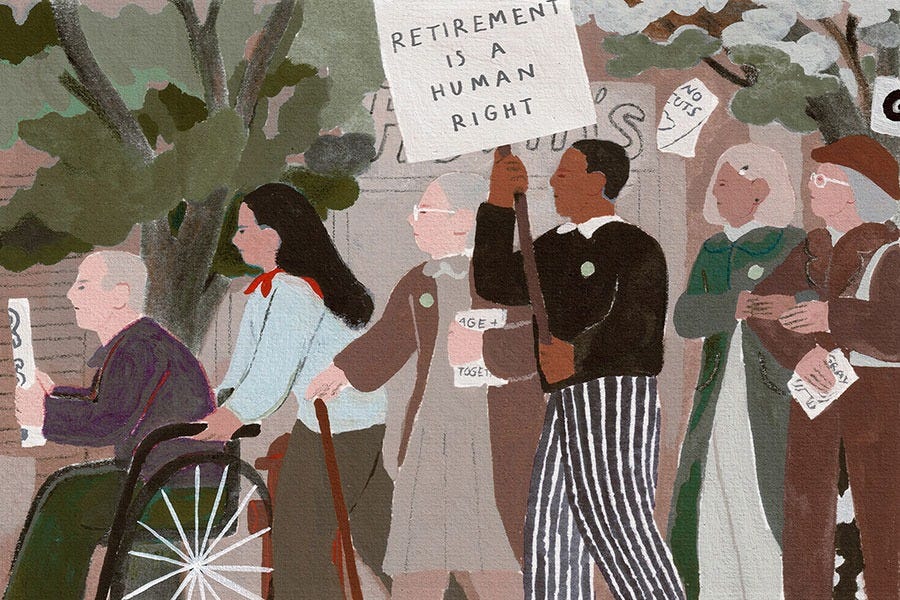
The Aging Class
Trevor Jackson
We know how long a human life span is, but what about the life span of a policy regime? If modern retirement was born in 1935 with the passage of the Social Security Act, it is now entering its ninth decade. Over that time retirement has been diminished and degraded; Social Security in particular has survived several assassination attempts. It is once again in the crosshairs: congressional Republicans have proposed raising the full retirement age to sixty-nine and changing the benefit formula, while Social Security offices and staff have been cut, and like the rest of the federal machinery, the system is being weaponized to enforce the Trump administration’s agenda. So are we closer to the end or to the beginning?
For the historian James Chappel, there is reason for hope: the idea of retirement has been different before and can be different again. Taken to an extreme, an ever-evolving idea of retirement could outlive drastic institutional change, perhaps enduring longer than the institutions of American democracy or beyond climate disaster. For the economist Teresa Ghilarducci, retirement is in crisis, and the crisis is only growing more severe. A “Maximalist Plan for Guaranteed Retirement Accounts” is needed to give it new life and to allow Americans to genuinely retire rather than continue working at diminished wages and with little security until they die.
Chappel is a historian at Duke University, where he teaches and researches the intellectual history of religion, gender, and the family in modern Europe and the United States. He is also affiliated with the Duke Aging Center, the longest continuously funded center on aging research in the US. In Golden Years, he sets out to tell the story of how old age emerged as a distinct phase of life and how American ideas about old age evolved across the twentieth century. The book is motivated in part by a puzzle: between the 1920s and 1970s “old age was a perennial issue in national politics. Since then, no major legislation has been passed, beyond some insufficient reforms to the preexisting system.”
The mystery deepens when you add the bleak evidence from Ghilarducci’s Work, Retire, Repeat: although older Americans are far more politically active than younger ones, account for an enormous proportion of federal spending, and may constitute one of the most effective voter interest groups in the US (to say nothing of their gerontocratic lock on all national political leadership), they have seen no institutional changes to old-age policy for a half-century. What they’ve seen instead is a continual erosion of their ability to retire and their standards of living once they do.
Chappel begins with two different visions of elder care that arose in the late nineteenth century. The Ex-Slave Mutual Relief, Bounty, and Pension Association recognized that formerly enslaved people tended not to have savings or employer pensions in their old age, since they hadn’t been paid for their work before emancipation and faced an exploitative labor market after. Led by a formerly enslaved washerwoman, the group advocated for pensions to former slaves—an approach “rooted in racial justice and in recognition of the many kinds of meaningful labor,” part reparations and part stimulus for the impoverished rural South. In contrast, the Fraternal Order of Eagles advocated for pensions for industrial wage laborers—for people who had worked in jobs that wore out their bodies and left them physically unable to work. The Eagles had in mind city-dwelling male breadwinners and excluded household and domestic work from their vision of who was among the deserving. The leader of the Ex-Slave Pension Association was later imprisoned on mail fraud charges, and the organization faded away, while the Eagles became one of the pressure groups that eventually led to Social Security. For Chappel, this was the first point when policy turned away from universality and toward a politicized idea of deservedness. Since then the institutions of American aging have reproduced rather than ameliorated the inequalities and injustices of the wider American economy.
Read the full article on the Review’s website here.
From the Archives: Worked to Death
Caitlin Zaloom on the precarity of public pensions
Jeff Madrick on the fading possibility of “a fairly comfortable old age”
Peter G. Peterson, in a two-part article, on the Reagan-era Social Security crisis and its possible solutions
An exchange challenging Peterson’s analysis and recommendations
V.S. Pritchett on getting old

The idea that the government should maintain Boomers' lifestyles in retirement is going to go over like a turd in the punchbowl with Gen Z.