Winter War
Tim Judah on Ukraine

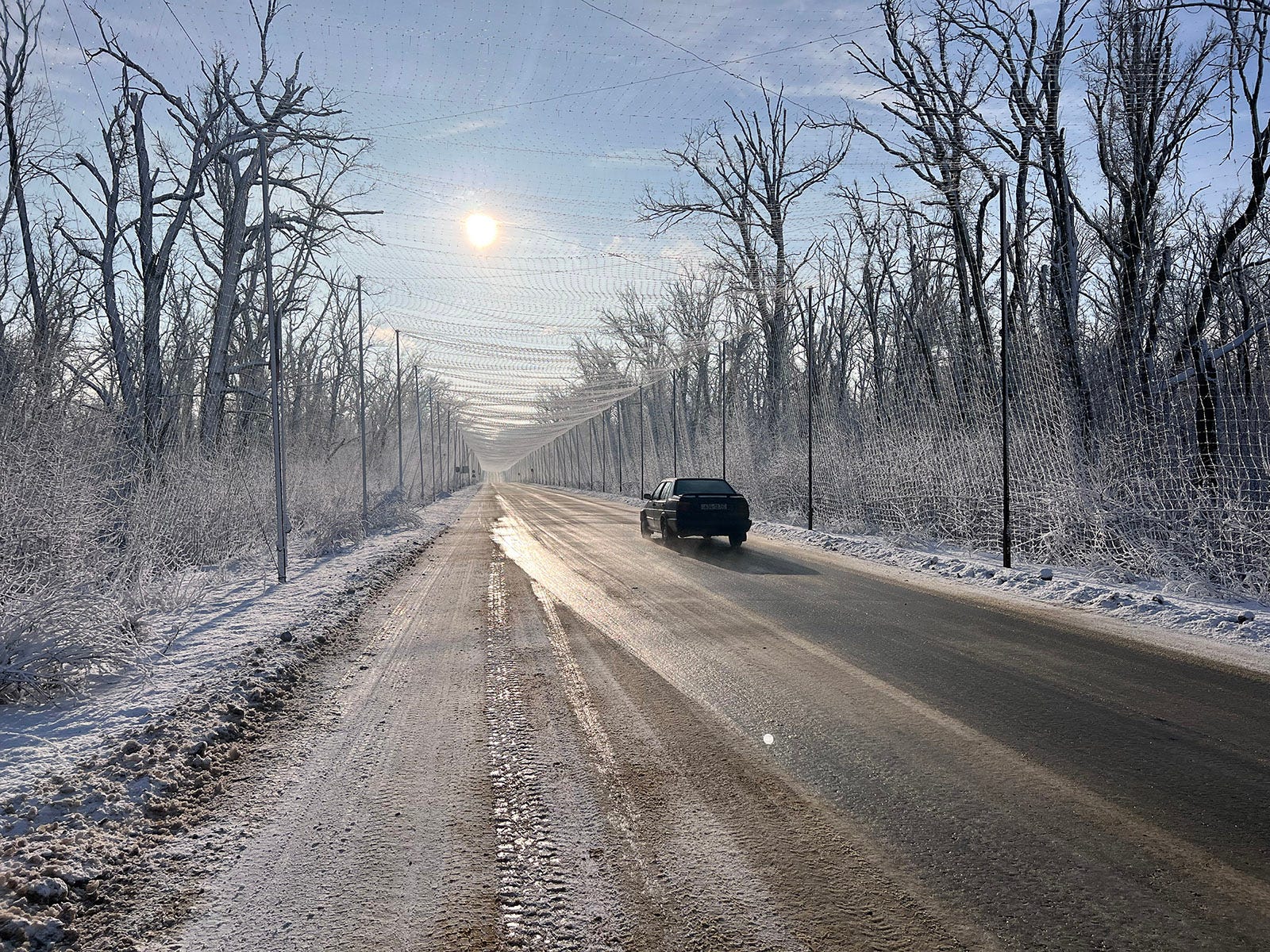
In the Review’s March 12 issue, Tim Judah reports from the cold winter in Ukraine, where the war with Russia has now been grinding on for four years:
In Kyiv it was −17 degrees Celsius (roughly 1 degree Fahrenheit), and the trees, with their bare branches coated in glistening ice, looked as if they had been turned to glass. The streetlights were on in some streets, but others were completely dark. [The novelist Andrey] Kurkov described the mood as “like when you get an overdose of bad news. You stop reacting, you just accept it.” He said he had stopped counting the children of friends who had been killed in the fighting and people he knew who had died after they had stopped seeking care when they were ill, “because they think that doctors should be paying attention to wounded soldiers, not to civilians.”
While the Russians bombard power stations and menace eastern Ukraine with FPV (first-person-view) drones, the Ukrainian economy has been suffering and young men have been leaving the country in droves to avoid being conscripted. And although many Ukrainians have proven resilient—engineering local solutions to the power, heat, and water outages, for example—Judah writes that “the last few months have been the hardest since the full-scale invasion began.”
Below, alongside Judah’s essay, are five recent articles from our archives about Russia’s invasion of Ukraine.
In August 2014 I went to see the Ukrainian novelist Andrey Kurkov in Kyiv.
Ukraine was emerging from the pro-Europe Maidan Revolution the previous winter; Russia had seized Crimea and was aiding and abetting pro-Russian rebels in the east of the country. Kurkov had just published Ukraine Diaries: Dispatches from Kiev, in which he imagined digging up potatoes at his country house in September, “regardless of the military situation,” and asked:
Where will I be? Where will my wife and children be in September? I want to believe we will be at home in Kiev, going to our country house every weekend like we usually do—grilling shashlik, gathering the harvest, making apple jam and spending the evenings in the summerhouse with a glass of wine, talking about the future.
He added, “It’s funny, but the future we talk about never seems to come.”
On the night of February 23, 2022, Kurkov invited me to dinner with friends at home in Kyiv. “I will cook borscht,” he said. The atmosphere was febrile. We made toasts “to victory” but had no idea of what was about to happen. A few hours later the Russians began their full-scale invasion of Ukraine.
For a while Kurkov set aside fiction. He wrote essays about the war, and last year he published Three Years on Fire: The Destruction of Ukraine, his fourth nonfiction book chronicling the revolution and then the war. The essays in Three Years on Fire accurately reflect the atmosphere of the Ukraine I know and have been reporting from for many years. In one he writes about a soldier who campaigned against the country’s predatory gambling industry—in the last few years gambling addiction has become a serious problem among soldiers who place bets on their phones—until he was killed in battle. In another essay we learn about the owner of the tropical fruit farm close to Kyiv who developed miniature banana trees that Ukrainians have been buying. At the beginning of the war, shelling cut the gas and electricity that kept his greenhouses warm, but he found that the trees were frost-resistant. Kurkov comments, “You could say the astonishing survival of these trees mirrors the unexpected staunchness with which Ukrainians are facing adversity.”
In January I was back in Kyiv. Kurkov and his wife had just returned from their country house. “Does the future still not come?” I asked. Well, he said, reflecting a common feeling of resignation, “the future is just too far away. We live every day only in reality and we wait for the next morning and then we take that as reality.”
In the first part of the war in 2014–2015, it was easy for people in Kyiv to think of the fighting in the east as very far away, but four years into this second part it is anything but. In 2022 the Russians reached the outskirts of Kyiv before being driven back. Now they are trying to freeze Ukrainians into submission by relentlessly attacking the country’s energy grid. For much of the day there is no electricity in Kyiv or most of the rest of the country. Some 60 percent of Ukrainians get their heat and hot water from power stations, which have also been under attack. Kurkov’s radiators were cold, but he said his apartment was still warm because the building was old and took a long time to cool down. However, in many districts radiators are only lukewarm even when they are on.
When Russia began the full-scale invasion in 2022, Ukrainians at first could not believe that it was launching a war to conquer the entire country rather than a more limited operation in the Donbas region in the east. Then came fear, followed by euphoria, as the Russians were driven back that summer and winter. Many in the West admired the Ukrainians’ resilience—so many volunteered to fight that the armed forces had to turn people away, and civilians mobilized in huge numbers to help their soldiers and refugees. Later came admiration for the drone technology Ukrainians have developed, which has transformed warfare. Now things are different again. “People are changing,” said Kurkov. “Attitudes are changing, dreams and hopes are changing.”
In Kyiv it was −17 degrees Celsius (roughly 1 degree Fahrenheit), and the trees, with their bare branches coated in glistening ice, looked as if they had been turned to glass. The streetlights were on in some streets, but others were completely dark. Kurkov described the mood as “like when you get an overdose of bad news. You stop reacting, you just accept it.” He said he had stopped counting the children of friends who had been killed in the fighting and people he knew who had died after they had stopped seeking care when they were ill, “because they think that doctors should be paying attention to wounded soldiers, not to civilians.” The nation, he said, was living through a
massive nervous breakdown because people don’t see the exit from this situation. People don’t understand how it can end. And they can imagine only a very bad ending to this story, because you cannot stop the war. I mean that is not up to Ukraine.
Read the full article on the Review’s website here.
From the Archives: A Bitter War
Linda Kinstler on redefining victory in Ukraine
Marci Shore on attending a literary festival in war-torn Kyiv
Aryeh Neier on Trump’s abandonment of Ukraine
Timothy Garton Ash on lessons for the West in Ukraine
Tim Judah on Putin’s invasion of Crimea