Whoopsy Daisy!
Jo Livingstone on Errata

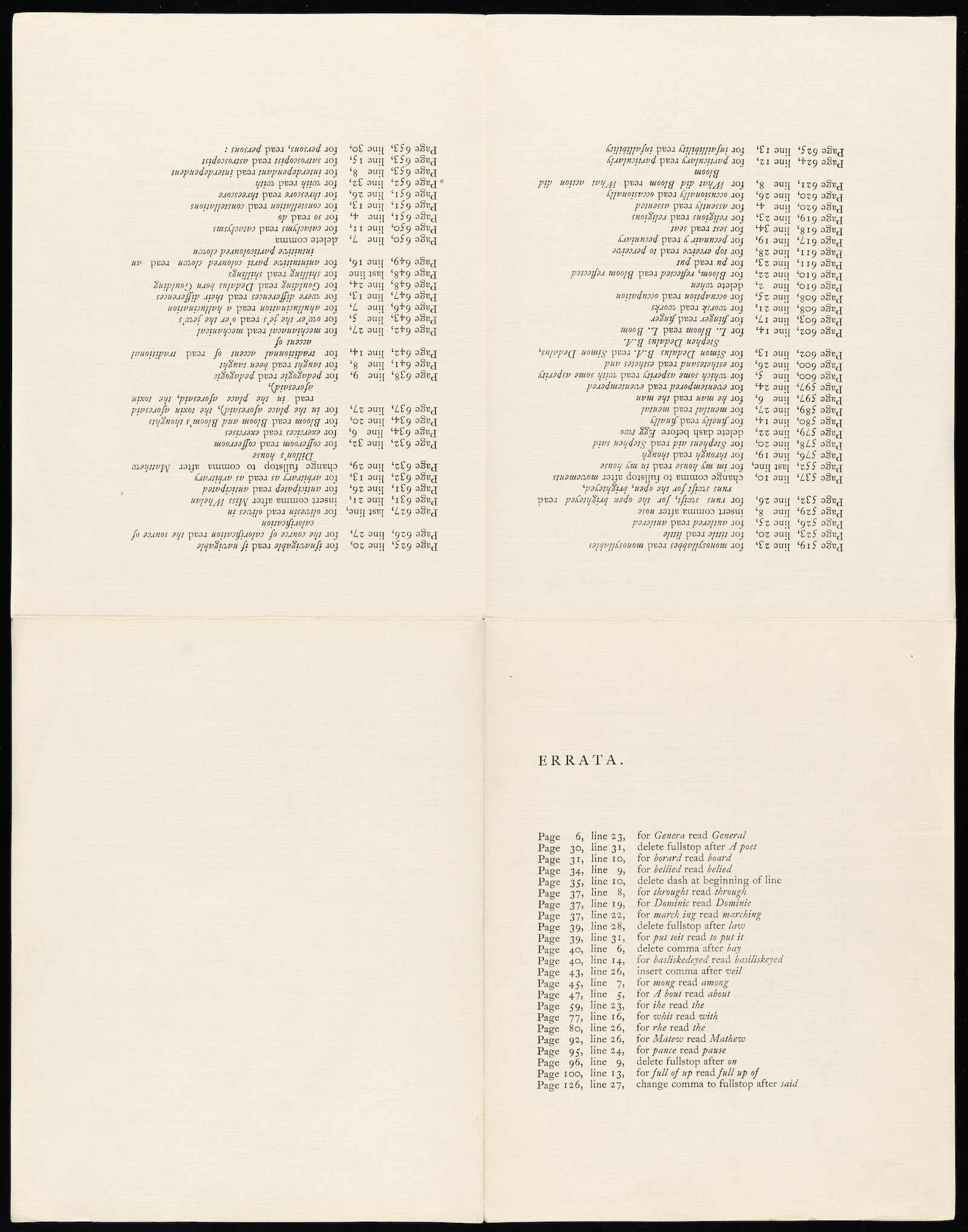
No sooner had the printing press been invented than the typo appeared. For the NYR Online this week, Jo Livingstone visits an exhibition of errata slips, publishers’ sometimes humble, sometimes proud, occasionally sarcastic, and surprisingly poetic acknowledgments of mistake(s) in their already printed books. Since the fifteenth century they’ve been dropping these compendia of “faults escaped in printing” into the pages or pasting them onto the backboards of everything from atlases to bank directories to Ulysses. “Publishing is a terrifying business precisely because mistakes are inevitable,” Livingstone writes. But there is comfort in knowing that even the Good Book is subject to human error:
The paradigmatic misprint happened to a Bible. Three little letters didn’t make it into an English printing in 1631. An incredibly dangerous joke? Satan guiding man’s hand? Either way, a whole batch of Bibles went into the world commanding, “Thou shalt commit adultery.”
Below, alongside Livingstone’s essay, are five articles and one extensive letter from our archives about errors, typos, and mistranslation.
We Goofed
Jo Livingstone
Yale University’s Beinecke Rare Book and Manuscript Library in New Haven, Connecticut, is a temple. Although the Beinecke is cuboid it has the atmosphere of a pyramid, flanked in faintly translucent marble slabs that suck light into the building and radiate it outward at the same time.
A new literary exhibition, “‘Beauties of My Style’: Errata and the Printed Mistake,” is not at the Beinecke; it is ninety feet away in the Hanke Gallery of the Sterling Memorial Library. This other Yale library is hideous in every way that the Beinecke shines. “Gothic revival” is the generous term. In a scathing 1930 critique later published in The Nation, a Yale undergraduate, William Harlan Hale, condemned SML’s combination of ecclesiastical decor and godless floorplan as a “cathedral orgy.” “How can students be educated to artistic appreciation,” he wondered, “under the eaves of an architecture that puts water tanks into church towers, and lavatories into oriels?”
Past SML’s narthex, in a gloomy, wood-paneled corner of its nave, is a small, sarcastic show. It celebrates a loaded little pocket of publishing history: the correction. Since the later fifteenth century, publishers have inserted—or “tipped in”—a piece of paper called an erratum into books printed with a mistake noticed too late. Often titled “faults escaped in printing,” and sometimes included in a later edition as a corrections page, errata often include spelling corrections, legal retractions, errors.
No sooner had the erratum become conventional than it was exploited for fun. A page titled “Faults escaped in the printing, which a wise reader may mend when he sees them” in a 1622 satirical poem turns out to be a poem of its own: “In the last Page, for conscience, read none./In every page, read sence for nonsence.” A century and a half later, Samuel Taylor Coleridge was abusing the form with glee. Some of the volumes on exhibition show him continually revising the poem “Effusion XX” post-publication—simply annoying—and using errata to critique the war in France: “Page 61, for MURDER read Fight for his King and Country.”
Practical problem-solving achieves shape and size in errata through the medium of graphic design. The slips are usually cut smaller than the volume and were sometimes pasted to the backboard. Their information appears in three to five columns of lists: page and line, “for,” the mistake, “read,” the correct word. Because every line on an erratum slip starts with a page reference, you could mistake them for sheets of anaphoric poetry at first: Where is the horse? Where is the rider? “Because of that format—you know, for X read Y—you get this poetry that’s really unexpected sometimes,” said Geoff Kaplan, a graphic designer and co-curator of the show.
In the Latin-infested parlance of the sixteenth century, an erratum technically notes a publisher’s fault; an author’s fault is conveyed via a corrigendum. The exhibition’s curators, Kaplan and the editor Rachel Churner, who co-run no place press, explained to me that they see an erratum as a kind of apology: “an attempt to hold oneself accountable,” as Kaplan put it. When you mislead readers, you must fix it, to make the world itself whole again. But an erratum, they also suggested, is at the same time a species of compliment, since you wouldn’t bother correcting a book whose mistakes didn’t matter to anybody. “We joke that it’s our own sort of redemption song,” Churner said. “We’ve made our own mistakes so many times. But look—other people have, too.”
Read the full article on the Review’s website here.
From the Archives: We Apologize for the Mistake
Evan Kindley on errors that make the canon
Daniel Drake on Trump’s typos
John Kidd on why Ulysses: The Corrected Version is incorrect, plus a letter correcting Kidd’s corrections
E.A.J. Honigmann on the case for a second King Lear
Vladimir Nabokov on an “infelicitous translation” of Pushkin