When Texas Was Green
Scott W. Stern on Lone Star environmentalism

Last Thursday, as part of its broader destruction of the Environmental Protection Agency, the Trump administration proposed easing the standards that govern how coal companies dispose coal ash, which often contains heavy metals that contaminate groundwater.
This week in the NYR Online, Scott Stern writes about “a brief period in the late 1960s and early 1970s” when a coalition of Texans, facing pollution-choked smog, “mysterious effluent” dumped into freshwater by factories, “acrid odors,” blackened vegetation, and a “pervasive” blue haze banded together to “[rise] up against environmental degradation like never before.” And while their popular campaign for the right to a clean environment was eventually quashed by legislators with strong ties to the oil industry, Stern writes, there are lessons for the present to be drawn from the unlikely flourishing of a green movement in the Lone Star State.
Below, alongside Stern’s essay, are five articles from our archives about the history of the American environmental movement.
‘Go Out and Sue a Polluter’
Scott W. Stern
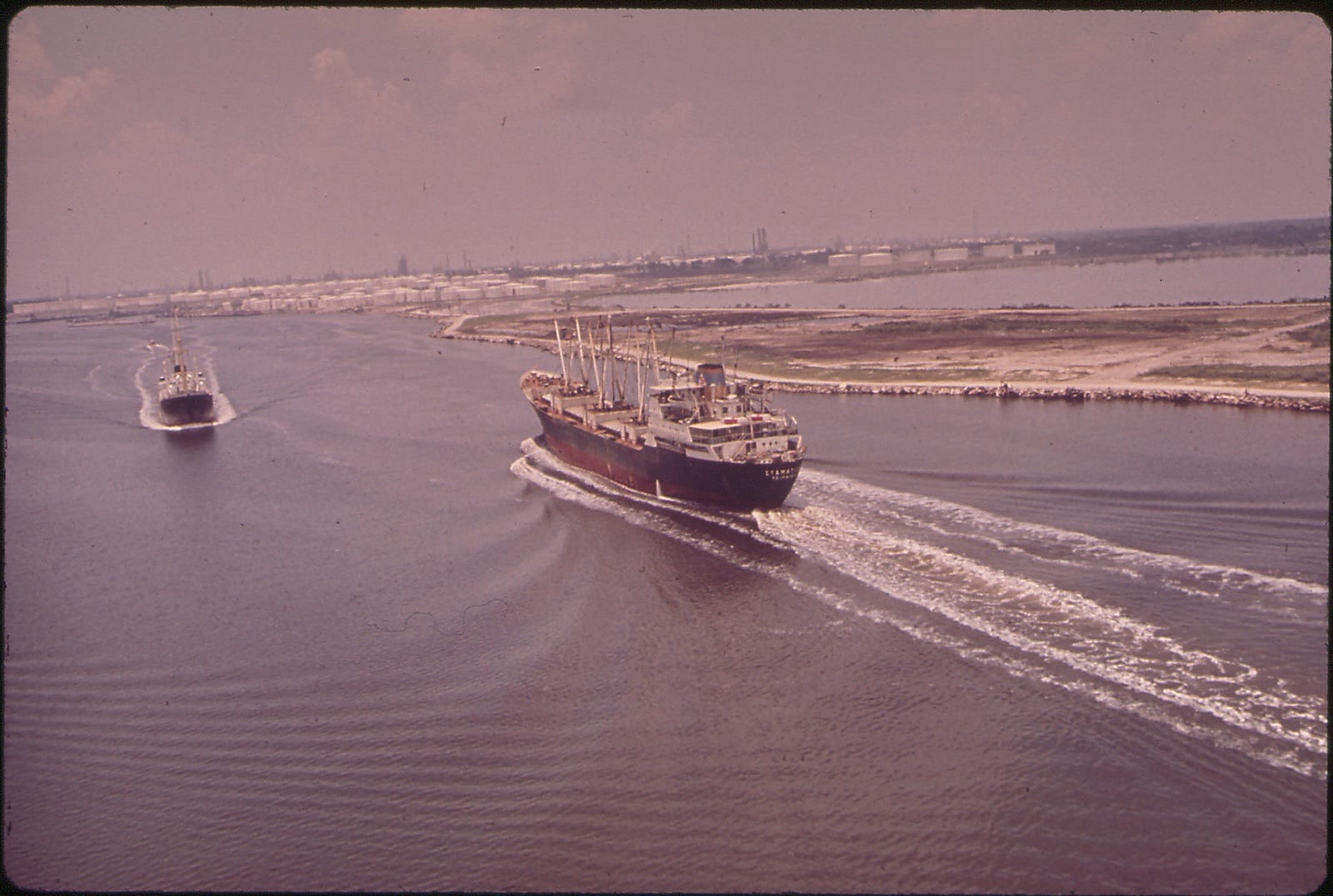
Shortly before Christmas in 1969 a dense fog rolled in across the bayous of the Texas Gulf Coast. For more than four days it blanketed a vast region, as far west as San Antonio and as far east as Port Arthur. Flights were grounded, cars crashed, and all traffic halted in the Houston Ship Channel, one of the busiest ports in the world. The murk posed a real threat to Texans with emphysema or asthma, to the elderly or the infirm. “These people are going to suffer more acutely,” a local physician told the Houston Post. Indeed, one Houston hospital reported a 240 percent surge in patients with breathing issues; a health officer noted a “tremendous increase” in upper respiratory symptoms.
To many Texans the source of the haze was, ironically, clear. It was “pollution-fed fog,” as the Post put it in a front-page headline, a glaring manifestation of a problem that plagued the industrialized parts of the region. So contaminated was the air that water droplets could cling to pollutants, slowing evaporation; the resulting scrim of moisture inhibited vertical air movement, trapping more pollution in turn.
At the moment the fog descended, Texans were rising up against environmental degradation like never before. Just days earlier State Representative Rex Braun, an intense, ruddy-faced man, warned an Arlington audience about the long-term effects of living with pollution. If the state couldn’t reduce it, he told the crowd, “you will drown in your own sewage, be buried in your own garbage or choked to death on your own bad air.”
Braun and a coalition of environmentally minded supporters pressed their case at a city council hearing soon after the haze cleared. A mother carrying an eleven-month-old baby in a yellow dress followed Braun at the podium; the child’s name was Tracy Lynn, a spokesman told the councilmembers, and her asthma was so severe that during the days of fog the doctors weren’t sure if she would make it. They advised the family to leave Houston; the air was too bad. Two days after the hearing a class of junior high school students unrolled a fifty-foot-long petition down the middle aisle of the city council chamber in nearby Baytown. “We, the undersigned, deserve the right to breathe clean air,” it declared, above some two thousand signatures. Under pressure, the Houston city council agreed to stop rubber-stamping grace periods for local industries to comply with air pollution regulations, a move that several councilmen described as “drastic.”
By March 1970 environmental furor had reached such a peak that Braun could mock “the Johnny-come-latelies to the anti-pollution battle” in a letter to a friend, recalling how, just a few years earlier, “we could only muster a handful of votes for my tough bills to curb air and water pollution.” Back then, he wrote, “rich Republican oil men didn’t even know what pollution was, much less how to spell it.” A month later, at an Earth Day rally in Texas, the progressive legislator and labor lawyer Bob Eckhardt similarly marveled at how quickly times had changed. “Now,” he told the crowd, “you are in the environmental upheaval.”
More than fifty years later, the story of Texas’s environmental upheaval remains little-known. Yet for a brief period in the late 1960s and early 1970s, the Lone Star State was the site of a homegrown, populist environmental movement. Its partisans were not, principally, elite conservationists or representatives from national green groups but working-class activists with material concerns and unusually motivated allies in local government. “Our trees are dying, our metal is rusting, our house paint is falling off and we cannot breathe,” one official in the shipping and refining hub of Galena Park told the press.
Their movement was especially strong in Houston and its heavily industrialized, polluted environs—the adopted home of Rex Braun. Today Braun is an obscure figure, but for a brief period, from his first legislative campaign in 1966 until his electoral defeat in 1972 and his early death in 1975, he was perhaps Texas’s leading environmental crusader. Over three terms in the state house, representing the most polluted district in Texas, he fought to win a “right” to a clean environment and then translate it into better conditions on the ground. To Braun and his constituents, as well as a largely forgotten cohort of environmental populist politicians, the battle against pollution was inseparable from the fight for industrial safety regulations, a minimum wage, and public health.
For more than six years I’ve been searching for records related to Braun and the fight he helped lead. Because he left behind no personal papers, I’ve compiled documents from far-flung archival collections across Texas. These papers help reconstruct the story of courageous campaigners battling what Braun called “a few greedy and callous men who think they have the right to dump their industrial garbage into the air.” But they also return us to a Texas in which populist environmentalism was imaginable, with a strong social base in labor unions and community organizations. As union density fell, the organs of civil society failed, and the environmental movement professionalized, the promise of this kind of environmental populism faded—which is not to say it can never return.
Read the full article on the Review’s website here.
From the Archives: Red Light, Green Light
Bill McKibben on the central problem for conservative environmentalists
Scott W. Stern on the working-class roots of the environmental movement
Leah Aronowsky on how fossil fuel companies avoid consequences for polluting
Tim Flannery on how Bush-era conservatives vilified environmentalists
Daniel J. Kevles on the legacy of Rachel Carson