

What If We Took Democracy Seriously? An Interview with Osita Nwanevu
“Democracy isn’t just some woolly ideal but the very means by which material lives might be improved.”

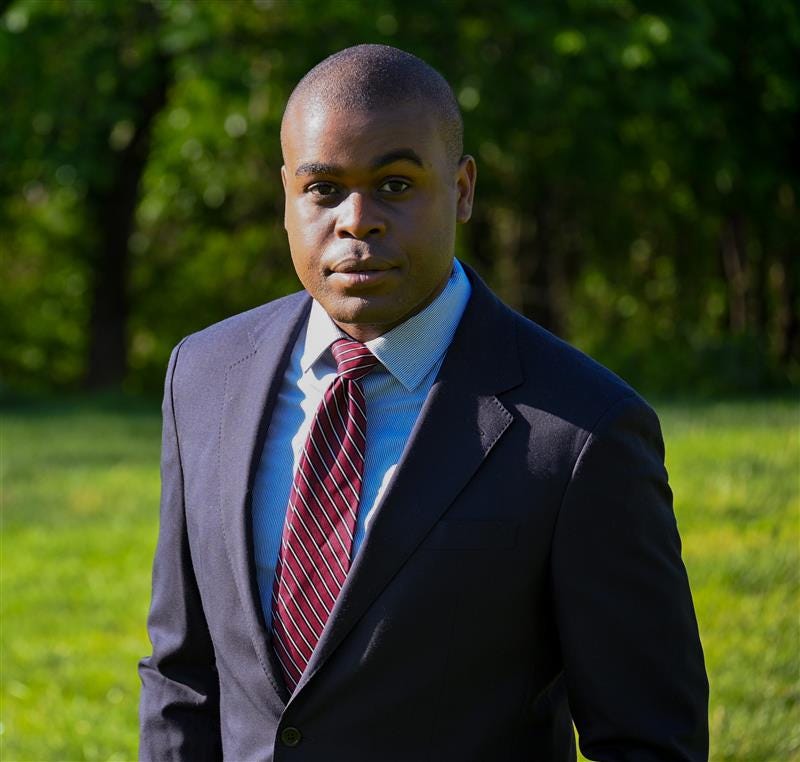
In our Fall Books issue, Osita Nwanevu reviewed Sam Tanenhaus’s doorstopper Buckley, a biography of the conservative intellectual and bon vivant remembered fondly—too fondly, Nwanevu argues—by many people appalled at the current state of argument in America.
Nwanevu, prolific in the pages of The Guardian, in American magazines, and on Bluesky (and, at one time, Twitter), is no stranger to the highs and lows of political discourse. His first essay for the Review, on the history of the Democratic Party from its beginnings through the Biden era, began with a discussion of the “one critical political skill” shared by Obama, Biden, and Trump: “the ability to repurpose a pejorative, to take a bit of language deployed by detractors and then turn it to their own ends,” from “Obamacare” to “Bidenomics” to “fake news.”
His first book, The Right of the People: Democracy and the Case for a New American Founding, published in August, is an attempt to revitalize our politics, which are trapped in institutions that Americans often assume are unchangeable. Nwanevu argues that traditions and laws we take for granted—the existence of political parties, for example, or the way we conduct elections—were meant to be adaptable well beyond the blinkered imaginations of the mainstream commentariat.
I wrote to Nwanevu over e-mail to discuss his essay, his book, and his predictions for the near future in America.
—Nawal Arjini
This interview was originally published as “What If We Took Democracy Seriously?” on September 27, 2025 at nybooks.com.
Nawal Arjini: You write, “If anything the idea that the slide from Buckley to Trump has been a reactionary degeneration of the movement isn’t quite fair to Trump”—as Trump is, for instance, less interested than Buckley was in being openly homophobic. What do you make of the nostalgia for the Buckley moment? Is it more than just nostalgia for racism, sexism, or class hierarchy in its most articulate form?
Osita Nwanevu: I think that’s about it, honestly. I don’t think most Republican voters think all that much about Buckley and his legacy. He’s a figure remembered primarily by elites on both sides of the aisle. Conservatives embarrassed by Trump’s political style and aesthetic pine for Buckley’s erudition. Liberals remember him as someone you could have an entertaining conversation with, as weaselly as Buckley could be in dialogue.
All of this stands quite apart from the substance of what Buckley said and believed. If tomorrow Donald Trump started espousing the social positions Buckley held circa 1965 and 1970, I think most mainstream commentators would describe it as further appeasement of the far right. Buckley’s position on immigration in the mid- to late 1990s—advocating for a total freeze on all immigration on sociocultural grounds—was to the right of the Trump administration today. Few people who aren’t on the left care all that much about this. For the diminishing few who remember him with real feeling, Buckley survives as an idea—an image without content. This is similar to what’s happened, on the other end of the political spectrum, to Martin Luther King Jr.—whom Buckley despised, incidentally.
Many liberals claimed during Trump’s first term that his administration was antidemocratic—which ended up being truer than they could have realized. But at the time making appeals to abstract ideals of democracy seemed to fall flat. In your book you propose a way of connecting those ideals to people’s material concerns; would you elaborate on that?
Many voters last year felt like they were being asked to choose between, on the one hand, defending democracy as an abstract ideal by protecting our existing institutions from Donald Trump and, on the other hand, preserving what they understood to be their material self-interest. And as much as the public might have opposed Trump’s authoritarianism—the effort to overturn the 2020 election, January 6, and all the rest—a critical share of the electorate decided to back him anyway out of a belief that he’d lower prices and otherwise improve the economy to their benefit.
I think that’s troubling. We need to offer a conception of democracy materially grounded enough to bridge that gap—to convince more people that democracy isn’t just some woolly ideal but the very means by which their material lives might be improved. That means taking the public’s skepticism of our political institutions seriously and making the case that democratizing them would help us pass policies that would put more resources in the hands of working Americans.
It also means presenting democracy as a system of values that might directly restructure the economy and people’s working lives—arguing, for instance, that labor unions are a vehicle for building democratic agency within the workplace and that they ought to be revived and strengthened on those grounds. Democracy—for some of the very disaffected working-class voters Trump has done well with, not to mention for people who oppose him but nonetheless feel disenfranchised by the way the system works in America—then becomes the way they earned their last raise or the way some aspect of their job was improved. They may then be willing to defend the democratic ideal from authoritarians on that basis. That’s the hope, anyway.
On that note, your book makes the case for workplace democracy—for taking labor power in the workplace as seriously as citizen power at the ballot. What would need to change for that to happen—in the labor movement, in electoral campaigns, in the way we understand politics?
The first step is convincing the American people that the basic democratic intuition—that we’re entitled to a measure of agency over the conditions that shape our lives—raises fundamental questions about the structure of the economy. In other words, getting people to appreciate the tension in the notion that an Amazon worker may rightly have their voice heard on what our foreign policy should be with respect to Iran but has no say whatsoever on the question of how Amazon should be run.
Beyond democratic principle, the subjugation of the American worker, which theorists like Elizabeth Anderson write well about, has practical consequences for American politics. It is a source of the inequality that allows the wealthiest people in the country to steer the electoral and policymaking processes. If workers were structurally given more power in the workplace and more authority over where the wealth they generate goes, we’d reduce inequality predistributionally—meaning without having to rely on a central authority to tax and redistribute wealth—both to their own material benefit and to the benefit of our political system.
All this means thinking beyond the revival of traditional unions, as crucial as they are. The structures of corporate governance can be reworked by statute; we can require companies of a certain size to give workers board seats, for instance, or have major corporations transfer some of their shares—and the shareholder votes bound with them—over to their employees. None of these ideas have any purchase in our economic policy discourse now, but they should if we take democracy seriously.
A lot of your writing builds on the documents and arguments from the Founding of this country, even as you propose radical changes to the “traditional” arrangement of the government. What do you think is the value of reclaiming the Founders, instead of, as others might suggest, abandoning their political thinking as hopelessly mired in its (racist, sexist, classist, etc.) time?
I don’t think I’m arguing that the Founders should be reclaimed as much as I’m trying to get readers to believe that they share the Founders’ prerogatives. Whatever else you might think about them, these men were revolutionaries, far more willing to countenance political violence than I am. They broke from an empire out of an understanding of what they were entitled to as human beings and their own perceived material self-interest. They won a bloody war and set up a system of government. After six years, they dismantled it to set up a new one more to their liking. That second try is the Constitution we’ve inherited.
There’s something softheaded about looking at that record and coming away with the lesson that we should be reverential about the political institutions we’ve inherited despite the obviously justified critiques of the Founders on modern egalitarian grounds. We’ve had more than two centuries of experience with the Constitution. In that time we’ve seen peer governments rise and fall. We study politics and governance with more rigor than they could have. So why shouldn’t we set ourselves toward writing a new compact someday? Why shouldn’t we make ourselves Founders?
For a while, America’s most popular politician was, famously, an independent; the reluctance of the New York Democrats to endorse the party’s candidate for mayor has suggested a hardening divide in the party. But, as you wrote in 2023, the Democrats’ “mutability all but ensures that the world’s oldest political party will grow much older still.” What are the odds you’d put on the resilience of the Democratic Party as such?
I think the Democratic Party will be with us for a long time. Whether it retains a meaningful amount of power in Washington is another question entirely. As far as population dynamics alone are concerned, the trajectory is not good—Republican-dominated states are growing, Democrat-dominated states are shrinking. The gerrymandering pushback we’re seeing is just about the only place where the party seems to be thinking structurally about its trajectory. I don’t know if that suggests they’re coming any closer to reckoning more deeply with the hole they’ve ended up in.
This article is part of a regular series of conversations with the Review’s contributors; read past entries here and sign up below to get them delivered to your inbox each week.
@Osita Nwanevu , thank you for introducing me to Elizabeth Anderson through this interview when it was first published online. Her work on the workplace as "private government" helped me understand how institutional power translates into bodily compliance and connects directly to what I've been exploring about fawning as capitalism's infrastructure.
When you write that workers have "no say whatsoever on how Amazon should be run" while being expected to have informed political opinions, you're describing the nervous system split that fawning creates. The body learns that hierarchy means threat, compliance means safety. That adaptation doesn't stay at work. It shapes what political possibilities we can even imagine.
I wrote about this in "Fawning and the Machinery of Capitalism." The question isn't just democratic structure but somatic capacity. Workplace democracy matters because it would let nervous systems practice agency instead of perfecting subordination.
https://yauguru.substack.com/p/fawning-and-the-machinery-of-capitalism?r=217mr3