‘War Breeds Tyrants’
Christopher de Bellaigue on Iran

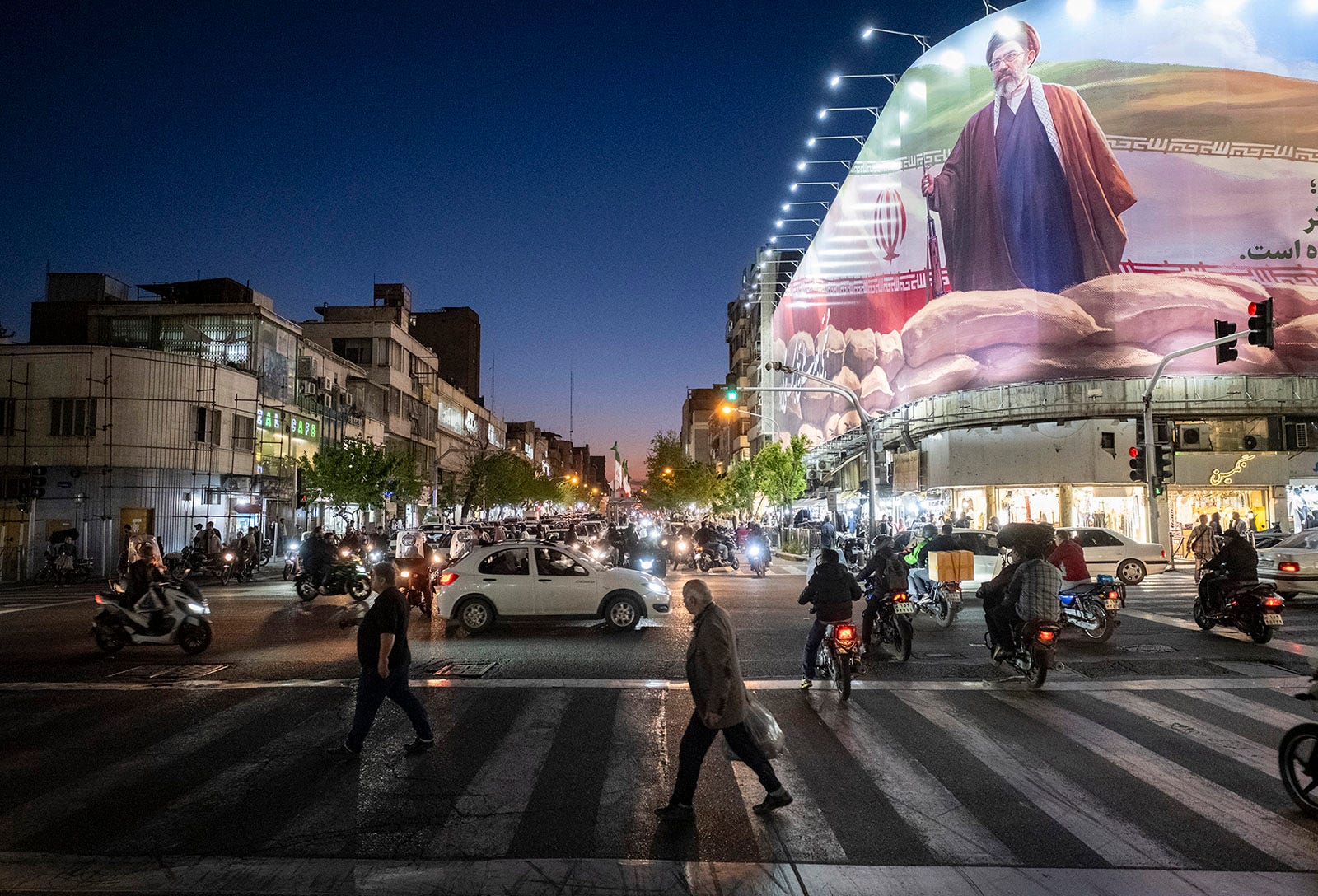
On the inconstant list of reasons given by United States officials for initiating a war in Iran, at least one seemed to indicate an interest in a better future: “All I want is freedom for the [Iranian] people,” President Trump said in late February. In the Review’s May 28 issue, Christopher de Bellaigue asks how that’s going:
Iranian democrats who were “against the war” desire regime change no less fervently than those who petitioned Trump to attack. The difference is that they want Iranians, not foreigners, to do the job.… The agony of ordinary Iranians, meanwhile, is forgotten.
Iran is entering a new winter of political failure that will be harder than that of the prerevolutionary period, when the experience of being insulted and infantilized by a crowned despot was alleviated somewhat by rising living standards. There is no such comfort now.
The destruction of civilian infrastructure by US and Israeli bombs has contributed to catastrophic inflation and the further immiseration of ordinary Iranians. The assassinations of Ayatollah Khamenei and other leaders, meanwhile, have entrenched a new generation of rulers and strengthened the Revolutionary Guard, which has tightened its control over civic life and continued the violent suppression of dissent. As Bellaigue reminds us, “War breeds tyrants.”
Below, alongside Bellaigue’s essay, are six articles and from our archives about the ongoing disaster in Iran.
Iran’s New Winter
Christopher de Bellaigue
n 1953 Iran’s prime minister, Mohammad Mossadegh, was toppled in a coup planned by MI6 and the CIA and carried out by Iranian army units and hoodlums supportive of Shah Mohammad Reza Pahlavi. Mossadegh had nationalized Iran’s British-run oil industry and allowed Iranians more freedom than they had ever known; the constitutional monarchy he favored was a path between the extremes of royal tyranny and popular radicalism that had beset the country for the previous three quarters of a century. In the years after Mossadegh’s overthrow, as the Shah built a dictatorship backed uncritically by the United States, Iranian democrats and liberals sank into a despondency that was expressed in works of art, perhaps the most lasting of which, the poem “Winter” by Mehdi Akhavan-Sales, describes the insidious effect of political failure on the spirit of the individual and the cohesion of society:
They do not wish to return your greeting, their heads are buried in their collars,
No one dares raise their head to greet, to acknowledge friends,
They see no further than their own foot,
For the path is dark and slippery,
And if you stretch a kindly hand toward someone,
They withdraw their hand from their coat-pocket with reluctance,
So searing is the cold.
The breath that rises warm from the chest turns to a dark cloud,
Standing like a wall before your eyes,
So much for breath; what do you hope to gain from meeting the eyes of friends
Near or far?
The revolution that swept away the Shah in 1979 was supported by the country’s liberals and leftists, but the government that replaced him was captured by hard-line theocrats and their followers in the Revolutionary Guard. Iran spent the next four and a half decades waging wars hot and cold, covert and declared, its hostility toward the West hardly wavering, regardless of the price to be paid in hardship at home and ostracism abroad.
The Islamic Republic was a pariah long before its latest war with the United States and Israel. Its economy has been crippled by sanctions and the corruption that is their concomitant, its middle class increasingly inured to privation, its workers crushed by inflation and the nonpayment of salaries, and life for all marred by the power outages, water shortages, and unchecked pollution that are the ambient signifiers of the failing state.
And yet the regime has repeatedly belied predictions of its demise, saved by revenue from the oil it sells to China and by a hard core of ideologues who retain a monopoly on force and a readiness to employ it against dissidents whom they view, without irony, as the agents of Satan. In January they suppressed mass protests with unprecedented savagery at the cost of thousands of lives. In the war that followed, Iran gained prestige around the world by defying its exponentially more powerful foes and not merely surviving the assassinations of Ayatollah Ali Khamenei and other military and civilian leaders but using them to inspire loyalists. My Iranian dentist in London was congratulated by his Malaysian, Pakistani, and Indonesian patients on the pluck exhibited by a regime he detests, which shows how cleverly the Islamic Republic wages the propaganda war.
Read the full article on the Review’s website here.
From the Archives: War in Iran
Will Alden on the pro-Pahlavi community in Los Angeles
Fintan O’Toole on Trump’s disembodied warmongering
Caitlin L. Chandler on Europe’s timid response
Amir Ahmadi Arian on a helpless view of his homeland from abroad
Orly Noy on being Iranian in Israel
Arang Keshavarzian on what fueled the protests that preceded the war

Join New York Review contributor and Pulitzer Prize-winner Marilynne Robinson for a four-part seminar on the New Testament. Sessions, to be hosted on Zoom, begin May 6. Purchase tickets here.