The Siren Song of Illness
Adam Kirsch on Thomas Mann’s sympathy with death

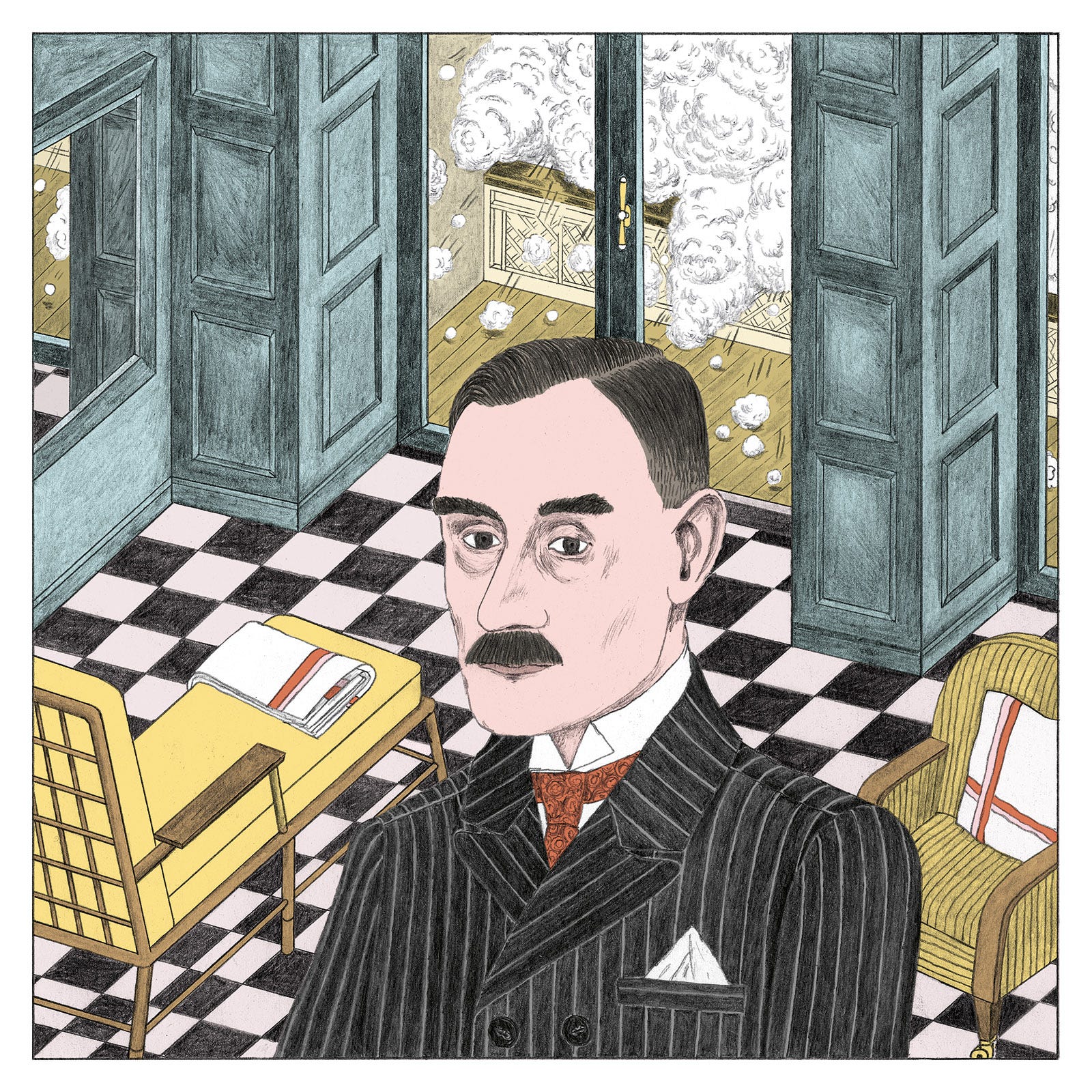
In 1912 the novelist Thomas Mann visited his wife at a sanatorium in the Swiss town of Davos, where she was taking a rest cure after being misdiagnosed with tuberculosis. Mann himself came down with a cold during the visit, which the facility’s director was eager to believe was also TB, and thus, writes Adam Kirsch in the June 25 issue of the Review, “the seed of [The Magic Mountain] was planted.” As Kirsch elaborates:
“It’s highly appropriate that The Magic Mountain should owe its existence to a misdiagnosis, since its great theme is ambiguity: the difficulty of distinguishing health from sickness, mind from body, time from eternity.”
Below, alongside Kirsch’s essay, are five essays from our archives about writing in sickness and in health.
The Siren Song of Illness
Adam Kirsch
In his study of The Magic Mountain, the critic Morten Høi Jensen writes that in 2018 he resolved “to figure out why Mann’s novel is so important to me.” That meant beginning “at the source,” in Davos, the town in the Swiss Alps where the book takes place in the years before World War I.
Today Davos is best known as the site of the World Economic Forum, where the rich and powerful gather every year “to improve the state of the world,” in the words of its mission statement. But Jensen discovered that Davos hasn’t forgotten The Magic Mountain, published in 1924: the town boasts a Thomas Mann Way and a Thomas Mann Place, as well as a series of plaques displaying passages from the novel. At his hotel he even found that the “sanatorium-world” Mann wrote about “is still intact.” His room came with a balcony and a wooden lounge chair for taking a rest cure, just as patients did a century ago.
In 1912 Mann’s wife, Katia, was one of them. Her chest complaint wasn’t severe, but her doctor sent her to Davos because any problem involving the lungs raised the terrifying specter of tuberculosis, at the time an incurable disease responsible for up to a quarter of all deaths in Europe. In the 1880s the pioneering microbiologist Robert Koch proved that tuberculosis, also known as phthisis or consumption, is caused by a bacterium that spreads through coughs and spittle. The discovery won him the Nobel Prize in Medicine, but it took a long time to translate into effective treatment: the first vaccine was administered in 1921, and the disease couldn’t be cured until the development of the antibiotic streptomycin in the 1940s. Before World War I there wasn’t even an accurate blood test for tuberculosis. Diagnosing it was more an art than a science, based on listening for ragged or hollow sounds in a patient’s chest or scanning an X-ray (a recent invention) for cloudy patches in the lungs.
A sanatorium could keep tubercular patients from infecting their families and neighbors, but it couldn’t really treat the disease. In theory, dry mountain air was good for weakened lungs, and a prolonged break from daily responsibilities, with plenty of food and rest, surely couldn’t hurt. But the establishments that started to spring up in the Swiss Alps in the late nineteenth century, such as the Waldsanatorium, where Katia Mann became a patient, were essentially wellness resorts where affluent guests pampered themselves in the name of health. Some died of tuberculosis, while others seemed to get well or were never sick at all; it wasn’t always possible to tell the difference. In the 1960s Katia Mann—still alive in her eighties—was told by a doctor who examined new images of her lungs that there was no sign she had ever had tuberculosis.
It’s highly appropriate that The Magic Mountain should owe its existence to a misdiagnosis, since its great theme is ambiguity: the difficulty of distinguishing health from sickness, mind from body, time from eternity. Jensen shows that the seed of the novel was planted when Mann visited his wife in Davos in May 1912 and came down with a cold. He was examined by the sanatorium’s director, whose thumping revealed a worrisome spot on his lung. He was advised to extend his stay, but his doctor at home forbade it: “You would be the first one to be examined in Davos who did not have some spot or other. Return to Munich immediately. You have no business in Davos.”
Read the full article on the Review’s website here.
From the Archives: In Sickness and in Health
Susan Sontag on metaphors of illness
John Banville on the Transcendentalists’ grief
Jane Mayhall on the short life of Stephen Crane
Fintan O’Toole on the itch, the pox, and the clap
Arnold Relman on breaking his neck