

The President Has Lost His Mind
Fintan O’Toole on Trump’s derangement syndrome

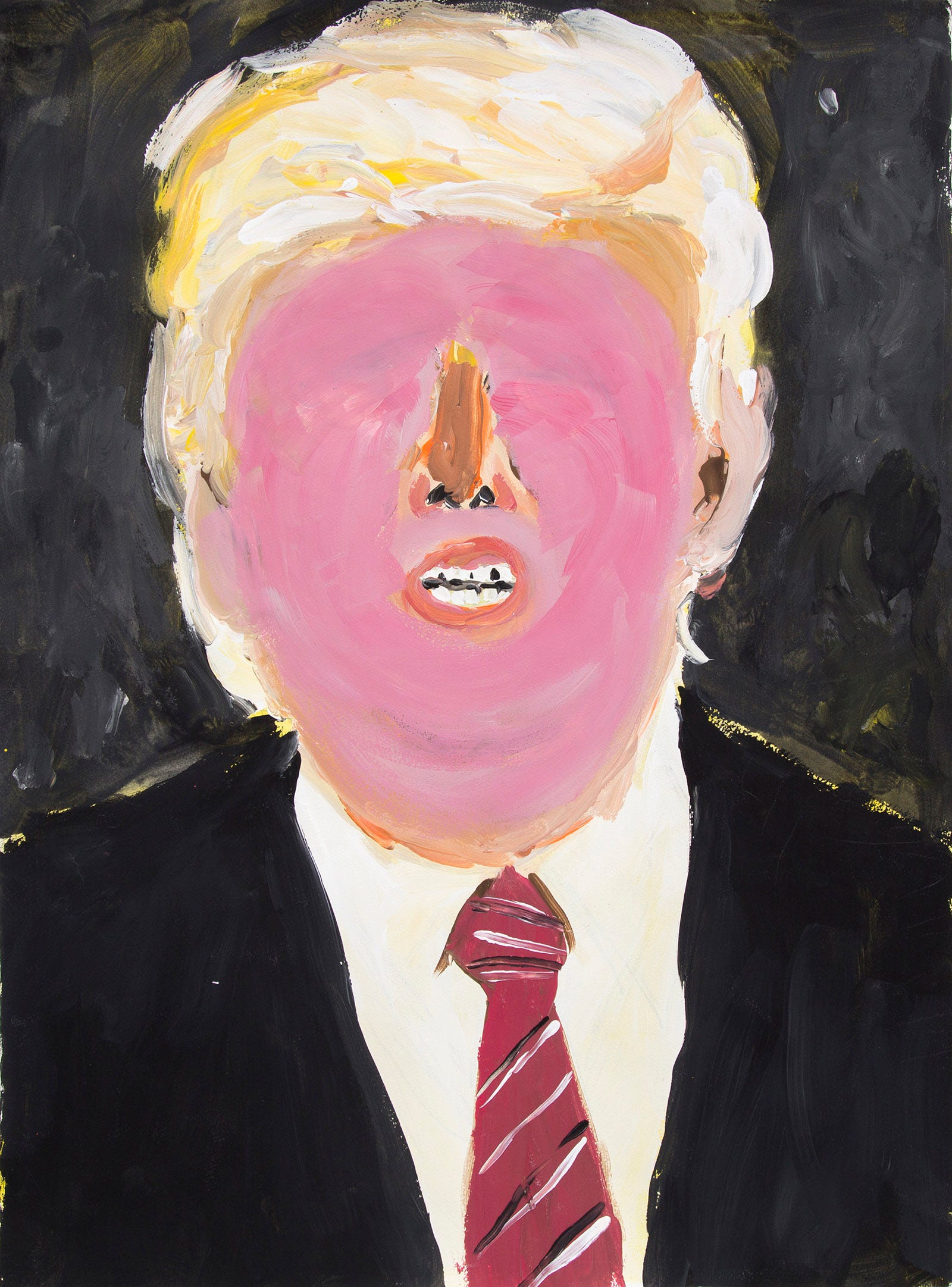
As the war in Iran and Lebanon enters its eighth week, Donald Trump’s seesawing declarations of violence, peace, raining hellfire, ceasefire, civilizational destruction, and international comity—a manic approach to negotiating typically euphemized by reporters as “mixed messages”—have grown increasingly deranged. In the Review’s May 14 issue, Fintan O’Toole writes that it is high time to dispense with the notion that the president is simply feigning madness.
Below, alongside O’Toole’s essay, are five articles from our archives about mad kings.
‘The Right Amount of Crazy’
Fintan O’Toole
In January, when The New York Times asked Donald Trump whether there were any limits on his global powers, he replied, “Yeah, there is one thing. My own morality. My own mind.” Since whatever morality he ever possessed has long since departed, the remaining question is whether he has also lost his mind. Given that, in the course of his war on Iran, he has chosen to present himself to the world as a genocidal maniac—posting on Truth Social that “a whole civilization will die tonight, never to be brought back again. I don’t want that to happen, but it probably will”—the answer may seem all too obvious.
Yet to arrive at it we have to tease out the relationships that are always at the heart of his persona: the complex connections between performance and reality, method and madness, bombast and bombs. With Trump, these oppositions are never absolute. The borders between them are always porous. On the one hand, there’s no doubt that in Trump’s chaotic mind there lurks the Madman Theory, a belief that acting crazy is a rational strategy. Richard Nixon coined the phrase for his chief of staff, H.R. Haldeman, during the Vietnam War:
I call it the Madman Theory, Bob. I want the North Vietnamese to believe I’ve reached the point where I might do anything to stop the war. We’ll just slip the word to them that “for God’s sake, you know Nixon is obsessed about Communism. We can’t restrain him when he’s angry—and he has his hand on the nuclear button”—and Ho Chi Minh himself will be in Paris in two days begging for peace.
The belief that Trump has been following Nixon’s playbook in relation to Iran has been a staple of recent media analysis. It is certainly valid. Yet it raises a further question: Is it possible for someone to act the lunatic while actually being one? We are faced with a vastly more consequential version of a Catch-22. In Joseph Heller’s novel, claiming to be crazy is taken as evidence of sanity. Likewise the only evidence that Trump might not be crazy is his obvious determination to seem so.
To get our bearings in this maze we might begin with Irving. He appears, shorn of a surname, in the book Tony Schwartz ghostwrote for Trump, The Art of the Deal (1987). While still at college, Trump has done his first deal, buying with his father and refurbishing an apartment complex in Cincinnati. He hires Irving to manage the project. Trump suspects that he is a thief and calls him “a short, fat, bald-headed guy with thick glasses and hands like Jell-O, who’d never lifted anything in his life beside a pen, and who had no physical ability whatsoever.”
But his saving grace is “an incredible mouth.” According to Trump, Irving would collect rents from the most recalcitrant tenants by putting on a show of frenzy:
He’d ring the doorbell, and when someone came to the door, he’d go crazy. He’d get red in the face, use every filthy word he could think of, and make every threat in the book. It was an act, but it was very effective: usually they paid up right then and there.
One day, while Irving was on his rounds, he knocked on a door, and a little ten-year-old girl answered. Irving said, “You go tell your father to pay his f—ing rent or I’m going to knock his ass off.”
Irving, says Trump, “left a very vivid impression on me.” Trump learned early on that screaming obscenities at ten-year-old girls and making every threat in the book was a good way to get what he wanted. There would seem to be a clear path from Irving to the flamboyantly demented Trump of his Easter Sunday morning post: “Tuesday will be Power Plant Day, and Bridge Day, all wrapped up in one, in Iran. There will be nothing like it!!! Open the Fuckin’ Strait, you crazy bastards, or you’ll be living in Hell – JUST WATCH! Praise be to Allah.”
Read the full article on the Review’s website here.
From the Archives: Daggers of the Mind
J.H. Plumb on mad King George
Mary McCarthy on Nixon’s bizarre behaviors
Charles J. Sykes on the GOP’s embrace of their own mad king
Lisa Appignanesi on Trump in the psychiatrist’s chair
Fintan O’Toole on how Trump treats his friends
There’s a certain historical irony here that’s hard to ignore. In monarchies, rulers like Charles VI of France—who at times failed to recognize his own family and believed himself made of glass—remained on the throne because rival factions feared the instability his removal might unleash; Philip V of Spain—who withdrew into long bouts of debilitating depression and disengaged from governing—was kept in power as courtiers ruled in his name to preserve dynastic continuity; and George III—who endured episodes of confusion, agitation, and incoherence—remained king even as power quietly shifted to a regent, because the image of the crown could not be allowed to fracture. In each case, courts and political systems bent themselves around the illusion of continuity. The king remained, even when the king was no longer fully there.
That, of course, is precisely what modern democracies are supposed to prevent. We pride ourselves on not having kings—on having built mechanisms to ensure that power is contingent, accountable, and ultimately removable. But that distinction only holds if those mechanisms function in practice, not just in theory.
Because if a leader’s competence is in question and yet no meaningful path exists to address it—if loyalty, fear, or political paralysis keep power in place—then we are not as far from those older systems as we might like to believe. We may rally for “No Kings,” but if power can persist independent of capacity, then, historically speaking, we might already have one.
I understand that this short video was produced in/by Iran: https://youtu.be/pDy5QtAq6b0?si=nHSVDexmwGRSEZBQ. If true, the leadership in Iran has guessed that all they have to do is wait out the madman's threat until TACO emerges.