The Liebesnacht
Martin Filler on Wagner

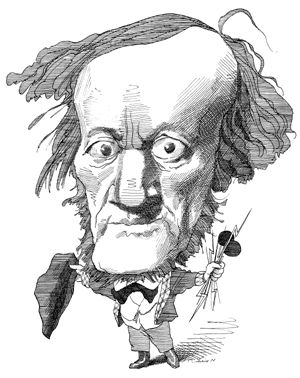
In our June 11 issue, Martin Filler—who, having published three essays about Wagner in the Review since 2010, is something of a die-hard Wagnerite himself—writes about the Metropolitan Opera’s newest production of “Wagner’s masterpiece,” Tristan und Isolde. The good news is, in spite of some clumsy staging, “trite symbolism,” and one “egregious” liberty on the part of the director, the show’s leads “enjoyed a joint triumph seldom encountered in opera, let alone in Tristan und Isolde, which has always been notoriously difficult to cast with two principals equal to those titanic roles and to each other.” In particular, Filler enthuses, the “rapturous Act Two duet, the Liebesnacht (night of love), was as gorgeously sung as any I’ve heard live.”
Below, alongside Filler’s essay, are five articles from our archives about Wagner.
Tunnel of Love
Martin Filler
No musical phrase affects die-hard Wagnerites as deeply as the Tristan chord, “the password, the cipher for all modern music,” as the German conductor Christian Thielemann has called it. This revolutionary break with harmonic convention—a combination of F, B, D-sharp, and G-sharp played by cellos, clarinets, bassoons, oboes, and an English horn, followed by a sequence whose haunting lack of resolution points the way to the once unimaginable realm of atonalism—appears in the opening measures of Richard Wagner’s music drama Tristan und Isolde. It hovers in the imagination much as it does in the concert hall, with a primal insistence that never diminishes no matter how often one hears it.
The Tristan chord resounded once again at the Metropolitan Opera on March 9, at the premiere of its tenth new mounting of the epic work it first staged in 1886. This was an event eagerly anticipated among opera fanatics for several reasons. It marked the first Met Isolde of the much-admired Norwegian soprano Lise Davidsen as well as the house debut of Yuval Sharon, the forty-six-year-old opera director known for his radical reimaginings of the genre, as he sets forth in A New Philosophy of Opera. (Every article about Sharon seemingly must mention his La Bohème, performed with Puccini’s four acts in reverse order, and his Götterdämmerung, presented in a Detroit parking garage.)
There was also much speculation as to whether the new production’s Tristan, Michael Spyres—a self-described “baritenor” because his range encompasses that of a baritone and a tenor—would have sufficient vocal stamina to make it through a nearly four-hour work he had not yet performed in public. And the fact that the first night occurred the day after an alarming New York Times article titled “The Met Opera’s Desperate Hunt for Money,” which detailed the organization’s deepening financial woes, only added to the drama.
As it turned out, Davidsen and Spyres enjoyed a joint triumph seldom encountered in opera, let alone in Tristan und Isolde, which has always been notoriously difficult to cast with two principals equal to those titanic roles and to each other. There has never been a surfeit of singers able to meet Wagner’s fiendishly taxing vocal demands, but a well-matched hochdramatische Sopran (high-dramatic soprano) and Heldentenor (heroic tenor) have emerged simultaneously only a handful of times. Most importantly, Davidsen and Spyres have a rare and palpable chemistry that invites comparisons to the two finest Tristan duos of the twentieth century: Kirsten Flagstad and Lauritz Melchior during the 1930s and 1940s and Birgit Nilsson and Wolfgang Windgassen during the 1950s and 1960s.1
Although I saw Nilsson’s phenomenal Isolde several times, on only one of those occasions was she paired with a comparably worthy Tristan: the Canadian tenor Jon Vickers, in a legendary Met performance in 1974. (The Stuttgart-based Windgassen, who disliked international travel, made very few US appearances and died later that year at age sixty.) Having attended numerous performances of the work worldwide, I can attest that Davidsen and Spyres’s rapturous Act Two duet, the Liebesnacht (night of love), was as gorgeously sung as any I’ve heard live.
Read the full article on the Review’s website here.
From the Archives: On Wagner
Martin Filler on Birgit Nilsson’s breakthrough as Isolde
Larry Wolff on Jonas Kaufmann’s triumph as Tristan
Daniel Barenboim on Wagner’s antisemitism
Bernard Williams on whether Wagner is worth the trouble
Robert Craft on the inescapable presence of the composer at Bayreuth