


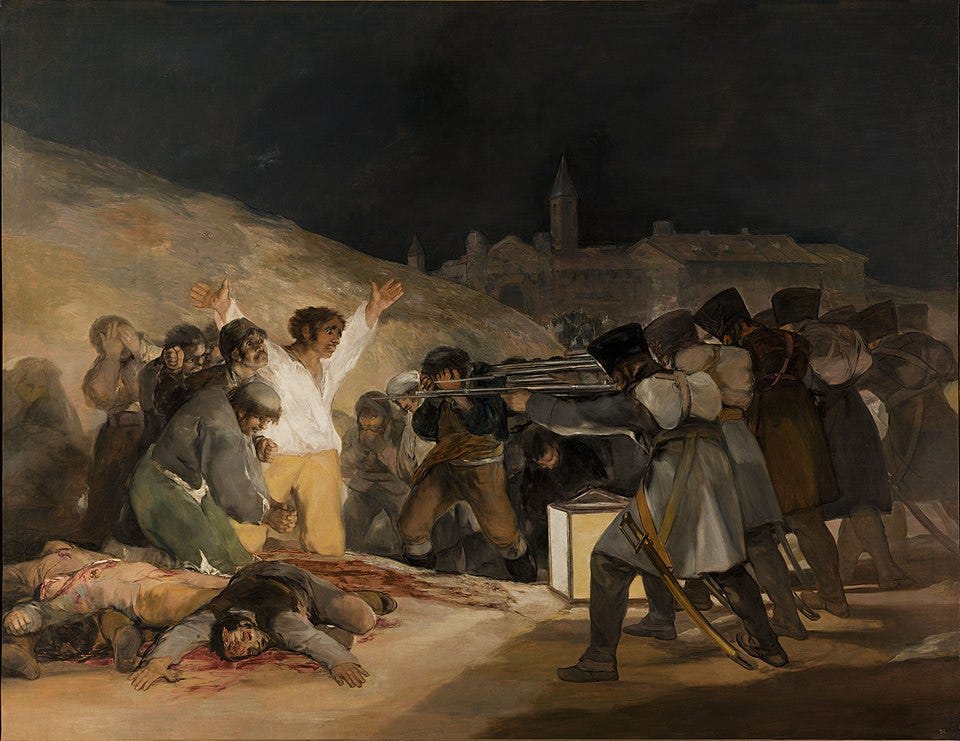
Two hundred and eighteen years ago today, French troops occupying Madrid in support of Napoleon’s bid to install his brother as the king of Spain rounded up and executed hundreds of Spaniards and executed them in the streets. In 1814, with Joseph Bonaparte safely deposed, Francisco Goya painted The Third of May 1808, a commemoration of the victims of Napoleon’s campaign.
In the Review’s June 29, 1989, issue, Robert Hughes wrote about a major Goya show at New York’s Metropolitan Museum, and included an extended analysis of The Third of May 1808, a painting not in the Met’s show.
The Liberal Goya
Robert Hughes
1.
I think most of us would agree that the Goya exhibition at the Metropolitan Museum is the most powerful show in town. We can say this even though it doesn’t give us the whole Goya. We can feel it because he speaks to us with an urgency that no artist of our time can muster. We see his long-dead face pressed against the glass of our terrible century, Goya looking in at a time worse than his.
You can make a proto-modernist out of Goya, just as the nineteenth century made him a proto-Romantic and then a proto-Realist. His dismembered carcasses in the Disasters of War directly inspired Géricault’s. Manet assiduously imitated him—his Parisiennes on the balcony are Goya’s majas transposed to Paris, his bullfight is a direct homage to Goya’s Tauromaquia. Dali constantly invoked him and from L’Age d’Or to The Exterminating Angel Luis Buñuel’s films elliptically refer to Goya and constitute a cinematic parallel to his eighty prints about the sexual and social follies of Spanish society high and low, the Caprichos.
Picasso, of course, meditated on Goya from first to last and was always scared of the comparison. Among Americans, to name only a couple, Goya surfaces dramatically in late works of Philip Guston (so many of which seem like homages to the Caprichos) and in the tragic blacks and humped profiles of Robert Motherwell’s Elegy to the Spanish Republic.
But you cannot make Goya into a proto-post-modernist. He is never trivial enough for that. It is the wholeness of his fiction, its unremitting earnestness, its desire to know and tell the truth, that our art has currently lost.
This is what used to be meant when a great artist was called “universal.” The term can’t be taken literally—there is no imaginable Goya that could mean as much to a Chinese as to a European—but it does suggest the power of such artists to keep appealing through their imagery to very different people along the strand of a common cultural descent, so that even when beliefs have lost their fervency, when both the oppressors and the oppressed are dead, when the references of religion and popular culture have changed, as they certainly have between Madrid in 1809 and New York in 1989—still we venture to claim Goya as our own. Our ability to describe ourselves is somewhat inflected by this man’s paintings, drawings, and prints.
We could not claim this for any of his Spanish contemporaries. It doesn’t entirely rest on his greatness as an artist either, since other great painters of the eighteenth and early nineteenth centuries don’t have Goya’s ability to project their images from their time into ours. No matter how much we love Watteau, his sense of society is closed to us forever; we will never be able to imagine ourselves taking part in those rituals on the shaven lawns of the paradise garden. But Goya is a different matter.
Two paintings that are not in the Metropolitan show underscore why nobody should call it a Goya retrospective, an event that now will never take place. The paintings commemorate a rising that touched off Spain’s War of Independence against France. On May 2, 1808, in the Puerta del Sol in the very heart of Madrid, a crowd of citizens turned into what authority would call a mob and attacked a detachment of Mameluke cavalry—the predecessors, one might say, of Franco’s Moors—led by the French general, Murat. One painting by Goya records the moment: the Dos de Mayo. A second, the Tres de Mayo, commemorates the next night’s reprisals, in which about forty madrileños found with weapons were summarily shot by French firing squads behind the hill of Principe Pio, outside Madrid.
The Second of May is a fine painting but not a great one; it is renovated Baron Gros with its heroic rocking horse, without the French etiquette of violence, and more abandoned in expressions. The Third of May (see page 28) is not renovated anything. It is truly modern and its newness seems to have ensured that, though a state commission, it remained in storage for the first forty years of its life.
The surface is ragged, for Goya is suppressing his fluency in the interests of a harsher address to the eye. Occasionally the signs of that fluency break through—one is the saber and sheath of the French soldier closest to us—a mere scribble, but what a scribble, of burnt umber, lightened by a swipe of yellow that begins in a round splotch at the tip of the sheath and swings right up the form. Elsewhere the improvised bluntness of his painting is tragically expressive, even—or perhaps especially—down to the blood on the ground, which is a dark alizarin crimson put on thick and then scraped back with a palette knife, so that its sinking into the grain of the canvas mimics the drying of blood itself: it looks crusty, dull, and scratchy, just like real blood smeared on a surface by the involuntary twitches of a dying body. The wounds that disfigure the face of the man on the ground can’t be deciphered fully as wounds, but as signs of trauma embodied in paint they are inexpressibly shocking: their imprecision conveys the sense of something too painful to look at, of the aversion of one’s own eyes.
Signs of past art are there: I suspect that the array of French barrels and bayonets carries a small sharp echo of a more triumphal and chivalrous military piece, well-known to Goya: the palisade of lances in Velasquez’s Surrender of Breda. Above all, there is the man about to be shot, whom we saw dragging the Mameluke backward off his horse on May Second. There he now stands, in his clean white shirt, throwing out his arms in a gesture that irresistibly recalls the Crucifixion. It is a gesture of indescribable power: it takes the spread arms of the passive crucified victim and makes them active, a flinging out of life in despair and defiance. Indeed, he has a face—coarse, swarthy, dilated in its last moment of vitality. All his fellow victims have faces too. By rendering them as national portraits—the faces of the pueblo—Goya grants the living their individually right up to the edge of the mass grave. The landscape, however, is featureless: a bare hill and bare rocks. And so are the soldiers, whose row of backs still strikes us as the first truly modern image of war because it is the first to register the anonymity, the machine-like efficiency, of oppression. Nothing personal.
We see only backs, braced forward into the recoil of those big .70-caliber flintlocks. And without knowing it, Goya piercingly anticipates our sense of modern documentary with that lantern: the minimal cube with its objective white light, presently to be invoked, in homage to Goya, by Picasso’s electric light in Guernica. In sum, this painting is as unlike all previous war paintings as Wilfred Owen’s writings from the trenches are unlike all Georgian and Victorian war poetry. And the difference is that Goya speaks for the victims: not only for those killed in French reprisals in Madrid, but for all the millions of individuals destroyed, before and since, in the name of The People. The Third of May is not a piece of reporting—any more than the Disasters of War will be. Goya didn’t see this scene; he almost certainly wasn’t there, though he was in Madrid. In any case it can’t have looked like this. But we can’t forget what he didn’t see.
I have dwelt on this painting because it exemplifies what is somewhat underplayed in the Metropolitan show. The idea of Goya as a man of the Enlightenment stops a long way short of explaining why his work has such a purchase on our imagination. The light of this lantern is not the light shed by Rousseau’s assumptions about the goodness of mankind, or by the hopes of the Spanish reformers that Goya saw crushed at the very moment in 1814 when he was painting The Third of May. They were crushed when that parody of kingship, Ferdinand VII, entered Madrid and, instead of restoring the rights of the Spanish people that Napoleon and the war had taken away, abolished the Constitution of 1812, and reinstated the Inquisition. To employ Milton’s stunning phrase about the illumination of Hell, it is “no light, but rather darkness visible.” Because The Third of May excites our pity and terror as no other painting of war has done—or, I suppose, will ever do—we incline to suppose that it does so in the name of liberal ideology.
But here our emphasis may be wrong. Perhaps in claiming Goya as a liberal we are only repeating the process by which successive moments of taste have appropriated him. There have been more than a few Goyas in the two hundred years since his birth. There was Goya the Romantic, the creation of writers like Théophile Gautier. We have had Goya the Man of the People, critic of established power and French imperialism, whose work argues for an immutable bedrock of his culture, the ser auténtico. His offspring is Goya the Incipient Marxist, in whose work the class struggle is set forth and predicted from the eye-line of the workers, a view based partly on his own humble birth—though it ignores some of Goya’s opinions of the common people, and creates problems when it comes to explaining his social climbing and canny self-interest. Then there is Goya the Surrealist, whose uncensored access to his own worst dreams would not be approached until the 1930s, with the anxious maturity of Picasso—and will certainly never be equaled.
There are other Goyas too—the existential one suggested by André Malraux’s Saturn, for instance—and in each a culture later than his own strives to locate itself, its own dreams, its own self-image. They are all partly true, and none of them wholly excludes the rest. For Goya’s personality was one of the richest and most various that an artist ever had: a remarkable blend of introspection, opportunism, and relentless curiosity; gluttonously drawn to the social framework but always alone among his fantasies.
He turns in the dark space of Bourbon history like a ball with mirrored facets, immediately casting back whatever pencil of light the specialist directs on him. He demands interpretation, he absorbs it and always seems to want more, because his work is so rich and so variegated.
So the latest Goya—the one the Metropolitan show invokes and to some degree invents—is Goya the Liberal. The use of the word “liberal” in its political sense began in Spain in his time, to distinguish reformers from the serviles, the conservatives who wanted no change in social ranking and the power of the Church and the Inquisition. It only got into English around 1830. Maybe the Spanish today want to stress Goya’s liberalism because they see their present king fulfilling the liberal promise of his ancestor Charles III in Goya’s time—and because Goya was too often claimed as “quintessentially Spanish” during the long Franco years. Maybe we like to hear it because American liberalism has taken such a beating from political speechwriters and TV preachers. That they could so easily turn America’s noblest tradition of political thought into the “L-word” is obscene, and perhaps it’s natural that survivors of this linguistic mugging should want to claim Goya as an ancestor for their own opinions about human freedom and rights. And there is a good deal of evidence for this in his work, especially the Caprichos, brilliantly explicated by Eleanor Sayre in the catalog. But it is not the whole story.
Goya’s liberalism is bound up with his class ambitions. In the late eighteenth century, which also saw the first phase of Goya’s career, Madrid had a thin veneer of ilustrados, whose influence was largely dependent on royal approval—which they got in plenty from Charles III. Their liberalism was safeguarded not by popular movements, but by the direct sympathy of the monarch. Like many of the aristocrats who supported the French Revolution in its pre-Jacobin years, they perceived their king as the caretaker of liberal reform.
But the common people and artisans from whose ranks Goya had risen were far more conservative. There was an immense chasm between popular and elite culture in Bourbon Spain. To the majo on the street, the ilustrado in the salon with his Frenchified ideas was virtually a foreigner. People rarely like the humanitarian plans of their social superiors. The culture of the Madrid pueblo had nothing to do with Beccaria or Diderot—or with Goya’s court portraits, for that matter. It was immersed in folk tales, superstitions, and ferociously dirty jokes. It clung to the bullfight; to flamenco singers and hellfire preachers; to the grotesque pantomimes known as tonadillas; to phantasmagorias full of witches and demons; to crude woodcuts and to a popular theater whose heroes were bandits, smugglers, and other enemies of authority; and to the codes of brash laconic dandyism and male bonding that were signified by the word majismo.
Aged forty-six, Goya painted himself as a majo (see page 29)—a costume which for an established court painter in the 1790s was roughly equivalent to black leather and jeans among New York artists in the Sixties. Populism stood for liberty—of a rough, conservative, intensely xenophobic kind, sentimental and hard-eyed by turns. And it was indissolubly linked to old Spain, black Spain, the Spain the ilustrados hoped to cure with their judicious enemas of liberal ideology. What the majos really thought of their would-be doctors and their medicine became brutally clear to Goya (and everyone else) after the Peninsular War broke out. They thought liberals were French quislings. The title of one plate from the Disasters of War is Popolacho, meaning “rabble” or “mob”—definitely not people; the victim on the ground is a liberal defrocked, and the instrument he is about to get the point of is a media luna, a tool with a half-moon cutter used to hamstring bulls. It was not etched by a man with stars in his eyes about the natural goodness of common folk.
The roots of Goya’s imagination were fixed deep in this world, and its imagery pervades his work. It is in some ways its deepest source. Yet his late work moves beyond purely Spanish concerns, though its dress is Spanish, and its encyclopedic despair and skepticism are just as much to do with his disillusionment at the failure of French revolutionary promises as with his loathing of the return of Spanish absolutism after the Peninsular War. He had followed the liberal blossoming of 1789, and the Paris bloodbath of the 1790s. He was the first great artist to bear witness to the atrocities committed by ideologues in the name of liberty. This was the Gorgon’s head of modern history. David could not look at it. But Goya could. And still he chose to spend his last years in France, and to die there. The developing drama of his work unfolds from his effort to move between these two mental worlds of the ilustrados and the pueblo, even as political events in Spain were tearing them apart. But the view he took of those events was deeply colored by his memories of the French Revolution, which is why no simple view of Goya as either a liberal or as a man of the people fits the late work.
When I first saw the current show in Boston I wanted to accept the Enlightenment view of Goya wholeheartedly, because it promised a way out of earlier stereotypes of the artist. It enables us to reread many of his images, even the most famous, such as the capricho El sueño de la razon, “The sleep of Reason brings forth monsters” (see opposite page). The figure of the artist dozing over the midnight oil and beset by foul imaginings is rooted both in the present and the past. In the present, because it seems to repeat the pose in which, in 1798, he painted the economist, writer, and educational reformer Gaspar Melchor de Jovellanos, whose Informe or report on agrarian law was the bureaucratic cornerstone of the Spanish enlightenment, and who was made minister of culture and justice by Charles III’s successor, Charles IV, for a brief nine months in 1789–1790 and was then banished to a long and frustrating exile for his liberal views. Goya paints this intellectual meditating on the cares of office in the splendors of the palace, symbolically blessed by Minerva, the goddess of wisdom.
In the etching, as Dr. Sayre shows, Minerva’s role is filled by a protective lynx, the symbol of alertness and skepticism—these big cats have night vision and can pierce the gloom of ignorance. The owl is a telling variation of Minerva’s emblem: it is offering the sleeper a pen with which to record error and superstition. And there is no doubt about the meaning of the bats, cats, and other critters that swarm through the sky to take over the man’s dreams. Goya’s owls on the sleeper’s back—one with its wings spread, the others staring at you—come from the similar cluster of owls on a ruined, inscribed tomb-slab which is the opening plate of the Scherzi by Giambattista Tiepolo, who had died in Madrid in 1770.
And then one recalls other and older images that Goya knew from the royal collections, such as those of Hieronymus Bosch, that favorite of the gloomy Philip II; in particular, the theme of Saint Anthony tempted by devils, of which the Escorial had no fewer than four versions. Eleanor Sayre points out that Goya didn’t want to paint “a dreaming artist surrounded by a wild phantasmagoria of bizarre, Bosch-like beings.” Certainly Bosch’s hellish little androids scuttling around the saint and his pig are fantastic in a way that Goya’s owls and cats are not. And yet I find it hard to suppose that Goya’s image is not a recycling of the Temptation of Saint Anthony, and harder still to believe that this was not a partly deliberate choice, signaling his own rootedness in a tradition that predated the Enlightenment by centuries. Indeed, until Goya’s own moment, it would be difficult to name a denser landscape of hysteria than in northern Europe between 1480 and 1550, with its pogroms and religious wars, its flagellants and prophets proclaiming the imminent arrival of the millennium—in some ways like the Middle East today, with priests instead of imams and right-wing rabbis.
Bosch’s importance to Goya can hardly be overestimated. Because of the influence Surrealism has had, inducing us to think of Bosch as though he were a Surrealist, coupled with the extreme difficulty of decoding the actual meaning of Bosch’s images—and the opacity of some of Goya’s as well—we are apt to get this slightly skewed. But it seems likely that Goya was drawn to Bosch not only by the unmatched power of the long-dead painter’s fantasy, but by his reputation as a moral allegorist. Here is Brother Joseph de Siguenca, an early seventeenth-century monk attached to the Escorial, defending his king’s favorite painter against the charges of frivolity and heresy.
I should like to point out that these paintings are by no means farces, but books of great wisdom and art, and if foolish actions are shown in them they are our follies, not his: and, let us admit it, they are a painted satire on the sins and fickleness of men…. Others try as often as possible to paint man as he looks from the outside, while this man has the courage to paint him as he is inwardly.
This is very close to Goya’s own statement for the Caprichos: “The author,” he writes,
is convinced that censoring human errors and vices—though it seems the preserve of poetry and oratory—may also be a worthy object of painting. As subjects appropriate to his work, he has selected from the multitude of errors and stupidities common to every civil society, and from the ordinary obfuscations and lies condoned by custom, ignorance or self-interest, those he has deemed most fit to furnish material for ridicule.
A full study of Goya’s debt to Bosch, and to later demonological painters, has yet to be made, and when it is done it will connect with Goya’s delight in demotic and populist fantasy, and unlock more of him than we now have.
Working from direct observation fixed by incessant note taking, he had the genius to make this symbolism of the body concrete, rather than schematic, so that we are always left feeling that such monsters may be chatting to one another, in darkness or sunlight, just around the corner. It was a thought that occurred to him when preparing to publish the Caprichos. “He who would catch a group of goblins in their den,” he wrote, “and show them in a cage at ten o’clock in the morning on the Puerta del Sol, would not need any rights of primogeniture to an entailed estate.” It was a joke: he meant that they’d be such curiosities that their owner would get rich. But it wasn’t a joke: to cage these goblins, these duendecitos, in the white sunlight of the printed page was to have power over them, more power than mere birth could give you; it was to have dominion over your own fears and society’s as well.
Read the full article for free on the Review’s website here.
Hughes' point about the ilustrados and the pueblo is the most durable part of this essay. Goya saw the same structure Japan saw with Meiji reformers and China with May Fourth: liberal modernizers backed by the state, treated as foreign agents by the people they meant to liberate. The Spanish word was afrancesados — the Frenchified ones. The labels rotate across cultures; the suspicion doesn't. What survives every reframing of Goya is exactly what Hughes identifies: the refusal to grant either side — the people or their improvers — the moral monopoly each kept claiming.
Hoya wanted so desperately to be a part of the knights of Malta that he created some of the most satanic visual imagery of his era.
He believed they were descendants of the Templars.