The Hormuz Bottleneck
Adam Hanieh on blocking the Strait of Hormuz

Bottling the World Economy
Adam Hanieh
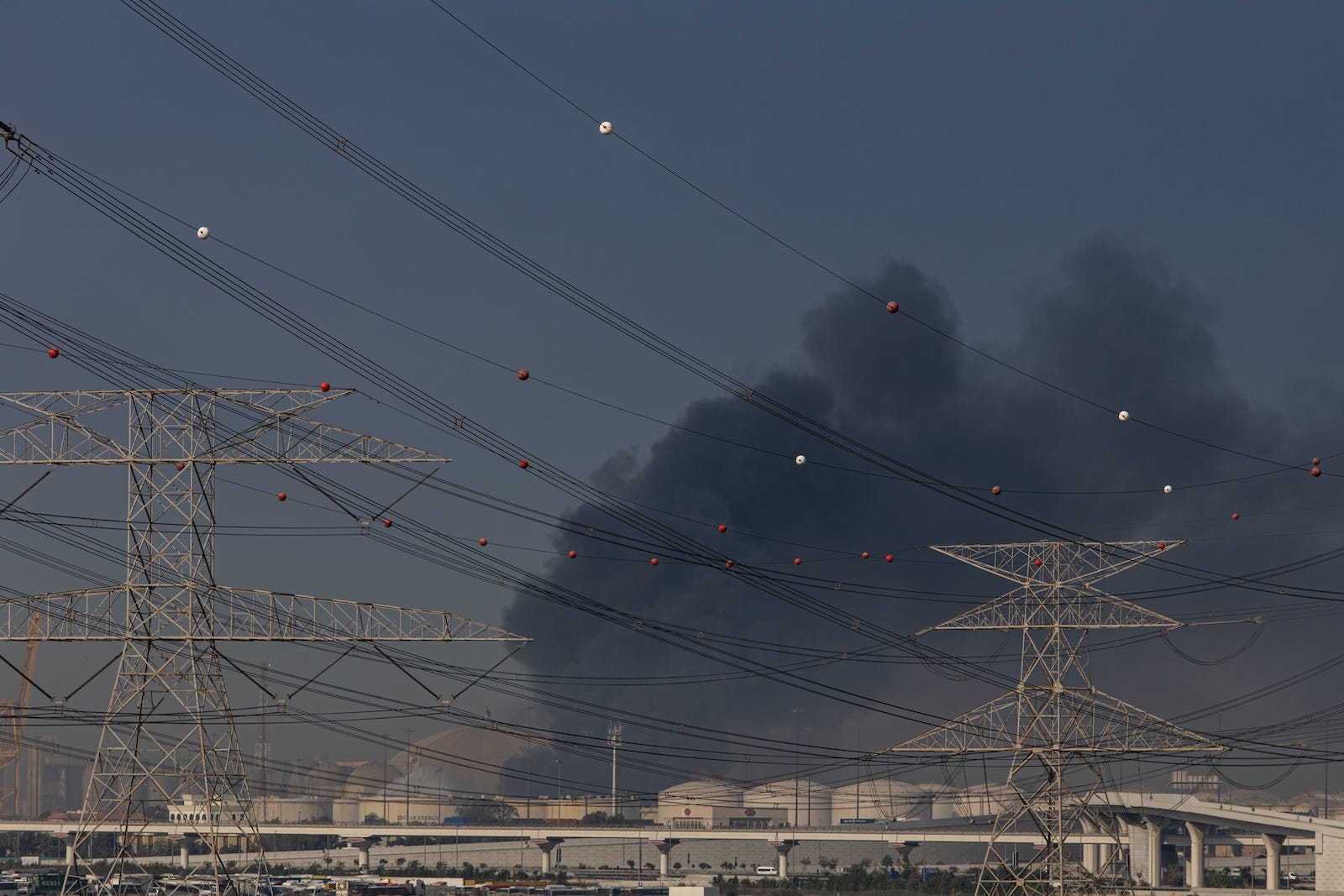
Amid the destruction of the US–Israeli war against Iran, much of the world’s attention has fixed on the Strait of Hormuz, the narrow passage through which roughly a fifth of the world’s oil and liquefied natural gas passes. In normal times ships traversing the Strait—which runs between Oman and the United Arab Emirates on one bank and Iran on the other—follow a pair of two-mile-wide lanes for inbound and outbound traffic, separated by a two-mile buffer. Shortly after the onset of the war Iran began attacking commercial vessels and laying mines in the waterway, effectively shutting it to most marine traffic. As of March 18 around 3,200 ships were stranded in the Gulf, with only a handful of tankers permitted to pass each day.
The disruption of this vital artery has sent markets into convulsions, with the international price benchmark for Brent crude oil briefly surging to nearly $120 a barrel on March 9, its highest level since Russia’s invasion of Ukraine sparked panic. Donald Trump has urged Western allies to help escort tankers through the Strait in an effort to keep prices in check, so far finding no takers; more recently he has threatened to strike Iran’s power plants if its government refuses to reopen the waterway. Oil, in this sense, has become a proxy for the war’s nearly incalculable costs.
Much of the instinctive anxiety around Hormuz is filtered through the memory of 1973, when several Arab oil producers imposed an embargo on the United States and other Western states in response to their support for Israel. Prices quadrupled within months, helping to produce recession, inflation, and a lasting sense that the Middle East possessed an “oil weapon” that could bring the global economy to its knees. Since then Western leaders and many commentators have understood wars in the region, above all, as potential threats to the global energy supply.
But this image of the Gulf as little more than the world’s oil spigot is profoundly outdated. Although oil and gas still underpin the region’s wealth, its energy companies are no longer merely producers and exporters of crude. Over the past decade they have become highly diversified industrial giants, anchoring a vast system of production and trade that includes chemical plants, fertilizer complexes, shipping routes, and container ports.
That structural transformation has woven the Gulf much more deeply into the global economy than was the case half a century ago. Because Gulf-produced chemicals now sustain everything from factories in China to farms in South America, disruption in the region ripples outward through industries and food systems across continents. The possible consequences of the current war are in this respect more extensive than those of the 1973 embargo, and far more catastrophic than can be gleaned from the gyrations of oil prices alone—especially for those living in the Global South.
The Gulf’s place in the global oil market was secured in the decades following World War II. As part of US-backed postwar reconstruction plans, cheap and easily extracted crude from the Gulf states and Iran helped drive Europe’s postwar transition from coal to oil, securing crude’s place as the dominant fossil fuel. At the time the global oil industry remained firmly under the control of seven large Western oil multinationals, the so-called Seven Sisters, which together commanded roughly 90 percent of the world’s oil production outside the US and the Soviet Union, as well as virtually all refineries, pipelines, and tanker fleets.1
In the 1960s and 1970s this Western domination of the oil industry began to unravel. The formation of the Organization of the Petroleum Exporting Countries (OPEC) in 1960, followed by the nationalization of oil industries across the Middle East and elsewhere, shifted much of the leverage over the extraction and production of crude to state-owned companies in oil-rich countries. In the Gulf, firms such as Saudi Aramco and the United Arab Emirates’ Abu Dhabi National Oil Company (ADNOC) emerged as increasingly powerful players.
Yet this transfer of ownership was only partial. Gulf states took over the “upstream” sector of the industry, the extraction of crude. But a handful of big Western oil multinationals, such as BP, Shell, Chevron, and Exxon, still managed much of the “downstream,” meaning everything that happens after crude is pumped from the ground: refining, producing chemicals, overseeing shipping networks, marketing petroleum products to the consumer. When the 1973 embargo got underway, these firms were able to use their command over global transport and distribution infrastructures to reroute crude supplies from other regions and avoid significant shortages. This is why the popular image of the 1973 oil crisis as a moment when the world was held hostage by a handful of greedy “oil sheikhs” is fundamentally mistaken. In reality prices at the gas pump in countries like the US were set by Western oil companies, which took advantage of the shocks of the 1970s to reap enormous profits.
For much of the twentieth century, the geography of the oil trade ran west. Western firms purchased crude oil from producers in the Gulf and shipped it to markets in Europe and the US, where it could be refined into various fuels and chemical products. From the early 2000s onward, however, that structure began to shift decisively eastward. China’s emergence as “the workshop of the world” required a huge increase in energy consumption, which in the past two decades has catalyzed a profound reorientation of the Gulf’s exports away from the traditional Atlantic economies and toward East Asia.
In 2000 China accounted for just 4 percent of global oil imports. Today that figure sits at around 25 percent, of which last year more than 40 percent came from Iraq and the Gulf monarchies. Over the same period China’s share of global liquefied natural gas (LNG) imports has also reached nearly 20 percent, more than a quarter of which originated from the Gulf in 2025, mostly from Qatar. The Gulf has thus become China’s largest oil supplier and its second-largest source of liquefied natural gas after Australia. Iran supplies another 13 percent of China’s oil, typically shipped through Malaysia and labelled as “Malaysia blend” to circumvent sanctions.
These changes in the global economy transformed the Gulf in turn. China’s surging demand helped drive a sharp increase in global oil prices during the first decade of the new millennium, securing the Gulf states billions of dollars in wealth. Some of that wealth flowed into the spectacular real estate projects that now dominate Gulf skylines, as well as into overseas acquisitions. But a significant share was spent on expanding national oil companies into a variety of downstream sectors, above all the manufacture of chemicals, plastics, fertilizers, and other industrial materials.
This process has connected the Gulf with global supply chains in far deeper and more complex ways than the familiar stereotype of oil wells and tanker routes might suggest. The region’s historic position in the making of the modern oil economy has turned it into a hub for the industries and infrastructures that convert hydrocarbons into the materials on which modern capitalism depends.
Among the most important chemicals that the Gulf started producing are polyethylene and polypropylene. These plastic resins make up nearly 60 percent of the world’s plastic production, ending up in everything from packaging and consumer goods to industrial piping, electrical insulation, and chemical storage systems. Today the Middle East, led above all by Saudi Arabia and the UAE, accounts for more than 40 percent of global exports of these two essential polymers, more than any other region in the world. Much like the Gulf’s crude oil, these materials flow predominantly to Asian markets, above all China. (Nearly a third of China’s polyethylene imports come from the Gulf.) From there they make their way to the rest of the world in the form of industrial and consumer goods.
The Gulf is also responsible for more than a quarter of the world’s methanol exports, 45 percent of global sulphur exports, and between 30 and 40 percent of the global helium supply. These are not marginal commodities. Methanol is a basic feedstock for plastics, paints, and construction materials; sulphur is converted into sulphuric acid for fertilizers and metals processing; helium is indispensable to semiconductor fabrication, aerospace systems, and other advanced technologies. Because these chemicals are generated as byproducts of the hydrocarbon industry, most of the firms that produce them are subsidiaries of the Gulf’s national oil companies (such as ADNOC, QatarEnergy, and Aramco).
Few nonspecialists ever think much about these chemicals, even though they are indispensable to the manufacture of countless goods. This invisibility distorts our picture of how global supply chains work, obscuring their enduring connection to the fossil fuel industry. Batteries and semiconductors, for instance, are often discussed as though they belonged to a world beyond fossil fuels. Yet their production remains fully dependent on chemicals that originate in the hydrocarbon economy.
Indonesia provides a revealing example. The country sits at the heart of the global nickel boom, producing more than half of the world’s nickel ore and rapidly expanding its large-scale capacity to produce metals destined for the batteries of electric vehicles. Yet nickel extraction depends upon a leaching process that uses sulphuric acid, and the sulphur used to make that acid comes overwhelmingly from the Gulf (the source of roughly three quarters of Indonesia’s imports). Far from standing outside these supposedly new “critical mineral” supply chains, the Gulf is deeply embedded in their foundations.
Read the full article on the Review’s website here.
These firms were the Anglo-Iranian Oil Company (now BP); Royal Dutch Shell; Standard Oil Company of California (now part of Chevron); Gulf Oil (now part of Chevron); Texaco (now part of Chevron); Standard Oil Company of New Jersey (now part of ExxonMobil); and the Standard Oil Company of New York (now part of ExxonMobil).
Also in the Review:
Dan Rockmore on the allure of algebra
Neve Gordon on how Israel pursues its ‘Gaza doctrine’ in Iran and Lebanon
David A. Bell on indigenous and enslaved people of colonial France
Omari Weekes on Tyriek White’s Brooklyn