

The Gray Tick
Amir Ahmadi Arian on Iran

In July 1987 the Hajj ceremony in Mecca turned into a bloodbath. Shia pilgrims, mostly Iranians, staged a protest, chanting against America, Israel, and Saddam Hussein. Saudi security forces confronted them. Violence erupted. Nearly four hundred people were killed.
I was seven years old. My favorite uncle happened to be among the pilgrims that year. In those paleolithic, pre-Internet times we had no way of knowing whether he had survived. Every afternoon state television broadcast updated lists of the identified victims. It took days before all the dead were named and we were able to confirm that my uncle was not among them.
Since I left Iran in 2011, that multiday sense of anticipation has settled into a permanent anxiety, a compulsive worry about the safety of loved ones who are hard to reach. Never is this feeling sharper than when the Iranian government shuts down the Internet and imposes a communication blackout. By now those of us who have lived in exile long enough to endure multiple such blackouts have developed what, joking with fellow exiled friends, I started calling the Gray Tick Syndrome: sending messages in group chats to people back home, then staring for hours at the gray tick, waiting for it to turn blue.
The first blackout I experienced from a distance was in 2019, when protests over a sudden spike in gas prices spiraled beyond the state’s control. The Internet was cut for five full days, and many hundreds of people were massacred across the country. The second was this past June, during the twelve-day war, when we lost contact with family and friends left exposed to Israeli bombers and drones. The third, which began on January 8 and persists as of this writing, has been the most terrifying yet.
In the West a consensus of sorts has emerged that this round of protests erupted when the national currency went into freefall and made transactions virtually impossible, prompting business owners in Tehran’s Aladdin mall—the commercial center for electronic devices—to shut their shops and take to the streets. This is partly true. And yet within barely a day people in western provinces such as Ilam and Kermanshah, hundreds of miles from Tehran, many of whom have never even been to the capital or owned any electronic device other than a cheap phone, had also risen up against the country’s increasingly unlivable conditions.
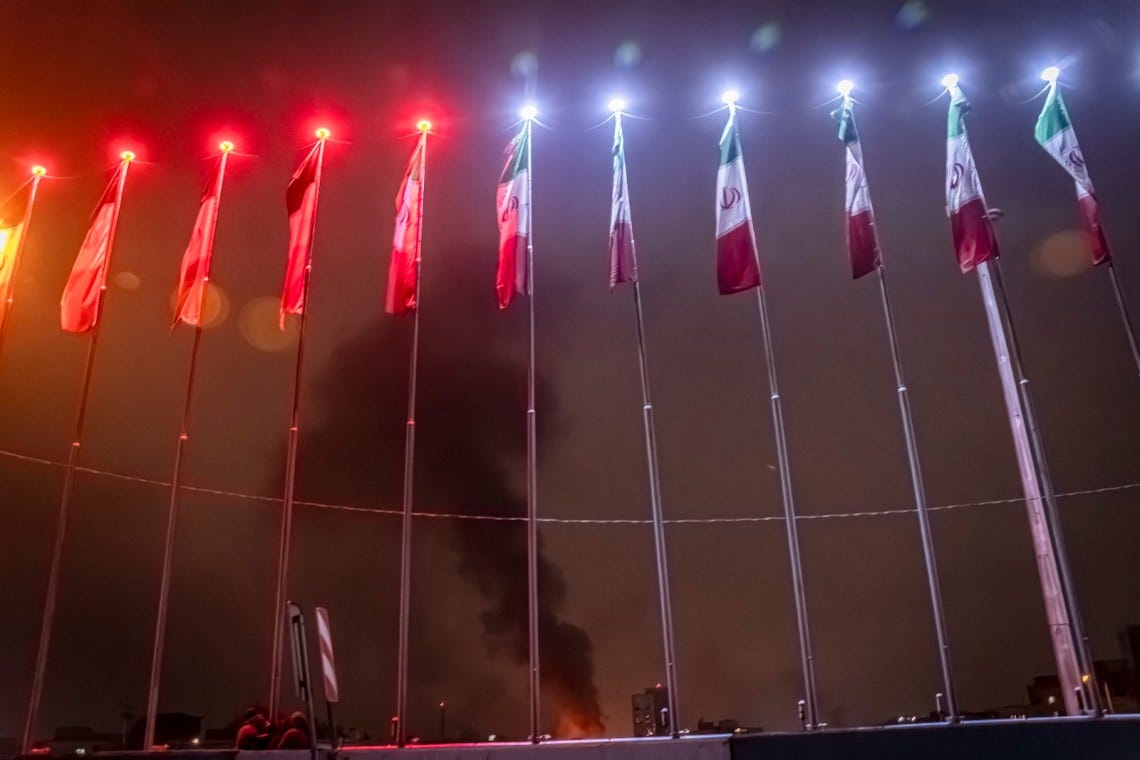
Over the past week the state has responded with ever more brutality. Thanks to the blackout we have seen almost nothing, yet the available footage circulating on social media points to full-scale urban warfare across countless large and small cities. Security forces have opened fire on protesters, who have fought back with their bare hands or with primitive weapons like rocks and Molotov cocktails. This time even landlines are down. The authorities have reportedly managed to disrupt Starlink servers as well. I have been in constant contact with Iranian friends abroad, and none of us has heard a word from our families and friends inside the country.
The scraps of information that do make it out suggest a horror show: hospitals overwhelmed with the dead and injured, morgues overflowing, bodies strewn around the streets. A doctor told Time that on the first day of the crackdown he called six hospitals in Tehran and found that they reported receiving a combined total of 217 bodies, most killed by live ammunition. We have seen horrifying footage from Kahrizak Forensic Medical Center: hundreds of bodies laid out in black bags with families wandering among them, trying to identify their loved ones. Even conservative estimates suggest that in the past five days many hundreds or even thousands of protesters have already been killed.
Read the full article on the Review’s website here.
From the Archives: A State of Fear
Amir Ahmadi Arian on Israel’s war on Iran
Christopher de Bellaigue on the Ayatollah’s dilemma
Ervand Abrahamian on the history of modern Iran
Haleh Esfandiari on the aftermath of the Green Revolution
Shaul Bakhash on the Iranian revolution

If you like our Substack, consider subscribing to our magazine by visiting nybooks.com/substack for a special discount on a full subscription.