

The Founding Fathers Go On Spring Break
Christopher Benfey on Jefferson and Madison’s Excellent Adventure

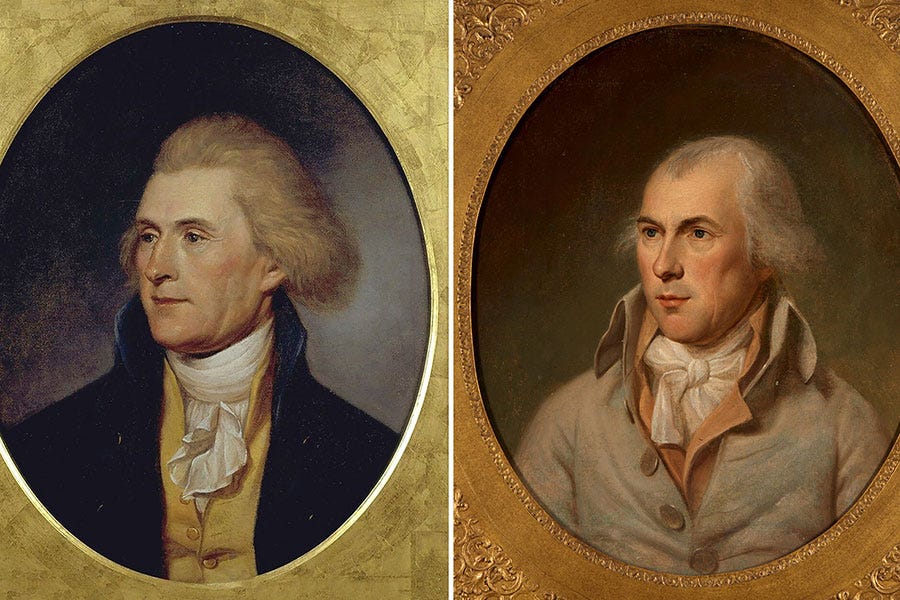
In the spring of 1791 Thomas Jefferson and James Madison, seeking, in Madison’s words, “health recreation & curiosity,” decided to go on an extended holiday together. As Christopher Benfey writes in the Review’s March 12 issue:
They envisaged a monthlong ramble up the Hudson River and down the Connecticut, with stops at the major battlefields of Saratoga and Ticonderoga in upstate New York and a foray into the newly admitted state of Vermont. Jefferson was forty-eight, Madison eight years younger.…
Neither traveler knew, in that spring of 1791, what form the federal government might eventually take. Neither knew that he would one day be president. Neither knew that this would be their final extended journey.
Unburdened by knowledge of the future, on their sojourn the Founding Friends nonetheless managed to encounter everywhere intimations of the nation’s future: “an invasive pest known as the Hessian fly, which had devastated the American wheat crop over the previous decade; an encounter with a free Black farmer in New York; the sugar maple tree of Vermont; and an interview with a few Indians on eastern Long Island.”
Below, alongside Benfey’s essay, are five articles from our archives about Jefferson and Madison.
As though aware that their images might one day adorn our monuments and our money, the principal Founders assiduously cultivated their personal appearances. Intent on conferring awe on the new office of the presidency, George Washington rode in a cream-colored coach drawn by pairs of white horses. Benjamin Franklin, divining that the French would respond to a more homespun persona, ditched his wig for a coonskin cap. On his way to New York in the spring of 1791 to meet his fellow Virginian James Madison for a holiday together, Thomas Jefferson stopped in Princeton to visit a barber. “He expects not to live above a Dozen years,” Abigail Adams wrote cattily, “and he shall lose one of those in hair dressing.”
Madison was the exception to such ostentatious display. A spindly five foot four, sickly, and weighing a hundred pounds, he didn’t strike much of a figure beside the six-foot-two Jefferson, with his carefully coiffed hair—“not red,” Madison corrected a biographer after Jefferson’s death, “but between yellow & red.” And yet it was Madison, gifted with the subtlest political mind and the shrewdest powers of persuasion among the Founders, who patiently shepherded the Constitution, via coaxing and compromise, through adoption and ratification. Maybe Madison’s inconspicuousness was itself a pose. “He seemed to lack a personal agenda because he seemed to lack a personality,” the historian Joseph J. Ellis has written, “yet when the votes were counted, his side almost always won.”
The Virginians planned their trip, as Madison put it, as one of “Health recreation & curiosity.” They envisaged a monthlong ramble up the Hudson River and down the Connecticut, with stops at the major battlefields of Saratoga and Ticonderoga in upstate New York and a foray into the newly admitted state of Vermont. Jefferson was forty-eight, Madison eight years younger. Appointed by Washington to be the first secretary of state, Jefferson had recently returned from his sojourn in France. He had served as the United States minister in Paris during the eventful years of 1784–1789, when he had a close-up view of the early stages of the French Revolution, and advised Lafayette on its course.
Jefferson was already established as the lyric poet of revolution, having framed the case against the tyrannical George III in the ringing clauses of the Declaration of Independence. Unlike Washington or his versatile aide-de-camp, Alexander Hamilton, neither Jefferson nor Madison, rich landowners and slaveholders responsible for extensive plantations, had seen military action in the war. Governor of Virginia when British troops advanced on Richmond in 1781, Jefferson was roundly condemned for fleeing the capital city. Offended by the investigation that eventually cleared him, he vowed never to accept public office again, a promise quickly broken amid the pressing needs of the new nation.
Read the full article on the Review’s website here.
From the Archives: Founding Fraternity
Annette Gordon-Reed on the battle for Jefferson’s legacy in Charlottesville
Emma Rothschild on Jefferson and Madison’s French lessons
Gordon S. Wood on James Madison, the “quintessential liberal”
Edmund S. Morgan on Jefferson and Madison’s letters
Garry Wills on Jefferson’s conversion to a cult of Jesus

I assume they swigged switchel to party down.