The Fight Inside Iran
Arang Keshavarzian on the country’s protests

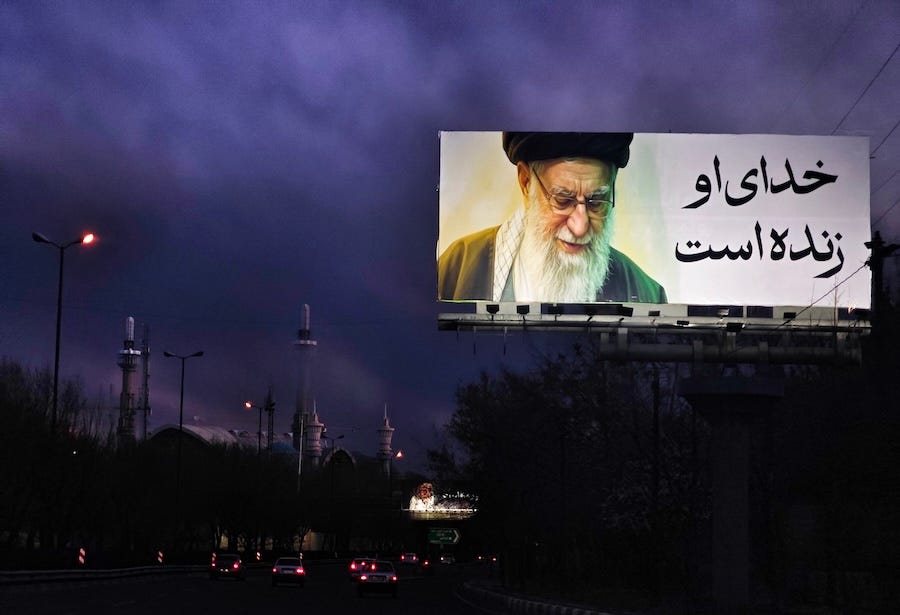
The joint US–Israeli bombing of Tehran, now in its eleventh day, has already taken a heavy toll across the city. Among the numerous civilian sites in Iran’s capital to have suffered damage from what Pete Hegseth calls “death and destruction from the sky” is its Grand Bazaar, long a hub for the city’s influential merchants. “Nine weeks earlier,” Arang Keshavarzian wrote on Sunday in the NYR Online, “that bazaar had been at the center of a very different upheaval. In late December shopkeepers, moneylenders, and merchants there took to the streets, igniting an immense wave of protests against the regime that was brutally repressed by Iran’s security apparatus. When they unleashed this week’s violence, the US and Israel at once obscured the memory of that uprising and capitalized on it.”
Below, alongside Keshavarzian’s essay, we have gathered recent pieces about the war on Iran alongside essays from our archive about the political and economic shifts that transformed the country in the first decade of this century.
On February 28 Israeli warplanes assassinated Ali Khamenei, Iran’s leader, by dropping thirty bombs on his compound in Tehran. It was the opening salvo of the US and Israel’s joint war of choice. Within a day missile attacks and aircraft sorties had done grave damage across the country: in southern Iran airstrikes hit a girls school, killing at least 175 people, most of them children between seven and twelve. Mostly lost in the unrelenting news cycle were reports that the US and Israel had also bombed the historic center of Tehran, which houses the nineteenth-century Golestan Palace and the entrance to the city’s Grand Bazaar. A brief video clip of the aftermath showed a few disoriented men milling around, caught up in the fog of war.
Nine weeks earlier that bazaar had been at the center of a very different upheaval. In late December shopkeepers, moneylenders, and merchants there took to the streets, igniting an immense wave of protests against the regime that was brutally repressed by Iran’s security apparatus. When they unleashed this week’s violence, the US and Israel at once obscured the memory of that uprising and capitalized on it. In his eight-minute Truth Social video announcing the war, which has no legal sanction from the US Congress or the UN, Trump referred back to the Dey protests—named after the Persian month in which they took place—and called on Iranians to again confront their rulers by taking to the streets: “The hour of your freedom is at hand…When we are finished, take over your government. It will be yours to take.”
Back in January, before the hellfire of war and rubble, and before the blood on the streets had even dried, Mohammad Maljoo, an economist and progressive commentator in Iran, warned of the challenge ahead. The regime, he argued, “wanted to buy silence with violence.” But “violence did not speak just from the side of the state. Calls for revenge, for attacks, for a violent response to the prevailing violence also echoed throughout the public sphere.” During and after the Dey uprising many protesters and opposition groups—from a former prime minister under house arrest to mothers whose children were killed in earlier waves of repression—insisted on the need for a social revolution from within Iran itself; others felt desperate enough to call for US military action to open the way beyond the Islamic Republic or even to the restoration of the Pahlavi monarchy. Two paths lay open for Iranian society, Maljoo wrote: “transforming suffering into a conscious collective force,” or “slipping into a cycle that recognizes blood as the sole language of politics.”
By launching this war Trump and Netanyahu have steered Iran—not to mention the entire Middle East—firmly onto the latter path. The besieged Islamic Republic now finds itself having to fight a multifront war, navigate a transition to a new leader (for whom Israel has already issued a death sentence), and maintain control over a restive and polarized society. Still reeling from January’s crackdown, Iranian citizens must wonder if they have any say in what comes next—if this is a war for regime change or state collapse. With the war’s instigators trying to bend the Dey protests to their own purpose, it has become all the more urgent to understand the uprising’s causes and legacy.
This is not an easy task. It is too soon to collect the necessary information for an anatomy of the 2025–2026 protests and too early to move beyond the dread and trauma. The death toll itself remains a matter of pitched debate. Iranian officials place the total number of dead at 3,117 and claim that most of them are “martyrs” killed by “rioters,” “foreign agents,” and “terrorists.” A reputable Washington-based organization, the Human Rights Activists News Agency, sets the figure to at least seven thousand, of which a little over two hundred were security personnel. Trump, in his speech announcing the attack, put the total at “tens of thousands,” echoing the claims of some diasporic opposition groups. But by any measure far more people were killed during the Dey protests than in any earlier cycle of protest in the country, including the entire thirteen months of the 1979 revolution. At the peak of the uprising on January 8 and 9 the clashes between well-armed security forces and large crowds of mostly peaceful protesters consumed several city centers, from Tehran to Mashhad, in the country’s northeast. Beyond the murdered thousands, many more were injured, imprisoned, interrogated, or condemned to Iran’s already long death row.
When a full account of the uprising is written, it will be in relation to a war that will forever change the region. But January’s protests were not just the prelude to a geopolitical contest. They offer a window into the fortunes of Iran’s citizens, the changing structure of its state, and the trajectory of the regime the US now seeks to obliterate.
Read the full article on the Review’s website here.
From the Archives: Iran Then & Now
David Cole on Trump’s ungovernable “morality”
Joost Hiltermann on America’s unfathomable motives in Iran
Haleh Esfandiari on the brutal tactics of Iran’s security forces
Roger Cohen on the Iranian opposition’s efforts to win at the ballot box
Christopher de Bellaigue on the brief hope for liberal reform in Iran