

The Docteur Is In
David Beal on the Congolese guitarist Docteur Nico

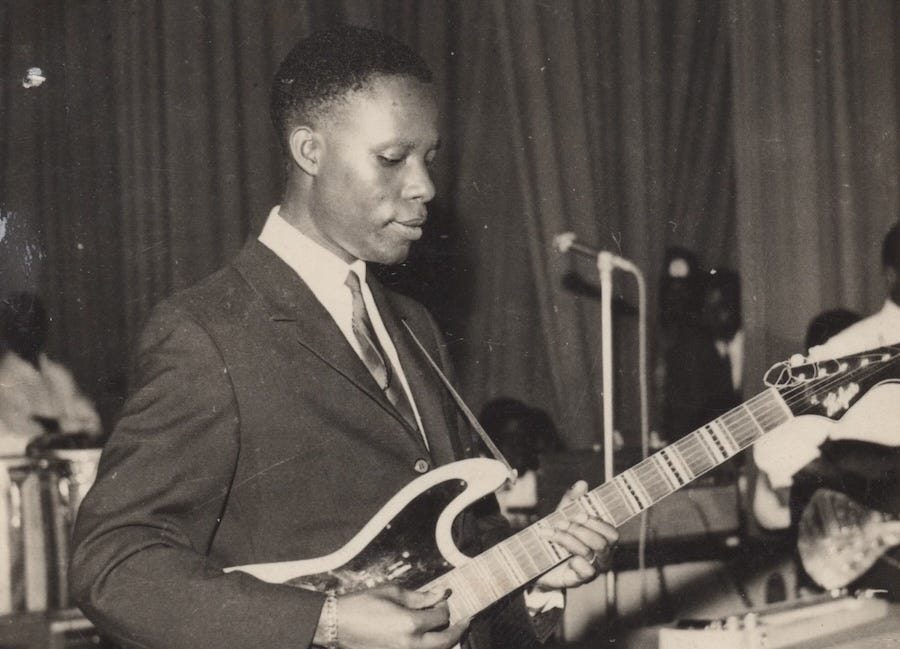
Below we are pleased to present a preview of David Beal’s definitive essay on the Congolese guitarist Docteur Nico, including rare images from his performances as well as samples of some of the greatest music in the world. You can read the complete essay here.
In January 1960 Brussels hosted a “Round Table” conference of Congolese and European leaders to negotiate the future of the Belgian Congo. Anticolonial resistance had surged across Africa over the previous decade; in the Congo the antagonism had reached its peak in 1959 after colonial authorities killed dozens—possibly hundreds—of protesters in the infamous Léopoldville riots. Looking to avoid the kind of protracted independence war that had engulfed Algeria, while also maneuvering to retain some control of the mineral-rich Congo in the coming decades, the Belgians agreed to organize a set of meetings with Congolese political leaders, who presented a united front in demanding formal independence. The conference, which lasted for weeks, was a high-stakes political bargaining session determining when and how power would be transferred. But it was also a kind of international theater, in which a new generation was announcing itself on the world stage.
Representing the Congo were not just the major players from different factions of the independence movement—Patrice Lumumba, Joseph Kasavubu, Moïse Tshombe, and dozens of others—but also members of two of the country’s most popular rival bands, African Jazz and O.K. Jazz, who joined the trip both to entertain the delegates and to prove that the Congo was, as the singer Joseph Kabasele later put it, “ready to enjoy its independence.” Among them was the electric guitarist Nicolas Kasanda, then twenty years old. It was almost certainly his first journey abroad. For the Belgians, he later remembered, “it was the first time they had seen an African guitarist.” Before the trip was over, he would pick up a nickname: Docteur Nico.
The musicians were a sensation in the metropole. They stayed longer than the delegates themselves, playing hotels, bars, and cafes for three months and touring France and Holland. Their popularity didn’t insulate them from flagrant racism; Belgians tried to rub the color off the musicians’ skin in disbelief, and audiences approached Nico at concerts to check if he was miming over a tape of someone else playing. (“Go ahead,” he told them.) But their skill was undeniable, and their music directly confronted the colonists. One of the songs they recorded there, “Indépendance Cha Cha,” would soon reach well beyond Brussels, becoming an early Pan-African independence anthem.
Much of the song’s power comes from Docteur Nico’s guitar solo, one of the signature passages in Congolese popular music. It begins with a four-note statement played twice in a row, followed by a rapid two-note tremolo. A series of repeated motifs unfolds, shifting in and out of step with the rhythm section’s basic cha-cha-cha beat. As they’re elaborated in a single fluid melodic line—without chordal embellishments or double stops—they delay and accelerate, growing in tension before sliding into the guitar’s upper register and doubling back on themselves.
The genius is in the phrasing, which jumps all around the bar line and generates its own rhythmic logic. The solo seems to spring away from the beat before letting gravity pull it back. With his eye on the finish line, Nico locks into a long counterpoint passage with the rhythm guitar, guiding the band to a final valedictory two-note flourish. The song was in a mixture of Lingala and French, and it extolled various Congolese independence leaders and political parties represented at the Round Table. But it was Nico’s guitar solo that seemed to perform the work of liberation, echoing the call of the delegates and crystallizing the anticipation of a nation on the brink of independence.
It also stood, alongside many of Nico’s records, among the most innovative contributions that anyone in the world had made by then on the electric guitar. Nico’s best material uses the distinctive capabilities of that amplified instrument to draw you inexorably inside the song. On exquisite tracks like “Mawonso Mpamba,” also recorded on that Brussels trip, he plays with an almost cantabile feeling, emulating a vocalist and outlining the harmony with a string of trills, mordents, and hammer-ons; the phrases rise and fall like breaths. But he also seems to be dancing with the guitar’s pickups, adjusting the position of his right hand to produce ever-subtler gradations in tone. It’s as if he is making electricity itself sing.
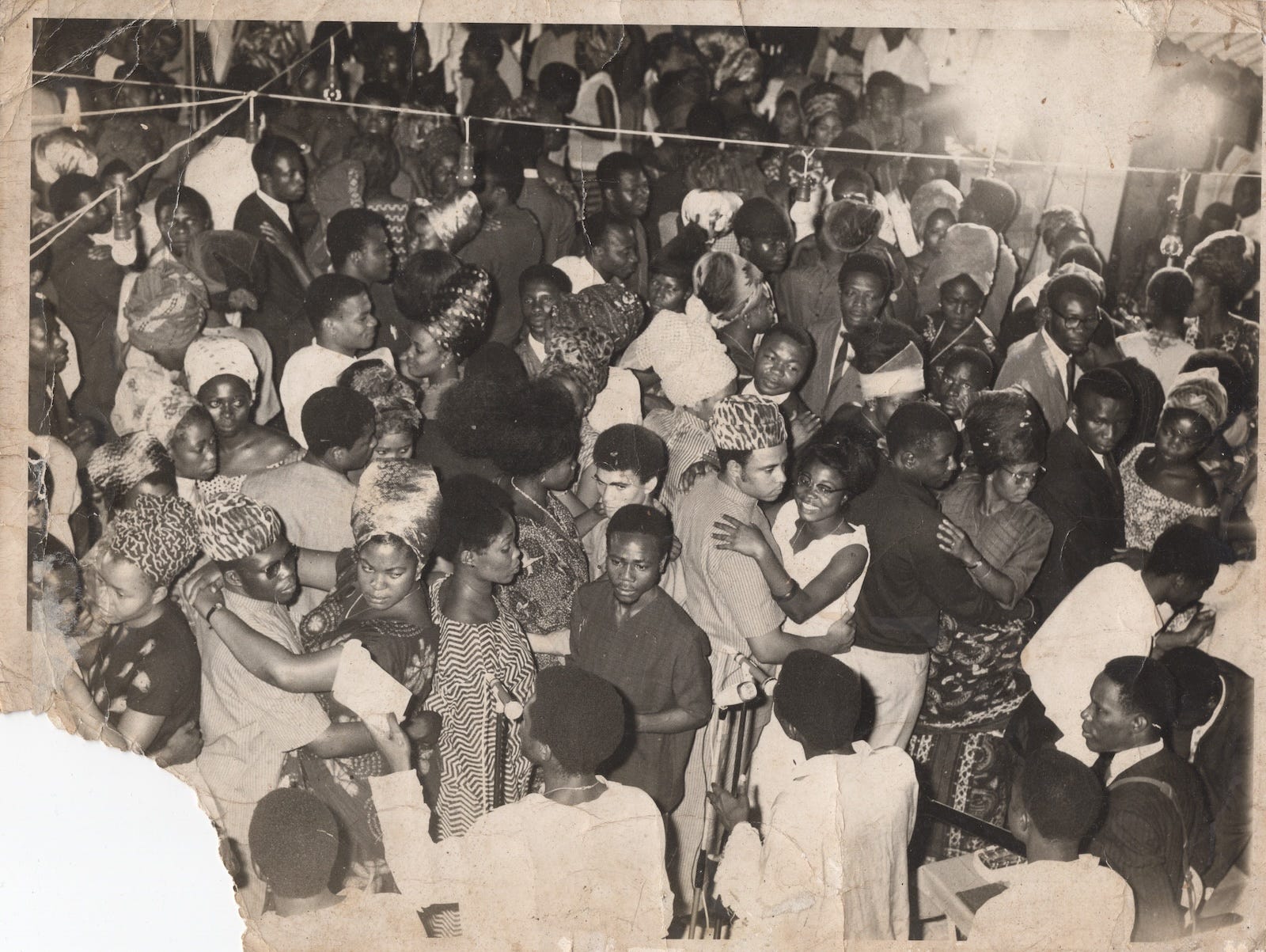
By the time of the Round Table, Nico had been playing professionally since his early teens and had already helped to establish the electric guitar in Congolese rumba, a hybrid form that emerged in the 1940s and 1950s and became one of the dominant styles of popular music in Africa. His deep connection to the instrument was anchored in this music and its exhilarating synthesis of African and Latin American rhythms. The Afro-Cuban son music that had such a central part in the development of Congolese rumba had itself evolved from the musical practices of central Africa, brought over to the Caribbean during the Atlantic slave trade. In the first half of the twentieth century these sounds returned to the African continent on commercially recorded 78rpm records, influencing many emerging forms of popular music there in turn. These records’ son clave rhythms—and variants like cha-cha-cha, mambo, merengue, and pachanga—would become foundational to Congolese rumba.
The electric guitar, too, would eventually come to define the sound of the music (sometimes known as rumba lingala or, a bit later, soukous). And yet when the instrument was introduced to Congolese studios in 1953, it was still relatively young in the world. Eddie Durham and Charlie Christian were spearheading its use in American jazz bands by 1940, but it was only beginning to secure its place in popular music. In its early days in America it would become associated with the skill and theatrical showmanship of artists like T-Bone Walker and Chuck Berry, as well as with the burgeoning technical explorations of artisan studio practitioners like Les Paul and Chet Atkins. It had a spirit of novelty, accommodating the mindset of the improvising virtuoso and the inventor-mechanic in equal measure.
Nico, developing his style slightly later and on a different continent, blended these approaches as well as any of the instrument’s pioneers. He taught auto mechanics at a trade school in Léopoldville in the early 1960s, balancing the job with his music career, and his melodic gifts were clearly matched by an extensive technical mastery and a sense of wonder at the power of the machine. He was always tinkering with amps, vibrato effects, and tape delay, dialing in the perfect tone or making the guitar mimic another instrument. On “Bougie Ya Motema,” a mixture of tape delay and palm muting simulates a likembe (a type of Congolese mbira or thumb piano). On records like “Merengue Scoubidou” he may have used a German guitar with a feature called “Orgletone,” a volume swell knob controlled with the pinky of your strumming hand. He has such facility with the effect that it sounds a bit like he is playing a merengue accordion through a tremolo amp—or as if Pops Staples is playing with Johnny Ventura.
Nico, however, said that he could play without these effects and still achieve the same sounds. “I don’t need an echo, but if I have an echo, that’s great,” he told the historian Gary Stewart in 1985. He said that Django Reinhardt was his favorite musician, and he distinguished himself from players like Les Paul (whom he seems to have called by his wife’s name): “Mary Ford, he played the guitar very well. But his guitar was rigged.” He spoke of the guitar as full of “secrets”—secrets that in his early days he alone had to discover. He even claimed that Europeans had devised amplifier effects based on techniques he had first introduced with his fingers.
But it was in Africa that his music would prove most influential. Generations of players have traced their styles directly back to Nico, who toured extensively in West and East Africa and whose records were distributed across the continent. His playing left other musicians in awe; the legendary Cameroonian saxophonist Manu Dibango, an early bandmate of Nico’s, called him “the finest guitarist of the sixties in Africa.”1 His songs, and Congolese rumba generally, were eagerly adopted in other liberation struggles. Rwandans sang “Indépendance Cha Cha” on the streets in 1962 after achieving their own independence from Belgium, and the Angolan writer Jorge Macedo said that hearing Nico’s records “inflamed our nationalist spirit.”2
Nico was one of the quintessential musicians of African modernity, and one of the great visionaries of the electric guitar and its possibilities. But unlike other trailblazers of the instrument, his name is not engraved on Gibsons across the world, and his records have never been sent to outer space. Some of his music has long been unavailable or poorly transferred; Nico died in 1985, at forty-six, just as a rapidly growing market for “world music” was vaulting his contemporaries Franco Luambo and Tabu Ley Rochereau to prominence as torchbearers for Congolese rumba in the West. Scholarship on his life and music is limited in English to a handful of indispensable sources, most notably a small discography by Alastair Johnston and Stewart’s exhaustive narrative history of Congolese rumba.3 Two excellent new authorized compilations of his work, Roger Izeidi Presents Vita Matata with African Fiesta and Docteur Nico Presents African Fiesta Sukisa 1966–1974, both released by the Belgian reissue label Planet Ilunga, clear the path considerably for new listeners, bringing dozens of previously un-reissued tracks from the middle of his career to light.
Around the time of independence, listeners in the Congo seemed to immediately understand the importance of Nico’s sound. After hearing “Indépendance Cha Cha” in a bar in Léopoldville, one listener was overheard saying, “It’s Nico’s revolution.” But Nico’s relationship to political events of the time is still unsettled, and Nico himself remains something of an enigma. Tracking his life through the many recordings he made with his three primary bands from the mid-1950s to the mid-1970s—African Jazz, African Fiesta, and African Fiesta Sukisa—one senses the thrill of an artist attempting to radically expand African popular music, and the pain of someone on whom that attempt took a personal toll. His legacy lives chiefly in the sound of his instrument and its place in the music he pioneered, both of which seemed to allow a nation brutalized by colonial domination to access a richer and more joyous emotional life.
Read the full article on the Review’s website here.
🔥🫡