


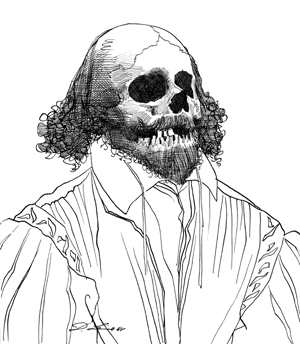
It’s Oscar night in America. For the ninety-eighth year in a row, the silver screen’s shiniest stars are assembling in the city of angels to celebrate the year in cinema.
Among the most-nominated films this year is Chloe Zhao’s adaptation of Maggie O’Farrell’s 2020 novel Hamnet, which tells the story of the death of Shakespeare’s son and the subsequent writing of Hamlet. In the Review’s October 21, 2004, issue, Stephen Greenblatt took on the historical facts of the Shakespeare family’s tragedy, endeavoring “to trace Hamlet back to a personal experience of grief and to sketch a long-term aesthetic strategy that seems to have emerged from this experience.”
Alongside Greenblatt’s history, we’ve collected five essays from the last year about some of tonight’s nominees: Nawal Arjini on Marty Supreme, Jonathan Lethem on One Battle After Another, Beatrice Loayza on The Secret Agent, Kevin Power on KPop Demon Hunters, and Miranda Seymour on Frankenstein.
1.
Shakespeare was in the business, all of his life, of probing the passions of his characters and arousing the passions of his audiences. His skill in doing so is almost universally acknowledged to have been unrivaled, but the inner sources of this skill remain largely unknown. Scholarship has tirelessly reconstructed at least something of his wide-ranging, eclectic reading, but his own passionate life—his access through personal experience and observation to the intense emotions he represents—is almost completely mysterious. None of his letters, working notes, diaries, or manuscripts (with the possible exception of “Hand D” in Sir Thomas More) survives. His sonnets have been ransacked for autobiographical evidence, but, though written in the first person, they are baffling, elusive, and probably deliberately opaque.
Over centuries of feverish speculation, the most compelling reflections on the presence of Shakespeare’s emotional life in his plays—preeminently, James Joyce’s brilliant pages in Ulysses, but there are many others—have focused on Hamlet. This biographical attention to a work deriving from recycled materials and written for the public stage would seem inherently implausible, were it not for the overwhelming impression on readers and spectators alike that the play must have emerged in an unusually direct way from the playwright’s inner life, indeed that at moments the playwright was barely in control of his materials. I will attempt in what follows to trace Hamlet back to a personal experience of grief and to sketch a long-term aesthetic strategy that seems to have emerged from this experience.
Sometime in the spring or summer of 1596 Shakespeare must have received word that his only son Hamnet, eleven years old, was ill. Whether in London or on tour with his company he would at best have only been able to receive news intermittently from his family in Stratford, but at some point in the summer he presumably learned that Hamnet’s condition had worsened and that it was necessary to drop everything and hurry home. By the time the father reached Stratford the boy—whom, apart from brief visits, Shakespeare had in effect abandoned in his infancy—may already have died. On August 11, 1596, Hamnet was buried at Holy Trinity Church: the clerk duly noted in the burial register, “Hamnet filius William Shakspere.”
Unlike Ben Jonson and others who wrote grief-stricken poems about the loss of beloved children, Shakespeare published no elegies and left no direct record of his paternal feelings. It is sometimes said that parents in Shakespeare’s time could not afford to invest too much love and hope in any one child. One out of three children died by the age of ten, and overall mortality rates were by our standards exceedingly high. Death was a familiar spectacle; it took place at home, not out of sight. When Shakespeare was fourteen, his seven-year-old sister Anne died, and there must have been many other occasions for him to witness the death of children.
In the four years following Hamnet’s death, the playwright, as many have pointed out, wrote some of his sunniest comedies: The Merry Wives of Windsor, Much Ado About Nothing, As You Like It. This fact is, for some, decisive evidence that the father’s grief must at most have been brief. But the plays of these years were by no means uniformly cheerful, and at moments they seem to reflect an experience of deep personal loss. In King John, probably written in 1596 just after the boy was laid to rest, Shakespeare depicted a mother so frantic at the loss of her son that she is driven to thoughts of suicide. Observing her, a clerical bystander remarks that she is mad, but she insists that she is perfectly sane: “I am not mad; I would to God I were!” Reason, she says, and not madness, has put the thoughts of suicide in her head, for it is her reason that tenaciously keeps hold of the image of her child. When she is accused of perversely insisting on her grief, she replies with an eloquent simplicity that breaks free from the tangled plot:
Grief fills the room up of my absent child,
Lies in his bed, walks up and down with me,
Puts on his pretty looks, repeats his words,
Remembers me of all his gracious parts,
Stuffs out his vacant garments with his form.
(III.4.93–97)
If there is no secure link between these lines and the death of Ham-net, there is, at the very least, no reason to think that Shakespeare simply buried his son and moved on unscathed. He might have brooded inwardly and obsessively, even as he was making audiences laugh at Falstaff in love or at the wit contests of Beatrice and Benedick.[^1] Nor is it implausible that it took years for the trauma of his son’s death fully to erupt in Shakespeare’s work or that it was triggered by an accidental conjunction of names. For Hamnet and Hamlet are in fact the same name, entirely interchangeable in Stratford records in the late sixteenth and early seventeenth centuries. Shakespeare evidently named his son after his recusant neighbor and friend Hamnet Sadler, who was still alive in March 1616 when Shakespeare drew up his will and left 26 shillings, 8 pence to “Hamlett Sadler...to buy him a ringe.”
Writing a play about Hamlet, in or around 1600, may not have been Shakespeare’s own idea. At least one play, now lost, about the Danish prince who avenges his father’s murder had already been performed on the English stage, successfully enough to be casually alluded to by contemporary writers, as if everyone had seen it or at least knew about it. Someone in the Lord Chamberlain’s Men, with an eye on revenues, may simply have suggested to Shakespeare that the time might be ripe for a new, improved version of the Hamlet story. For that matter, with his high stakes in the company’s profits, Shakespeare was sin- gularly alert to whatever attracted London crowds, and he had by now long experience of dusting off old plays and making them startlingly new. The likely author of the early play, Thomas Kyd, was no obstacle: he had died back in 1594, at the age of thirty-six, possibly broken by the torture inflicted upon him when he was interrogated about the charges of blasphemy and atheism brought against his roommate, Christopher Marlowe. In any case, neither Shakespeare nor his contemporaries were squeamish about stealing from each other.
Shakespeare had certainly seen the earlier Hamlet play, probably on multiple occasions. When he set to work on his new tragedy, he likely had it by heart—or as much of it as he chose to remember. It is impossible to determine, in this case, whether he sat down with books open before him—as he clearly did, for example, in writing Antony and Cleopatra—or relied on his memory, but he had also certainly read one and probably more than one version of the old Danish tale of murder and revenge. At the very least, to judge from the play he wrote, he carefully read the story as narrated in French by François de Belleforest, whose collection of tragic tales was a publishing phenomenon in the late sixteenth century. Belleforest had taken the Hamlet story from a chronicle of Denmark compiled in Latin in the late twelfth century by a Dane known as Saxo the Grammarian. And Saxo in turn was recycling written and oral legends that reached back for centuries before him. Here then, as so often throughout his career, Shakespeare was working with known materials—a well-established story, a familiar cast of characters, a set of predictable excitements.
If Shakespeare had died in 1600 it would have been difficult to think that anything was missing from his achievement and still more difficult to think that anything yet unrealized was brewing in his work. But Hamlet makes it clear that Shakespeare had been quietly, steadily developing a special technical skill. This development may have been entirely deliberate, the consequence of a clear, ongoing professional design, or it may have been more haphazard and opportunistic. The achievement was, in any case, gradual: not a sudden, once-and-for-all discovery or a grandiose invention, but the subtle refinement of a particular set of representational techniques. By the turn of the century Shakespeare was poised to make an epochal breakthrough. He had perfected the means to represent inwardness.
The task of conveying an inner life is an immensely challenging one in drama, since what the audience sees and hears is always in some sense or other public utterance—the words that the characters say to one another or, in occasional asides and soliloquies, directly to the onlookers. Playwrights can pretend, of course, that the audience is overhearing a kind of internal monologue, but it is difficult to keep such monologues from sounding “stagey.” Richard III, written in 1591 or 1592, is hugely energetic and powerful, with a marvelous, unforgettable main character, but when that character, alone at night, reveals what is going on inside him, he sounds oddly wooden and artificial:
It is now dead midnight.
Cold fearful drops stand on my trembling flesh.
What do I fear? Myself? There’s none else by.
Richard loves Richard; that is, I am I.
Is there a murderer here? No. Yes. I am.
Then fly! What, from myself? Great reason. Why?
Lest I revenge? Myself upon myself?
Alack, I love myself. Wherefore? For any good
That I myself have done unto myself?
O no, alas, I rather hate myself
For hateful deeds committed by myself.
I am a villain. Yet I lie: I am not.
(V.5.134–145)
Shakespeare is dramatizing his chronicle source, which states that Richard could not sleep on the eve of his death, because he felt unwonted pricks of conscience. But though it has a staccato vigor, the soliloquy, as a way of sketching inner conflict, is schematic and mechanical, as if within the character on stage there was simply another tiny stage on which puppets were performing a Punch-and-Judy show.
In Richard II, written some three years later, there is a comparable moment that marks Shakespeare’s burgeoning skills. Deposed and imprisoned by his cousin Bolingbroke, the ruined king, shortly before his murder, looks within himself:
I have been studying how I may compare
This prison where I live unto the world;
And for because the world is populous,
And here is not a creature but myself,
I cannot do it. Yet I’ll hammer it out.
My brain I’ll prove the female to my soul,
My soul the father, and these two beget
A generation of still-breeding thoughts.
(V.5.1–7)
Much of the difference between the two passages has to do with the very different characters: the one a murderous tyrant full of manic energy, the other a spoiled, narcissistic, self-destructive poet. But the turn from one character to the other is itself significant: it signals Shakespeare’s growing interest in the hidden processes of interiority. Locked in a windowless room, Richard II watches himself think, struggling to forge a metaphoric link between his prison and the world, reaching a dead end, and then forcing his imagination to renew the effort: “Yet I’ll hammer it out.” The world, crowded with people, is not, as he himself recognizes, remotely comparable to the solitude of his prison cell, but Richard wills himself to generate—out of what he pictures as the intercourse of his brain and soul—an imaginary populace. What he hammers out is a kind of inner theater, akin to that already found in Richard III’s soliloquy, but with a vastly increased complexity, subtlety, and above all self-consciousness. Now the character himself is fully aware that he has constructed such a theater, and he teases out the bleak implications of the imaginary world he has struggled to create:
Thus play I in one person many people,
And none contented. Sometimes am I king;
Then treason makes me wish myself a beggar,
And so I am. Then crushing penury
Persuades me I was better when a king,
Then am I kinged again, and by and by
Think that I am unkinged by Bolingbroke,
And straight am nothing. But whate’er I be,
Nor I, nor any man that but man is,
With nothing shall be pleased till he be eased
With being nothing.
(V.5.31–41)
Richard II characteristically rehearses the drama of his fall from kingship as a fall into nothingness and then fashions his experience of lost identity—“whate’er I be”—into an intricate poem of despair.
Written in 1595, Richard II marked a major advance in the playwright’s ability to represent inwardness, but Julius Caesar, written four years later, shows that, not content with what he has mastered, Shakespeare subtly experimented with new techniques. Alone, pacing in his orchard in the middle of night, Brutus begins to speak:
It must be by his death. And for my part
I know no personal cause to spurn at him,
But for the general. He would be crowned.
How that might change his nature, there’s the question.
It is the bright day that brings forth the adder,
And that craves wary walking. Crown him: that!
(II.1.10–15)
This soliloquy is far less fluid, less an elegant and self-conscious poetic meditation, than the prison soliloquy of Richard II. But it has something startlingly new: the unmistakable marks of actual thinking. Richard speaks of hammering it out, but the words he utters are already highly polished. Brutus’s words by contrast seem to flow immediately from the still inchoate toing-and-froing of his wavering mind, as he grapples with a set of momentous questions: How should he respond to the crowd’s desire to crown the ambitious Caesar? How can he balance his own personal friendship with Caesar against what he construes to be the general good? How might Caesar, who has thus far served that general good, change his nature and turn dangerous if he is crowned? “It must be by his death”: without prelude, the audience is launched into the midst of Brutus’s obsessive brooding. It is impossible to know if he is weighing a proposition, trying out a decision, reiterating words that someone else has spoken. He does not need to mention whose death he is contemplating, nor does he need to make clear—for it is already part of his thought—that it will be by assassination.
Brutus is speaking to himself, and his words have the peculiar shorthand of the brain at work. “Crown him: that!”—the exclamation is barely comprehensible, except as a burst of passionate anger provoked by a phantasmatic image passing at that instant through the speaker’s mind. The spectators are pulled in eerily close, watching firsthand the forming of a fatal resolution—a determination to assassinate Caesar—that will change the world. A few moments later Brutus, intensely self-aware, describes for himself the molten state of consciousness in which he finds himself:
Between the acting of a dreadful thing
And the first motion, all the interim is
Like a phantasma or a hideous dream.
The genius and the mortal instruments
Are then in counsel, and the state of man,
Like to a little kingdom, suffers then
The nature of an insurrection.
(II.1.63–69)
Was it at this moment, in 1599, that Shakespeare first conceived of the possibility of writing about a character suspended, for virtually the whole length of a play, in this strange interim? Brutus himself is not such a character: by the middle of Julius Caesar, he has done the dreadful thing, the killing of his mentor and friend—possibly his own father—and the remainder of the play teases out the fatal consequences of his act.
If Shakespeare did not grasp it at once, then certainly by the following year he understood perfectly that there was a character, already popular on the Elizabethan stage, whose life he could depict as one long phantasm or hideous dream. That character, the prince of the inward insurrection, was Hamlet.
2.
Even in its earliest-known medieval telling, Hamlet’s saga was the story of the long interval between the first motion—the initial impulse or design—and the acting of the dreadful thing. In Saxo the Grammarian’s account, the murder of Amleth’s father Horwendil (the equivalent of Shakespeare’s old King Hamlet) by his envious brother Feng (the equivalent of Claudius) was not a secret. Glossing over “fratricide with a show of righteousness,” the assassin claimed that Horwendil had been cruelly abusing his gentle wife Gerutha. In reality, the ruthless Feng had simply seized both his brother’s kingdom and his wife. No one was prepared to challenge the usurper. The only potential challenger was Horwen- dil’s young son Amleth, for by the time-honored code of this pre-Christian society a son was strictly obliged to avenge his father’s murder.
Feng understood this code as well as anyone, so that it was reasonable to expect that he would quickly move to eliminate the future threat. If the boy did not instantly come up with a clever stratagem, his life would be exceedingly brief. In order to grow to adulthood—to survive long enough to be able to exact revenge—Amleth feigned madness, persuading his uncle that he could never pose a danger. Filthy and lethargic, he sat by the fire, aimlessly whittling away at small sticks and turning them into barbed hooks. Though the wary Feng repeatedly used intermediaries (the precursors of Shakespeare’s Ophelia, Rosencrantz, and Guildenstern) to try to discern some hidden sparks of intelligence behind his nephew’s apparent idiocy, Amleth cunningly avoided detection. He bided his time, slipped out of traps, and made secret plans. Mocked as a fool, treated with contempt and derision, he eventually succeeded in burning to death Feng’s entire retinue and in running his uncle through with a sword. He summoned an assembly of nobles, explained why he had done what he had done, and was enthusiastically acclaimed as the new king. “Many could have been seen marvelling how he had concealed so subtle a plan over so long a space of time.”
Amleth thus spends years in the interim state that Brutus can barely endure for a few days. Shakespeare had developed the means to represent the psychological experience of such a condition—something that neither Saxo nor his followers even dreamed of being able to do. He saw that the Hamlet story, ripe for revision, would enable him to make a play about what it is like to live inwardly in the queasy interval between a murderous design and its fulfillment. The problem, however, is that the theater is not particularly tolerant of long gestation periods: to represent the child Hamlet feigning idiocy for years in order to reach the age in which he could act would be exceedingly difficult to render dramatically exciting. The obvious solution, probably already reached in the lost play, is to start the action at the point in which Hamlet has come of age and is ready to undertake his act of revenge.
In Saxo the Grammarian’s Hamlet, as in the popular tale by Belleforest, no ghost appeared. There was no need for a ghost, for the murder was public knowledge, as was the son’s obligation to take revenge. But when he set out to write his version of the Hamlet story, either following Kyd’s lead or on his own, Shakespeare made the murder a secret. Everyone in Denmark believes that old Hamlet was fatally stung by a serpent. The ghost appears in order to tell the terrible truth: “The serpent that did sting thy father’s life/Now wears his crown” (I.5.39–40).
Shakespeare’s play begins just before the ghost reveals the murder to Hamlet and ends just after Hamlet exacts his revenge. Hence the decisive changes in the plot—from a public killing known to everyone to a secret murder revealed to Hamlet alone by the ghost of the murdered man—enabled the playwright to focus almost the entire tragedy on the consciousness of the hero suspended between his “first motion” and “the acting of a dreadful thing.” But something in the plot has to account for this suspension. After all, Hamlet is no longer, in this revised version, a child who needs to play for time, and the murderer has no reason to suspect that Hamlet has or can ever acquire any inkling of his crime. Far from keeping his distance from his nephew (or setting subtle tests for him), Claudius refuses to let Hamlet return to university, genially calls him “our chiefest courtier, cousin, and son,” and declares that he is next in succession to the throne. Once the ghost of his father has disclosed the actual cause of death—“Murder most foul, as in the best it is,/But this most foul, strange, and unnatural”—Hamlet, who has full access to the unguarded Claudius, is in the perfect position to act immediately. And such instantaneous response is precisely what Hamlet himself anticipates:
Haste, haste me to know it, that with wings as swift
As meditation or the thought of love
May sweep to my revenge.
(I.5.29–31)
The play should be over then by the end of the first act. But Hamlet emphatically does not sweep to his revenge. As soon as the ghost vanishes, he tells the sentries and his friend Horatio that he intends “to put an antic disposition on”—that is, to pretend to be mad. The behavior made perfect sense in the old version of the story, where it was a ruse to deflect suspicion and to buy time. The emblem of that time, and the proof of the avenger’s brilliant, long-term planning, were the wooden hooks that the boy Amleth, apparently deranged, endlessly whittled away on with his little knife. These were the means that, at the tale’s climax, Amleth used to secure a net over the sleeping courtiers, before he set the hall on fire. What had looked like mindless distraction turned out to be brilliantly strategic. But in Shakespeare Hamlet’s feigned madness is no longer coherently tactical. Shakespeare in effect wrecked the powerful and coherent plot that his sources conveniently provided him. And out of the wreckage he constructed what most modern audiences would regard as the best play that he had ever written.
Far from offering a cover, the antic disposition leads the murderer to set close watch upon Hamlet, to turn to his counselor Polonius for advice, to discuss the problem with Gertrude, to observe Ophelia carefully, to send for Rosencrantz and Guildenstern to spy upon their friend. Instead of leading the court to ignore him, Hamlet’s madness becomes the object of everyone’s endless speculation. And, strangely enough, the speculation sweeps Hamlet along with it: “I have of late—but wherefore I know not—lost all my mirth.” “But wherefore I know not”—Hamlet, entirely aware that he is speaking to court spies, does not breathe a word of his father’s ghost, but then it is not at all clear that the ghost is actually responsible for his profound depression. Already in the first scene in which he appears, before he has encountered the ghost, he is voicing to himself, as the innermost secret of his heart, virtually the identical disillusionment he discloses to the oily Rosencrantz and Guildenstern:
O God, O God,
How weary, stale, flat, and unprofitable
Seem to me all the uses of this world!
Fie on’t, ah fie, fie! ‘Tis an unweeded garden
That grows to seed; things rank and gross in nature
Possess it merely.
(I.2.132–127)
His father’s death and his mother’s hasty remarriage, public events and not secret revelations, have driven him to thoughts of “self-slaughter.”
By excising the strategic rationale for Hamlet’s madness, Shakespeare made it the central focus of the entire tragedy. The play’s key moment of psychological revelation—the moment that virtually everyone remembers—is not the hero’s plotting of revenge, not even his repeated, passionate self-reproach for inaction, but rather his contemplation of suicide: “To be or not to be; that is the question.” This suicidal urge has nothing to do with the ghost—indeed Hamlet has so far forgotten the apparition as to speak of death as “The undiscovered country from whose bourn/No traveller returns”—but rather with a soul-sickness brought on by one of the “thousand natural shocks/That flesh is heir to.”
Read the full article for free on the Review’s website here.

loved it: https://annakeating.substack.com/p/hamnet-femininity-and-saving-the?r=7wggg&utm_medium=ios
I, too am appreciative of this deep dive. You brought me closer to experiencing Shakespeare as a man bent on wanting acclaim through entertainment, but also, you spun the life and times of the people around him, which brought him to life. Thank you!