

Revenge of the Count
Michael Dirda on ‘The Count of Monte Cristo’

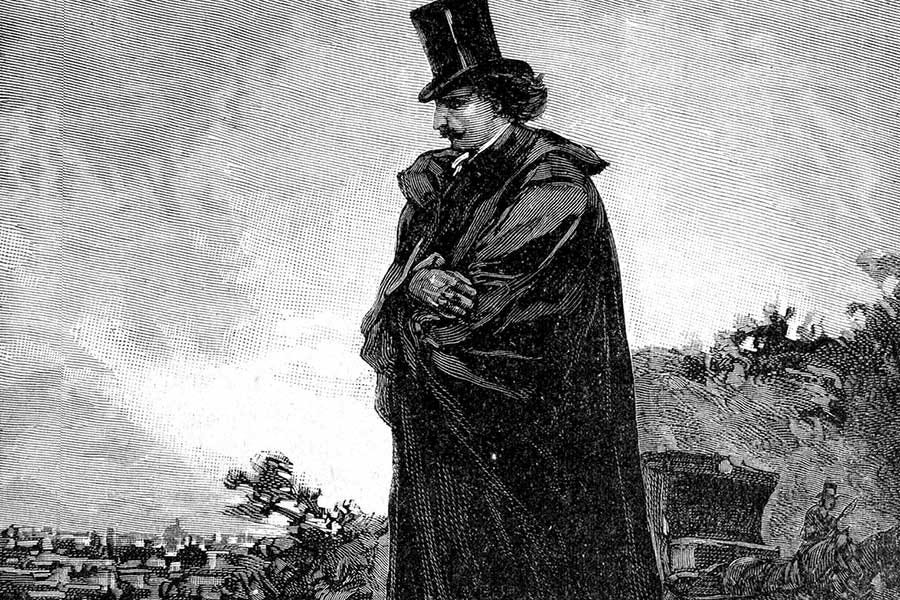
In the Review’s April 9 issue, on the occasion of the eight-episode PBS adaptation, Michael Dirda revisits Alexandre Dumas’s The Count of Monte Cristo, “simply the classic novel of revenge”:
The Hound of the Baskervilles might have been more spookily atmospheric, Journey to the Center of the Earth more wondrous, and King Solomon’s Mines even more adventure-packed, but The Count of Monte Cristo offered an overweight, near-sighted kid from a working-class family something irresistible: the possibility of reinvention. If, against all odds, Edmond Dantès could remake himself, so could I.
Dumas, who “lived intensely and on a grand scale,” had a genius for “transmuting dry historical records into vibrant page-turners.” In the Mémoires tirés des archives de la police de Paris of 1838, he found an ideal historical record—“about an unjustly imprisoned shoemaker”—for a vibrant 1,243-page novel of “incarceration, escape, and revenge.”
Below, alongside Dirda’s essay, are five articles from our archives about Dumas and the French Romantics.
Dantès’s Inferno
Michael Dirda
More than half a century ago, on a sunny and breezy afternoon, I took the excursion boat from the Vieux Port in Marseille out to the small island that serves as the bare and rocky home of the forbidding Château d’If. I remember marveling that I should be about to visit the prison where Edmond Dantès had been incarcerated for fourteen years before seizing a dangerous opportunity to escape, wrapped in a sack as a dead man, then cast into the waters of the Mediterranean. To be certain that the body would never rise to the surface, guards attached a heavy cannonball to the sack. But as all the world knows, Edmond Dantès did rise again, transformed from an innocent young sailor into that courtly yet implacable avenger, the Count of Monte Cristo.
For most readers Alexandre Dumas’s The Count of Monte Cristo is simply the classic novel of revenge. For me, however, it was an inspirational self-help manual. At the age of ten or eleven, I’d read a highly abridged children’s edition, a Golden Picture Classic priced at 50 cents. Though little more than a précis of the actual book, this oversized paperback, printed on the pulpiest of papers, marked a watershed in my young life. The Hound of the Baskervilles might have been more spookily atmospheric, Journey to the Center of the Earth more wondrous, and King Solomon’s Mines even more adventure-packed, but The Count of Monte Cristo offered an overweight, near-sighted kid from a working-class family something irresistible: the possibility of reinvention. If, against all odds, Edmond Dantès could remake himself, so could I.
The book’s opening chapters might be summed up by inserting its hero’s name into the first sentence of Kafka’s The Trial: “Someone must have been telling lies about Edmond Dantès, for one morning, without having done anything wrong, he was arrested.” The year is 1815 and Dantès, a guileless nineteen-year-old sailor from Marseille, is about to marry his sweetheart, Mercédes, when he is suddenly plucked from his wedding feast, accused of being a spy for Napoleon, and, without explanation, sentenced to life in solitary confinement in the Château d’If. Following six years of vainly protesting his innocence, Dantès resolves to starve himself to death. But after refusing to eat for several days, the would-be suicide detects a scratching inside his dungeon wall. An elderly prisoner named the Abbé Faria, hoping to burrow through the bricks and mortar to the outside, has miscalculated and tunneled into the adjoining cell.
During the next eight years, the two prisoners work together on another escape tunnel while the learned cleric teaches his new disciple ancient and modern languages, history, and the social graces. It was this section of the novel that most captured my imagination, as it does for many others. So potent is this notion of reinvention through learning that it’s become one of storytelling’s favorite tropes, underlying such differing later works as The Great Gatsby; Bernard Shaw’s play Pygmalion and its musical recreation, My Fair Lady; and the 1998 film The Mask of Zorro.
In the novel’s unabridged translation by Robin Buss, the Abbé Faria tells his pupil that he long ago whittled down a collection of 5,000 volumes to the 150 works that truly mattered:
I devoted three years of my life to reading and rereading these hundred and fifty volumes, so that when I was arrested I knew them more or less by heart. In prison, with a slight effort of memory, I recalled them entirely. So I can recite to you Thucydides, Xenophon, Plutarch, Livy, Tacitus,...Dante, Montaigne, Shakespeare, Spinoza, Machiavelli and Bossuet; I mention only the most important.
Like a precursor to Mortimer J. Adler, the good abbé was a firm proponent of an education based on the “Great Books.” As for me, shortly after finishing my Golden Picture Classic version of Dumas’s novel, I started to sneak into the adult section of the library, beginning a lifelong effort to educate myself.
Like The Odyssey and Don Quixote, The Count of Monte Cristo is one of those books people think they know even if they’ve never read it, at least not in its entirety. Most of the commonly available translations in English are abridged. More often than not, we simply recall some children’s edition, or a worn Classics Illustrated comic, or one of the fifty or so film and television adaptations, ranging from a silent one-reeler in 1908 to this spring’s eight-episode Masterpiece series on PBS.
The original text, after all, is very long—Buss’s English version runs 1,243 pages of clear but fairly small type, making it almost twice the length of Dumas’s previous blockbuster, that boisterous and swashbuckling epic of eternal friendship, The Three Musketeers. Amazingly, both books, along with several others of comparable lengths, were published during the years 1844–1846, Dumas’s anni mirabiles.
Though focused on the relentless Edmond Dantès, The Count of Monte Cristo is at the same time a sprawling, digressive work, covering a quarter-century of French history, evoking the culture of three cities—Marseille, “white, warm, throbbing with life”; Rome, a labyrinth of romance and mystery; and Paris, a morass of duplicity and corruption—and featuring dozens of characters ranging from smugglers and brigands to international bankers and self-important aristocrats.
Above all, it is vastly entertaining. Yet if you read the unabridged novel today, it quickly grows clear why so much has been cut to make it suitable for the young or acceptable in a Hollywood film. As Buss writes in the introduction to his translation:
There are not many children’s books, even in our own time, that involve a female serial poisoner, two cases of infanticide, a stabbing and three suicides; an extended scene of torture and execution; drug-induced sexual fantasies, illegitimacy, transvestism and lesbianism; a display of the author’s classical learning, and his knowledge of modern European history, the customs and diets of the Italians, the effects of hashish, and so on.
That’s quite an inventory, yet the last phrase—“and so on”—isn’t just a rhetorical flourish. Dumas’s novel also includes rape, mercy killing, starvation to death, a beheading, a woman half incinerated by her foster son, a mute and paralyzed man who can only communicate through eye blinks, an enslaved Nubian who has had his tongue cut out, sudden-onset insanity, suggestions of an unhealthy attachment between two mothers and their sons, and the unknowing betrothal of a sister to her brother.
If some of these elements call to mind Jacobean tragedy or racy soap opera, that’s no coincidence. Born in 1802, Alexandre Dumas initially made his name—and the first of several fortunes—as a playwright, indeed one of the pioneers of romantic French drama. Only in the 1840s did he begin publishing fiction, most of which depended on his flair for both dialogue and breath-taking coups de théâtre. (In Dumas’s best-known play, Antony, the hero stabs his married mistress to death to protect her honor.) Yet just as Balzac aimed to portray every aspect of contemporary French society in his multivolume Comédie humaine, so Dumas loosely planned to chronicle all of French history between the Renaissance and the Napoleonic era. He came close. The once-standard Michel Lévy edition of his complete works comprises three hundred volumes, most of them novels about France’s past.
Dumas also managed to publish much besides historical fiction: travel books (about Switzerland, Russia, Spain), tales of the supernatural (The Wolf-Leader, Castle Eppstein, The Corsican Brothers), a garrulous, immensely long memoir of his youth, serious works of history and biography, and, posthumously, a huge dictionary of gastronomy.
Given such plenty, the prodigious author was often accused of operating a fiction factory and exploiting the work and talent of others. But as has been frequently pointed out, none of Dumas’s research assistants and coauthors—not even the best, Auguste Maquet, who worked with him on The Count of Monte Cristo and suggested the entire first section of the novel—ever achieved anything of note on their own. To a large extent, Dumas needed help because he simply lacked a creative imagination.
His particular genius lay in transmuting dry historical records into vibrant page-turners through his mastery of dialogue, pacing, and dramatic confrontation. Dumas would first talk over a book with an assistant, perhaps ask him to do some research and prepare an outline, then follow up with further discussion of the action and plot, this time in more detail. Only when he had settled the whole arc of the novel in his own mind did Dumas put pen to paper: as he once said, “As a rule I do not begin a book until it is finished.” He then wrote fast, a single draft on blue paper, never bothering about accents, commas, and punctuation, working long hours at a time. As Andrew Lang has said, Dumas’s “career was one of unparalleled production, punctuated by revolutions, voyages, exiles, and other intervals of repose.”
Generous to a fault, the lover of many women, and an inveterate punster, Dumas lived intensely and on a grand scale, but these days if people know anything about him, it’s that he was Black. His father, Thomas-Alexandre Dumas, was the child of an enslaved Haitian and a French aristocrat. A man of immense physical strength and charisma, Thomas-Alexandre rose through the ranks of the French army to become a much-admired general. Had he not fallen out with Napoleon, the emperor would have been the godfather of the novelist. Instead, as we are reminded by Tom Reiss in his Pulitzer Prize–winning biography, The Black Count (2012), the general—en route home from Napoleon’s Egyptian campaign in 1799—was arrested in Italy and incarcerated for nearly two years in a dungeon-like prison. Reiss and others believe that Dumas partly drew on Thomas-Alexandre’s experiences in depicting Edmond Dantès’s suffering and despair in the Château d’If.
Read the full article on the Review’s website here.
From the Archives: The French Romantics
Peter Brooks on Alexandre Dumas
Graham Robb on cavaliers and musketeers
Richard Holmes on Théophile Gautier
Simon Leys on the colossal legacy of Victor Hugo
V.S. Pritchett on the spell of George Sand

Miss Ada Doom’s Reviews From the Woodshed: Alexandre Dumas’s The Count of Monte Cristo: a prison education is the best you can get, apparently. Revenge bad, but for a long time before that, good. Money talks, if you’re sitting on a treasure trove or your editor is paying you by the word. Wait and hope, wait and hope - but first a little compound vengeance. All terribly stirring. Three and a half out of four cows.