


Alan Alexander Milne was born 144 years ago today. In the Review’s September 20, 1990, issue, Janet Adam Smith wrote about Milne, his halcyon childhood, his mathematical acumen, his work for Granta and Punch, his stifled literary ambitions, and, naturally, his most famous creations—Pooh, Eeyore, Christopher Robin the character, and Christopher Robin Milne the son.
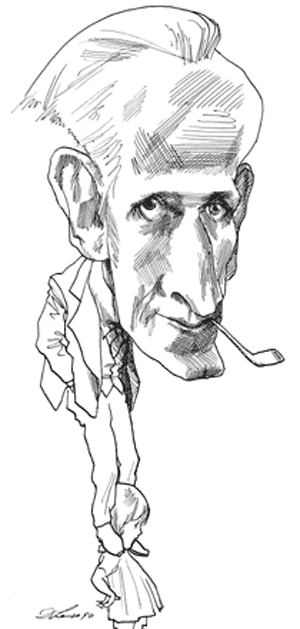
“It is ghastly to think of anyone who wrote such gay stuff ending his life like this,” wrote P. G. Wodehouse in 1954 on hearing that his old acquaintance A. A. Milne had been paralyzed by a stroke. Two years later Milne’s life did indeed end sadly: his only son estranged, his wife aloof, his novels mostly unread, his plays mostly unperformed, himself famous only for his books for children. He had become the man behind Winnie-the-Pooh.
It all began so brightly in 1892. “Everything we are is that way because that was how our parents made us,” he once told his son, and certainly Alan Milne felt he had been lucky in his. His father was headmaster of a small private school for boys in north London, with unusually progressive views for his time. He and his wife aimed to run the school like a happy family: the food was good, the discipline firm but kind, the teaching imaginative. A loutish twelve-year-old who was fascinated by the jelly-graph—a primitive reproducing machine—was set by the headmaster to produce a school magazine, the first step in the the career of Alfred Harmsworth, the future Lord Northcliffe. A young master was encouraged to take his class to examine the strata of Primrose Hill, to botanize on Northwood Common, to rear silkworms. This was H. G. Wells, who taught at Henley House for a few years in his twenties and greatly admired his headmaster: “The boys had confidence in him and in us and I never knew a better-mannered school.”
For Alan and his two older brothers home and school were under the same roof, and they passed easily from one to the other without the trauma felt by Graham Greene in his father’s school. In class, Mr. Wells made mathematics exciting: “We got to fractions, quadratics and problems involving quadratics in a twelve month.” At home there were readings of Alice, Uncle Remus, George Macdonald’s Golden Key, and on Sundays The Pilgrim’s Progress. Alan and Ken, his senior by sixteen months, enjoyed a freedom unimaginable to proper London children today. “We were allowed to go [on] walks by ourselves anywhere, in London or in the country”—and this before they were ten years old! They would get up early and bowl their hoops from Kilburn to the Bayswater Road, a good two miles, and back before breakfast. On holidays in Kent or Surrey they would be off on their bikes, chasing butterflies, exploring mysterious woods and ruined houses, imagining adventures on schooners and desert islands. One long-lasting fantasy was of waking up one morning and finding that everyone else in the world was dead—but there were still animals.
Alan, spotted by Wells as a promising mathematician, was soon outstripping Ken and Barry, who was three years older. Ken won a scholarship to Westminster School when he was twelve; Alan, always compelled “to prove myself the better man of the two,” had the same success next year when he was eleven. This was a pattern that continued: Alan leaping ahead of Ken in lessons and games, and sometimes feeling bad about it; Ken—“kinder, larger-hearted, more lovable, more tolerant, sweeter tempered”—apparently not resentful at being trumped by his younger brother. The two stayed very close: “Throughout his life I never lost Ken, nor he me.”
After the warmth of Henley House, Westminster was a comedown. Breakfasts—Alan’s favorite meal—were awful; washing was done in cold water; junior boys lived in fear of tanning by seniors; there was bad language and smutty talk (which Milne hated all his life). Though he made a brilliant start in mathematics, when an end-of-term report accused him of lacking ambition he stopped working hard and coasted along the rest of his school days. He played for Westminster at cricket and football, he read voraciously, and spent the long hours of weekend leisure—one amenity that Westminster offered—with Ken. They fooled about together, planned their next holiday enterprises, and wrote light verses which they submitted to various papers over the initials A. K. M. Alan’s mathematics remained good enough to win him a scholarship to Trinity College, Cambridge—and because he had been fascinated by a copy of the magazine Granta, Cambridge was where he wanted to be for other reasons than mathematics.
In the year above him at Trinity were Leonard Woolf, Clive Bell, and Lytton Strachey, all then—according to Woolf—“very serious young men.” In the Granta set, to which Milne quickly gravitated, it was bad form to be serious. The magazine was very different from the periodical that bears its name today. It aimed to be an undergraduate Punch: light verse à la Calverley, amusing prose trifles. Milne shone in both genres and one prose piece, “Jeremy, I and the jelly-fish,” caught the eye of Punch stalwart R. C. Lehmann: “a piece of sparkling and entirely frivolous and irresponsible irrelevance,” he called it, and invited the author to send in something to Punch.
Milne became editor of Granta (securing a contribution for a May Week number from the now famous H. G. Wells), and left Cambridge with a poor degree and an urge to try his hand as a journalist. Back in London he wrote Granta-type sketches and poems and fired them off at newspapers and weeklies. Wells was helpful with suggestions and introductions, Alfred Harmsworth was not. Milne began to appear regularly in Punch and in 1906, when he was twenty-four, he was invited to join the staff as assistant editor: in addition to his salary he would be paid for his contributions at double rates.
A staple of Punch humor was the everyday life of the middle classes. R. C. Lehmann’s son John, whose stamp collecting had been the subject of an article, felt that his father “used us all quite shamelessly.” Milne concocted his sketches from things that happened in his digs, on his London outings, on country weekends, or excursions with the now married Ken. Sometimes it was hard going: “I know no work manual or mental to equal the appalling heart-breaking anguish of fetching an idea from nowhere.” J. M. Barrie praised these Punch pieces for their “gaiety and irresponsibility,” and encouraged Milne to try his hand at a play.
By 1913 he was in a position to marry a vivacious young woman whom he proposed to on a ski slope in Switzerland in a snowstorm. She was Dorothy de Sélincourt, niece of the Wordsworth scholar Ernest de Sélincourt, and goddaughter of Punch editor Owen Seaman. Alan and Dorothy—now called Daphne, or Daff—settled in Chelsea, a bright young couple rather like the bright young couples of his Punch sketches. Daphne organized their apartment and made all the practical decisions while he wrote amusing pieces about their domestic doings. One reason for his choice of wife, Milne claimed, was that “she laughed at my jokes.”
Milne had been much impressed by The Great Illusion (1910), Norman Angell’s exposure of the futility of war, but in 1914 he agreed with Wells that Britain was fighting “a war that will end war.” Early in 1915 he was commissioned in the Warwickshire Regiment and in 1916 was in the thick of the battle of the Somme: a truly hideous experience but at least, as a signals officer, he was not required to kill. Invalided home with trench fever, he spent the rest of the war in staff jobs in England. He expect to go back to Punch when demobilized; but to Owen Seaman, who had take a rabidly patriotic line throughout the war, Milne was now “an unpatriotic Radical” whom he wouldn’t have back on the staff.
By this time Milne had an alternative to light verse and whimsical prose. During the war a comedy he had written some years before, Wurzel-Flummery, was produced at the New Theatre between two Barrie one-acters; a second play Belinda—“a purely artificial comedy whose only purpose was to amuse,” he described it—was staged in 1918; and with Mr. Pim Passes By in 1920 (the first play Peggy Ashcroft ever saw in a theater) Milne became famous and his income shot up. In the same year a further fortune came into his life with the birth of his son, registered as Christopher Robin, known to his parents as Billy Moon. (Leonard Moon, a brilliant Westminster cricketer, had been Milne’s schoolboy hero.) The verses the child occasioned—most of them first appearing in Punch with illustrations by Ernest Shepard—were collected in two volumes which had a wild success in Britain and America, the printers hardly able to keep up with the demand. In 1924 the Milnes bought a weekend and holiday house on the edge of Ashdown Forest in Sussex: the forest and his son’s toys came together to produce Winnie-the-Pooh. Again Shepard illustrated, and readers loved the pictures as much as the stories. (Recently three unpublished Pooh drawings were sold at Christies for almost £60,000.) Henceforth it was Pooh, Pooh, all the way: Milne the playwright, Milne the novelist, was eclipsed by Milne the creator of Pooh. No matter that after 1928 he wrote no more children’s books but went on publishing plays, novels, an autobiography: the label would stick for life.
In due course Christopher departed to boarding school…
Read the full article for free on the Review’s website here.
If you like our Substack, consider subscribing to our magazine by visiting nybooks.com/substack for a special discount on a full subscription.