


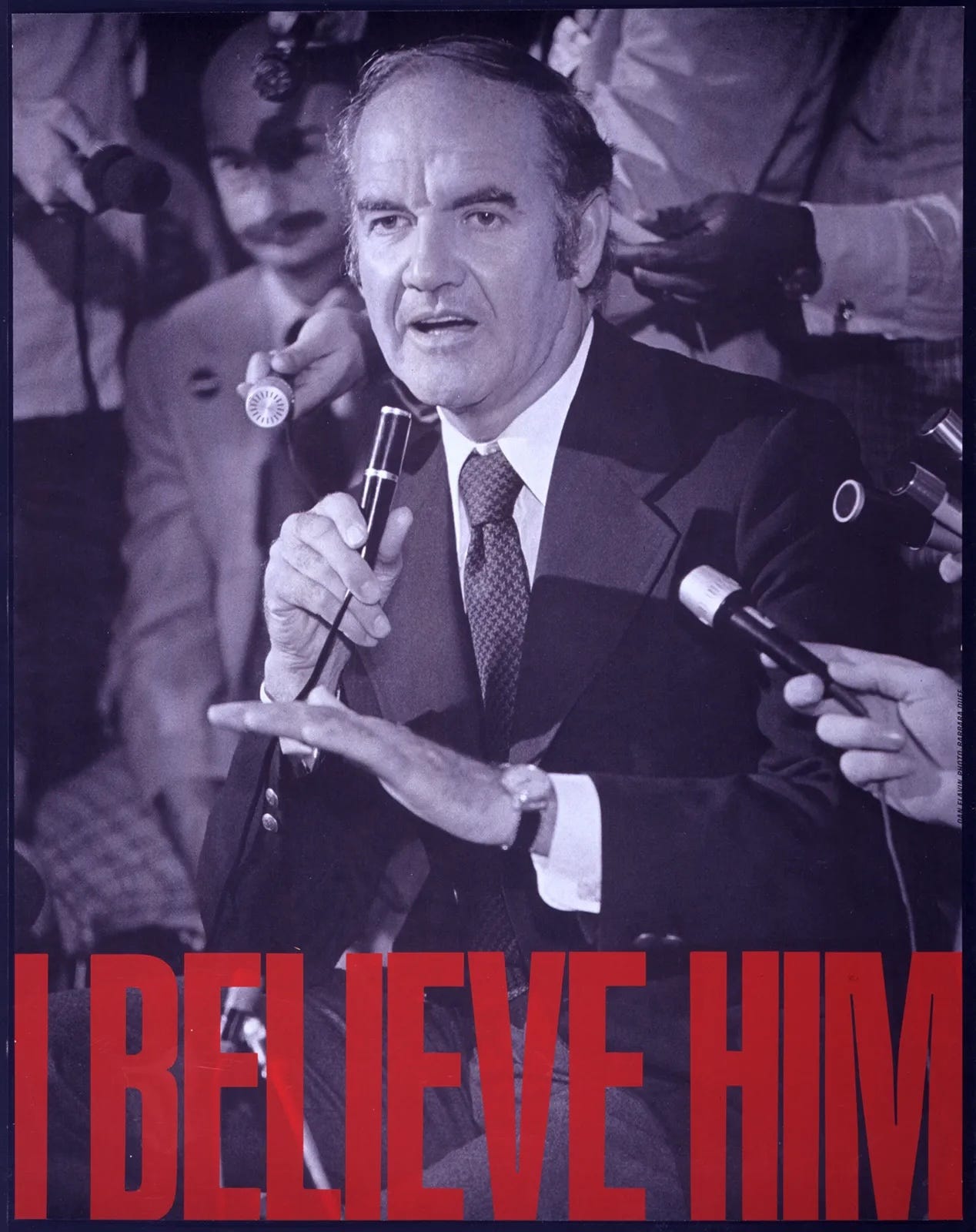
In the Review’s May 4, 1972, issue, shortly after nearly 75 million Americans filed their income taxes, then presidential candidate George McGovern published his campaign’s proposal for tax reform—an effort to make the American system of taxation “truly progressive.” As the economist Wassily Leontief wrote in his introduction to McGovern’s program, the federal tax code is “one of the most effective means of bringing about a distribution of income compatible with the prevailing standards of social justice.”
Tax Reform
The purpose of taxation
In the United States, taxes pay for those activities which we wish to have carried out by government rather than by the private sector. The costs are supposed to be carried by each income group paying its share and by those within each income group paying a similar amount. The progressive tax system asks those who are better off to bear a greater share of the load than those who have less ability to pay. In general, the progressive system is one of the most positive elements of our tax system.
Individual income taxes
Previous efforts at tax reform have failed to bring our system closer to a truly progressive one. Every effort at reform shows that the cloth of our tax codes is so worn that every patch rips another hole somewhere else. Even more importantly, efforts to promote fairness by giving everyone his own loophole are slowly dismantling the progressive federal income tax.
The actual tax system is just about half as progressive as it is supposed to be, according to the tax rates adopted by Congress. While nominal rates range from 0.1 percent at low incomes to 69.2 percent for those with incomes over $1 million per year, actual rates on average range from 0.7 percent to 34 percent.
Two taxpayers with the same annual income pay quite different taxes. A factory worker or a schoolteacher whose taxes are withheld from his wages cannot take advantage of loopholes. He may expect to pay almost $1,000 in taxes on earnings of $10,000. A wealthy person who receives $10,000 income from state and local bonds will pay no federal taxes at all. Clearly this system is unfair.
And these inequities are not theoretical. On the basis of 1969 tax returns, the last year for which figures are available, some 21,317 people earning more than $20,000 paid no federal taxes whatsoever. That includes fifty-six people with incomes in a single year of $1 million or more.
Because the effort to close one loophole at a time has been a failure and because to do so would still leave a great number of inequities until all were closed, we should shift to a really effective minimum tax. While a minimum tax was created in 1969 tax legislation, it is actually window dressing and is not effective. Recent reports indicate that some who earn over $1 million still pay no taxes.
I propose a minimum income tax so that the rich could not avoid their share of the tax burden no matter what loopholes they used. One possible formula would be a minimum income tax to apply to all those with total incomes in excess of $50,000. The entire income of any person in this range would be subject to payment of taxes at a rate of 75 percent of the current statutory rates at the rate that they would have to pay if there were no loopholes. All income regardless of source would be included. (Of course, if the computed tax exceeds the minimum tax, it would be payable.)
If this minimum income tax were now in effect it would bring in approximately $5 billion during the present fiscal year and $6 billion in fiscal 1973. That would amount to about a 7 percent increase in receipts from the individual income tax. This increase would be paid by the wealthiest 411,000 out of the 76 million federal taxpayers.
This basic tax reform would not unfairly penalize the wealthy just because they were well off. It would simply ensure that they could not dump their tax load onto the backs of already hard-pressed middle-income taxpayers.
Corporate taxes
The strength of the American economy is due mainly to the dynamic growth of the private sector led by corporations and other businesses. It is sound public policy to create the conditions for business to function effectively.
The federal tax system has been used to help the corporation. As Joseph Pechman, one of the leading tax experts in the United States, points out: “A special tax on the corporate form of doing business is considered appropriate because corporations enjoy special privileges and benefits.” In order to stimulate corporate economic activity, the federal government can and does alter tax rates. That is the principal form of assistance that has recently been given.
The present corporate tax rate is 48 percent of the taxable base defined by law. Of this, 22 percent is the normal tax which applies, without the 26 percent surtax, to the first $25,000 of corporate net income. This feature is of special benefit to small businesses—some 77 percent of the taxpaying corporations. It should be maintained.
In each postwar recession, demands have arisen to stimulate the economy through corporate tax reductions. These have taken the form not of overt tax reductions but of covert rate reductions in the form of increased depreciation allowances and special devices such as the investment tax credit. Such devices transfer profits from the taxable category to the untaxable category. In the process, the corporate income tax is gradually being abolished.
Because of steady reductions in the taxable base over the past twenty years, the effective corporation income tax rate has been cut in half. There is a real question about how much farther we can go.
The time has come to end the dismantling of the corporation income tax and to re-establish a fair balance between personal and corporate income tax collections. As a result, I have opposed the new depreciation guidelines and the investment tax credit. Special loopholes, such as percentage depletion, need not be phased out, but a broad balance also needs to be established between taxable and untaxable earnings of corporations. As it is, we have tipped that balance too far in the direction of untaxable earnings.
I propose that the actual corporation income tax be returned to its 1960 level by the elimination of the special loopholes that have been opened since then. (About two-thirds of the gap between the present level and the 1960 level results from Nixon Administration cuts in the last year.)
This reform of the corporation income tax would raise approximately $9 billion in the current fiscal year and about $17 billion in fiscal 1973 (based on Administration estimates of increased corporate activity).
This proposal for increasing the corporation income tax rate does not mean reduced government assistance to business. If the entire McGovern economic program were to be applied, there would be more stimulus to business than is available from the tax privileges now in effect. This program includes an immediate $10 billion fiscal stimulus to create new jobs and use underutilized capacity, economic conversion from a war to a peace economy with the extensive use of government contracting for specific purposes, and the Minimum Income Grant, discussed below, which would greatly stimulate consumer purchases. Nothing spurs profits like a strong full employment economy, which has the highest priority in my economic program.
In short, our corporations must be healthy and growing if our economy is to prosper. But we have a wider range of tools at our disposal than perpetual reductions in the corporation income tax.
Estate and gift taxation
Most Americans subscribe to a fundamental belief of our Founding Fathers that we should be allowed to keep a fair proportion of what we earn but should not be allowed to inherit great wealth. Yet, in practice, the loopholes in our gift and inheritance taxes are much greater than those in our income taxes. Just 9 percent of all families own 50 percent of all private assets. More than a quarter of all private assets are owned by less than I percent of the population. Although some of these fortunes are based on earned income, most are based on inherited wealth.
Estate and gift tax rates are high. But actual rates are a tiny fraction of the theoretical rates.
Estate and gift taxation should be reformed in the same manner as the income tax. Instead of proceeding to close loopholes one by one, a whole new system needs to be constructed.
Gift and inheritance taxes should shift from a tax on the estate or giver to a lifetime cumulative tax on the recipient. This shift would make it possible to prevent tax avoidance and would be more fair, because it would regard the money received as income to the recipient, which it is.
Read the rest for free on the Review’s website here.

Taxation is theft