Museumgoing
The Year in Art

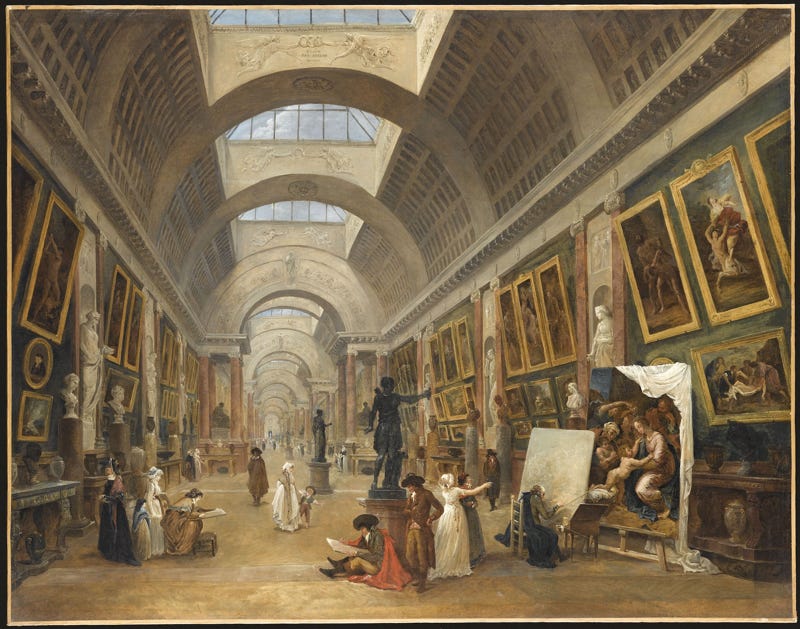
This year in New York City, after an extensive and at times controversial renovation, the Frick Collection returned to its original home, the Upper East Side Beaux-Arts mansion commissioned by the industrialist Henry Clay Frick for his family (and art). In our May 15, 2025, issue Martin Filler wrote about the redesigned Frick, noting that though the august permanent collection includes “artworks…esteemed for their exquisite quality and exceptional rarity, for many people the real thrill comes from viewing them amid the domestic trappings of a Gilded Age magnate. That voyeuristic impulse is considerably enhanced by the present refurbishment.”
Quality, rarity, and real thrills—what any visitor hopes to experience on a visit to a museum or gallery. In 2025 the Review’s writers visited exhibitions in New York and around the world, from Tacita Dean’s first US retrospective in Houston to a show at the Louvre dedicated to Watteau’s painting of Pierrot to the first art biennial in Tashkent, Uzbekistan.
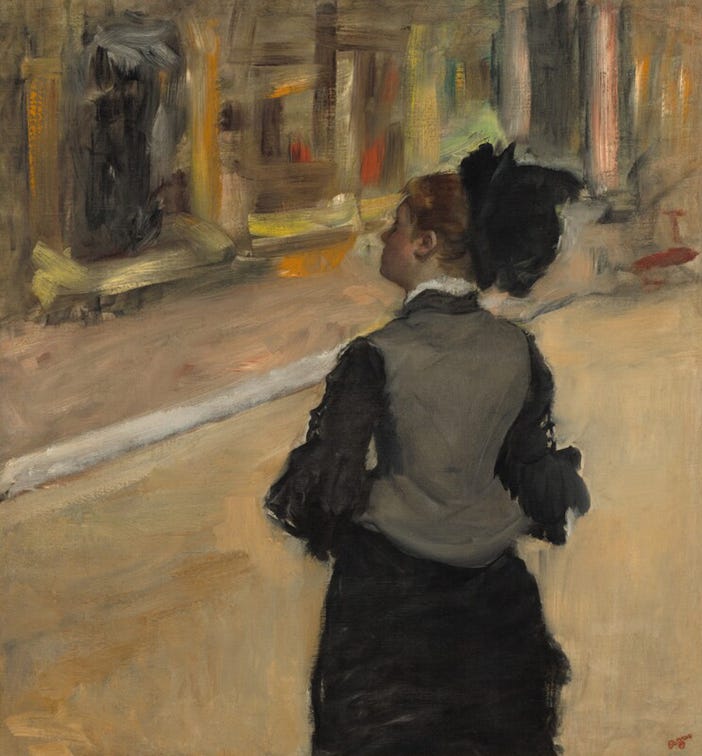
Our year in museums began in fourteenth-century Siena, which, Andrew Butterfield wrote in our February 13 issue, has long been treated by art historians as “little more than a charming backwater whose art was of secondary importance compared with that of Florence.” However, as demonstrated in “Siena: The Rise of Painting, 1300–1350,” at the Metropolitan Museum, in the Tuscan city “painters and sculptors engaged in a nonstop flurry of experimentation and innovation, changing almost all aspects of art, from the basic design of the altarpiece to the techniques of fresco and panel painting; perhaps most importantly, they nurtured a new emphasis on the naturalistic depiction of the world.” Two hundred years later and about two hundred miles north, in Verona, Paolo Veronese, “by every account a precocious learner, had already developed his own style…independently of what Titian and Tintoretto had been contriving in Venice,” wrote Ingrid Rowland in our August 21 issue. The Veronese show at the Prado in Madrid was, she noted, “epic in scale” yet still a showcase for his “elegant draftsmanship, precise detail, and limpid colors.”
In celebration of the semiquincentennial of the German painter Caspar David Friedrich’s birth, Michael Gorra visited exhibitions of his work in Hamburg and New York City. In Friedrich’s drawings and works on paper, Gorra wrote, he was “as fine and as imaginative a draftsman as anyone could wish,” while in his mountainous Romantic canvases, “look closely and you’ll see something marvelous.” Commemorating another milestone, Jed Perl went to “a lollapalooza of a show” at the Centre Pompidou in Paris dedicated to the centennial of Surrealism. “A movement that celebrates the dream, the other, and the unconscious offers limitless possibilities,” he wrote, perhaps a nod to the fourteen books and catalogs covered in his review.
While retrospectives and anniversary shows are a pleasure of riches, there is something particularly wonderful about the opportunity to look closely at a single favorite artwork. A new restoration of Caravaggio’s Ecce Homo at the Prado, Ingrid Rowland wrote, “brings a series of startling, unprecedented changes, many of them invisible before the recent cleaning.” The sad clown Pierrot, Colin Bailey believes, is “one of Watteau’s greatest, most moving—and most enigmatic—paintings.” And an eighteenth-century teapot by the English émigré South Carolinian potter John Bartlam prompted an investigation by Christopher Benfey: “Only ten of Bartlam’s pots have survived intact, all in England, and all closely resembling fragments unearthed at the site of his first pottery enterprise near Charleston. How his pots came to England remains a mystery.” Benfey plays detective, following a trail that leads back to the eccentric, indelible English potter Josiah Wedgwood.
And nearer to our own time and closer to home, exhibitions at MoMA and the Met on some of the female artists who have defined modern textile arts—Sophie Taeuber-Arp, Anni Albers, Sonia Delaunay—had Susan Tallman asking, “Why has it taken so long for a show like this to appear?” One possible answer: “Textiles chafe against our default notions of museum-quality art—they are too entwined with the functional, the folkloric, and the feminine to be taken quite seriously.”
Which brings us to art from the last fifty years or so. Sam Needleman traveled to the Menil Collection in Houston for the British artist Tacita Dean’s first US retrospective; Leo Rubinfien wrote about the rowdy marriage of image and text in Jim Goldberg’s photography books; Blair McClendon visited the Whitney Museum for a show that situated Alvin Ailey’s dance within the canons of modern art and black art; Celia Paul wrote about her own self-portraiture and the men who haunt it; Coco Fusco looked at Felix Gonzalez-Torres’s unlikely, subjective approach to portraiture; David Salle visited Storm King Art Center in New York’s Hudson Valley to see Arlene Shechet’s high modernist sculptures in nature; Jarrett Earnest contemplated Scott Burton’s inventive chairs, tables, and benches at the Pulitzer Arts Foundation in St. Louis; and Carolina Miranda admired Vincent Valdez’s moody, meticulous paintings at a show in Houston.
Sophie Pinkham traveled to Uzbekistan for the country’s first biennial, as well as a retrospective of paintings by the twentieth-century Uzbek painter Ural Tansykbayev. “Facing the past can be painful, even dangerous,” wrote Pinkham. “But in the service of a campaign to remake its image in the eyes of the world, Uzbekistan is now rallying the diverse forms of beauty at its disposal, from Silk Road caravanserais to Soviet modernist masterpieces to the work of young Uzbek artists.”
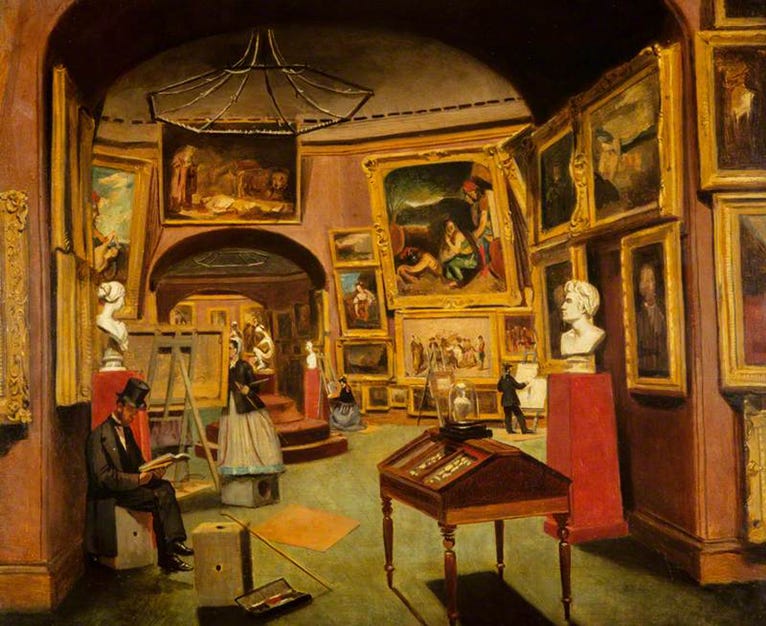
Back to museums themselves: Henry Frick may have had a collection, but he was not a collector in the truly obsessive sense. “Anyone can be bitten by the collecting bug, but only Albert C. Barnes would compare the bite to that of a mad dog,” Ruth Bernard Yeazell wrote about the founder of the eponymous foundation and museum, now in Philadelphia. Barnes, one of the early twentieth century’s nouveau riche, was a man who “ultimately preferred fast cars to foxhunting” and began hungrily—perhaps “indiscriminately”—to collect modern art. (Against Barnes’s rabidity, consider Belle da Costa Greene, J.P. Morgan’s librarian who stewarded the Morgan collection, which came to reflect what Heather O’Donnell called “her rarefied tastes: a head of a bodhisattva from the Northern Qi dynasty, an illuminated Turkish Quran, a nude by Henri Matisse purchased at Alfred Stieglitz’s 291 gallery.”) Across the street from the Barnes Foundation are the newly opened Calder Gardens. In our December 18 issue Martin Filler wrote, “Who doesn’t love a garden? Yet this elliptically named treasure is a museum all the same, and already an essential cultural destination by any definition.”
In a two-part essay from the end of 2025, Susan Tallman examined what some of those definitions might be. (The second part will be published on Thursday.) She focused in particular on the differences between a collector and a plunderer, and on the question of where (and to whom) art could be said to belong:
The question is not whether Western museums should return some of their holdings but how many, and via what legal and social mechanisms…. But in no conceivable universe is everything in all the museums going back home. So what are we to do with the rest? At the very least we owe some respect to the people who made these things, dead and gone though they may be, and also to their heirs. This means paying attention to the ideas and skills, the love and sorrow, the power they put into what they made.
It is hard to think of a better description of the pleasures and responsibilities of museumgoing.
—Lauren Kane