

Mourning Constitutional
Plus: Gunboats Without the Diplomacy; Precious Stones; Trump Comes for Philanthropy; and more

Laurence H. Tribe
Is the Constitution ‘Dead, Dead, Dead’?
Here we come to the dangerous crux of the matter. [Jill] Lepore says we will reach the point of our republic’s death as a failed experiment in self-government unless we “learn again to amend” or else “invent a new instrument to guarantee liberty, promote equality, nurture families, knit communities, thwart tyranny, and avert the destruction of a habitable earth.” Essential to her conclusion that the Constitution has reached that point by having become, at least for now, unamendable and thus not a legitimate foundation for governance is her claim that it provided for textual amendment but “did not dictate the method by which it ought to be interpreted.”
That claim is wrong.
Read the full article on the Review’s website here.
Fintan O’Toole
Whose Hemisphere?
Trump has long identified the European Union as America’s greatest enemy, ahead of China and Russia: “I think the European Union is a foe, what they do to us in trade.” In the week after the Venezuela attack, the EU moved to ratify a historic deal with the Latin American trade bloc Mercosur. The Europeans are thus clearly encroaching on “our” hemisphere as economic competitors and rivals. Is Trump therefore going to blockade Brazil or Argentina to stop this trade? And were he to do so, how would this aggression make sense in the light of his own National Security Strategy’s mission to “enlist our European and Asian allies and partners, including India, to cement and improve our joint positions in the Western Hemisphere”? Could it be that Trump and his aides are just making this all up as they go along?
Read the full article on the Review’s website here.
Jenny Uglow
All That Glitters
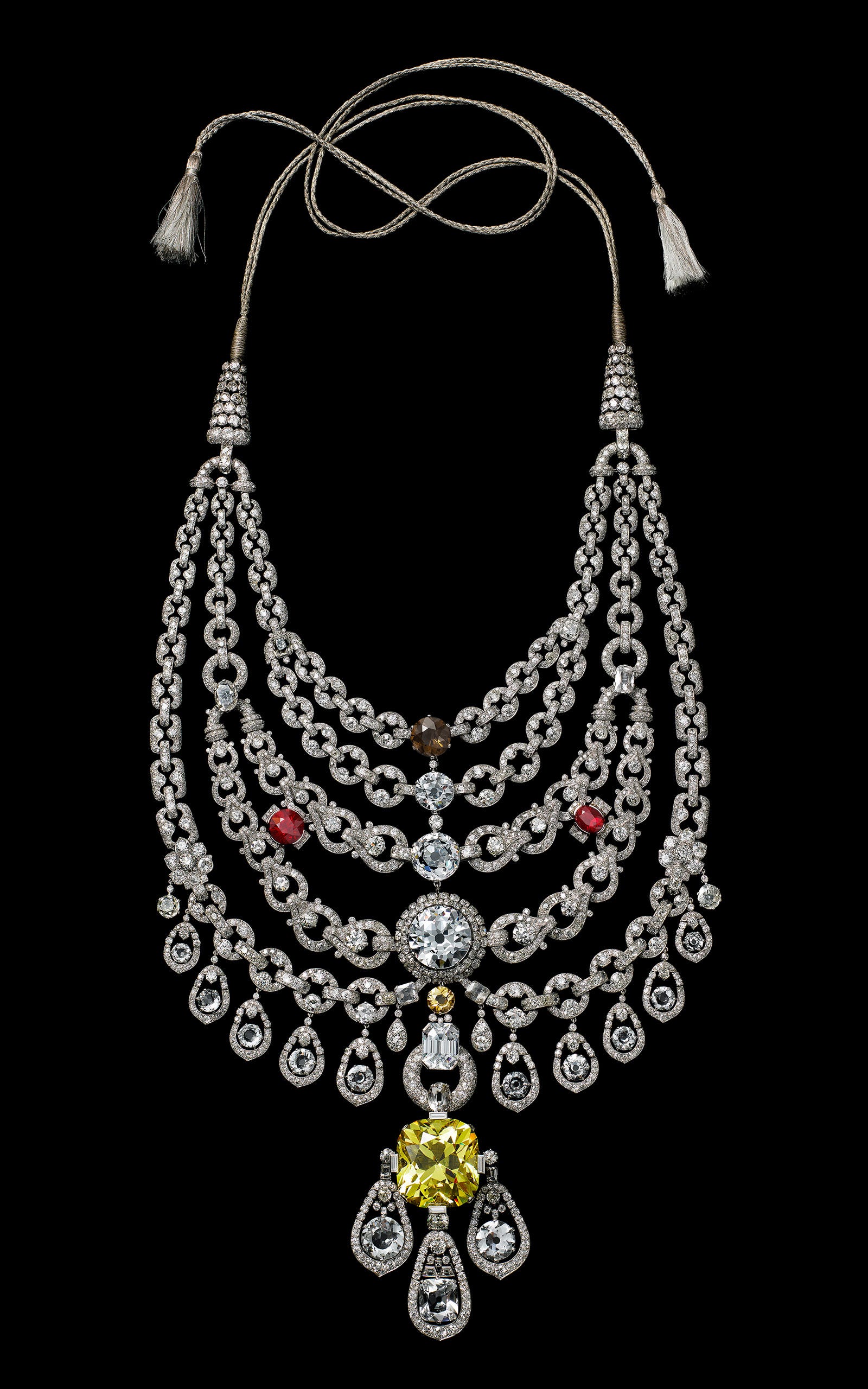
Cartier’s jewels bedecked a string of glamorous, constantly photographed women: Elsa Schiaparelli, Marlene Dietrich, Maria Callas, Elizabeth Taylor, and Grace Kelly, as well as the superrich, such as Daisy Fellowes from the Singer family and the Woolworth heiress Barbara Hutton. The company cannily made sure that its gems were seen in Vogue and Harper’s Bazaar. Cashing in on the movies, it loaned jewels to the stars: in How to Steal a Million Audrey Hepburn combines “Cartier diamonds with Givenchy fashion”; in The Thomas Crown Affair Steve McQueen sports a Tank Cintrée watch. Thin, rectangular Cartier watches twinkle casually in photos of Jackie Kennedy in 1969 and Andy Warhol in 1975. The royal bond also continued to boost Cartier’s image. Elizabeth II, who had a penchant for floral brooches, was often photographed wearing the famous Williamson diamond brooch, a diamond flower with a stunning pink diamond at its center, a stone discovered by Dr. John Williamson in Tanganyika (now Tanzania) in 1947 and presented to her at her wedding. The lasting flair for publicity is demonstrated by a dramatic portrait of Rihanna, photographed by Steven Klein and styled by Edward Enninful in 2016. Wearing a scroll tiara from 1902 and a choker worn by Clementine Churchill at the 1953 coronation, she could not look more up to date.
Read the full article on the Review’s website here.
Aryeh Neier & Gara LaMarche
Trump’s Attack on Philanthropy
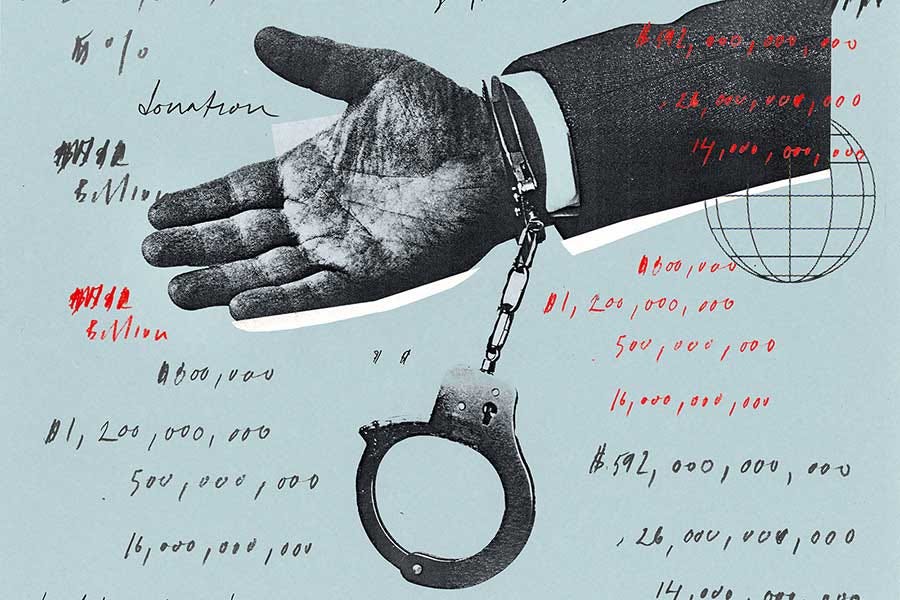
The Trump administration’s widening assault on civil society has found its first target in the world of philanthropy: the Open Society Foundations (OSF), established by George Soros and now chaired by his son Alex. Trump has called George Soros a “bad guy” who “should be put in jail,” and he recently suggested that prosecutors charge him under the Racketeer Influenced and Corrupt Organizations Act. In September Deputy Attorney General Todd Blanche—one of the president’s former personal lawyers, like a number of his appointees to the Justice Department and the courts—took up his recommendation and instructed more than six US attorneys’ offices to launch investigations of OSF on possible charges ranging from arson to support of terrorism, for which no evidence has been offered.
Read the full article on the Review’s website here.
More from our February 12, 2026, issue…
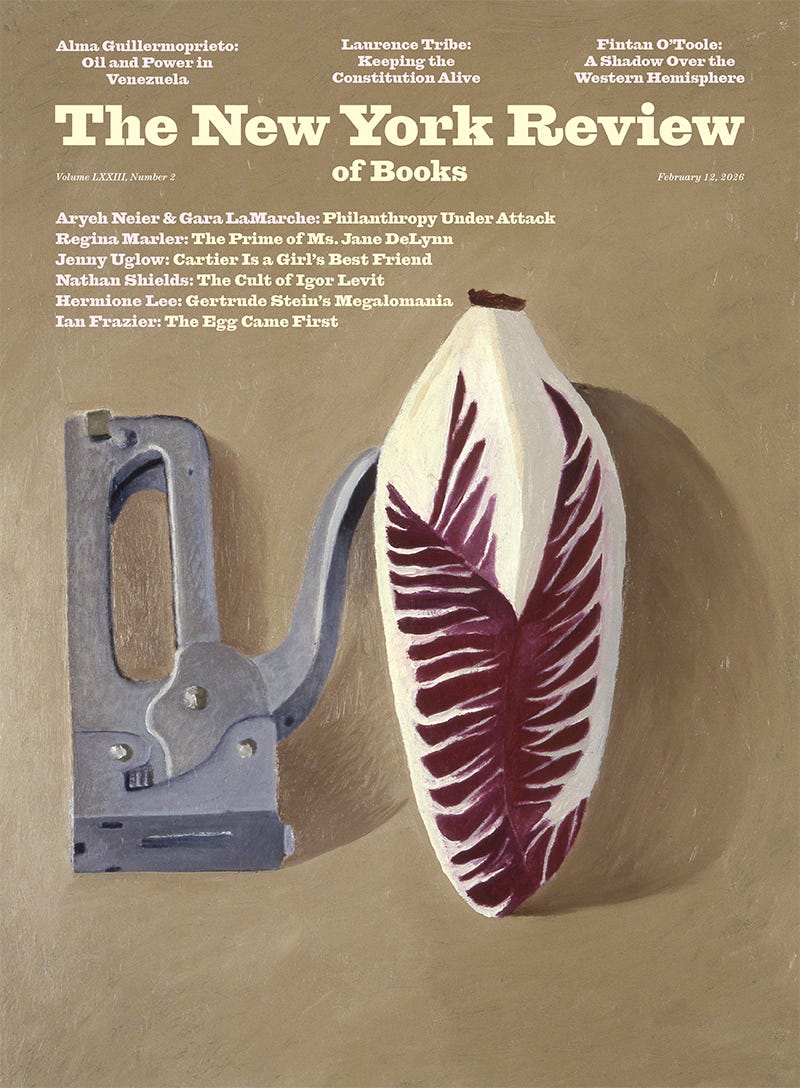
Alma Guillermoprieto on the US’s mad invasion of Venezuela
Hermione Lee on Gertrude Stein
Ian Frazier on the sea of chicken
Jérôme Tubiana on the crisis in Darfur
Beatrice Radden Keefe on Gothic fever
Regina Marler on Jane DeLynn
Cyrus Naji on an uncertain future in Bangladesh
Nathan Shields on Igor Levit
Vanessa Ogle on one ship’s journey through the global economy
Adam Kirsch on Gabriele Tergit’s Effingers
poems by Fernando Pessoa, Ben Lerner, and Kathleen Ossip

If you like our Substack, consider subscribing to our magazine by visiting nybooks.com/substack for a special discount on a full subscription.
Cool image.