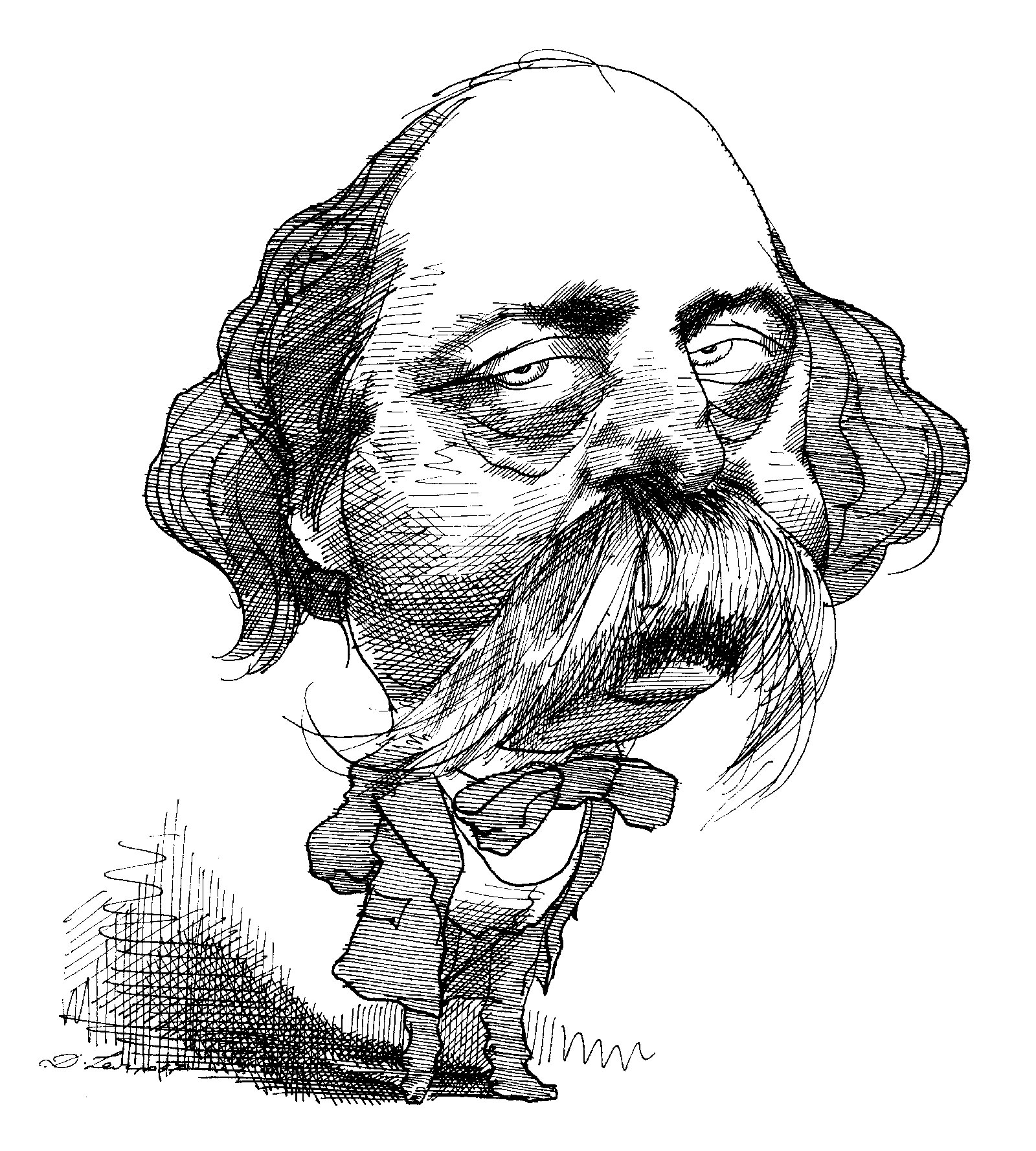
After being released in serial for a three months, Gustave Flaubert’s complete Madame Bovary was published as a complete novel 169 years ago today. In our July 16, 1987, issue, in a review of Mario Vargas Llosa’s The Perpetual Orgy: Flaubert and ‘Madame Bovary’—“a highly personal work about [Vargas Llosa’s] response to Flaubert’s life and writings”—Roger Shattuck wrote about the slightly ironic vogue for the nineteenth-century French novelist among twentieth-century writers, from Sartre to Woody Allen:
What did Flaubert do to deserve these sidelong tributes from novelists? His writing extends to many positions on the literary spectrum, from detached scientific description through the excesses of romantic yearning to the sassy, spontaneous voice of the wise fool in his incomparable letters.
Below we present an extended preview of the piece. Read the full article for free on the Review’s website here.
Has Flaubert become our Shakespeare? Or because of the modern attempt by prose fiction to dethrone poetic drama, is he simply overrated? We should listen carefully to what novelists have been saying. Henry James called him “a novelist’s novelist.” Conrad, Proust, Joyce, and Kafka left no doubt about how much they admired Flaubert and learned from him. More recently writings by Sarraute and Nabokov have reaffirmed his status as revered Master. Francis Steegmuller’s Flaubert and Madame Bovary, published in 1939, reads more like a novel than like a biography or a literary study. The three thousand pages of Sartre’s effort to settle the score with his literary father take on the compulsiveness of an unfinished pilgrimage. The Idiot of the Family absorbed and recycled Sartre’s considerable novelistic powers into a task already classified as impossible by Roquentin’s aborted biography of Rollebon in Nausea.
While Sartre was still toiling, the Peruvian novelist Mario Vargas Llosa spent over ten years on a highly personal work about his response to Flaubert’s life and writings. La orgía perpetua appeared in 1975 shortly after or just before Woody Allen wrote a story about a successful and disastrous attempt to meet Emma in the flesh by entering a supposedly therapeutic time machine. Most recently Julian Barnes’s “novel,” Flaubert’s Parrot, offers us the notes and fantasies of a fanatic and fetishistic amateur scholar unable to organize a proper book.
Meanwhile certified scholars continue to work strenuously on new studies and new editions. Flaubert’s complete Correspondance is appearing in the Pléiade collection and a two-volume selection in English has been published. The rush of events, reinforced by feminist concerns, has induced the translation, more than a century after its publication, of a novel by Louise Colet, Flaubert’s intermittent mistress and the recipient of his most important literary and personal letters.[^1] In this tale within a tale, mostly about George Sand and Alfred de Musset, Flaubert presides from a distance as the absent lover devoting himself to a great work. Colet portrays herself as being as scrappy as she is beautiful.
What did Flaubert do to deserve these sidelong tributes from novelists? His writing extends to many positions on the literary spectrum, from detached scientific description through the excesses of romantic yearning to the sassy, spontaneous voice of the wise fool in his incomparable letters. This profound versatility—not effortless but earned—has Shakespearean dimensions. One never recovers from Flaubert’s searing ironies on love, politics, beauty, and the bourgeois. The remarks that burst from him day after day about art, the imagination, and the discipline of work have formed our aesthetic attitudes as much as any other source since Hegel and Kant:
What seems to me the highest (and the most difficult) in Art is not to make us laugh or cry, not to arouse our lust or our rage…but to make us dream. Truly beautiful works do this. They are serene in appearance and incomprehensible…. Homer, Rabelais, Michaelangelo, Shakespeare, Goethe appear pitiless to me. It’s without bottom, infinite, multiple. Through small openings one sees precipices; below there’s blackness, vertigo. And yet something strangely calm hovers over the whole!
(To Louise Colet, August 26, 1853)
Halfway through the five years he devoted to Madame Bovary, Flaubert sent these lines off to Paris without making a copy, with no thought of developing a theory. He was simply responding to the grinding daily labor of planning and writing. Little by little he discovered an attitude toward art that combines the ideal (the classic improvement on nature) and the seaminess of the real. The attitude also rejects Plato’s notion of infection and extends Aristotle’s vague catharsis. “Dream” in the above passage includes think. Art permits us to contemplate and understand life, the representation of which preoccupied Flaubert all his life. And despite legends of misanthropy and ritual grumbling, the hermit of Croisset never abandoned life. His purportedly “uneventful” existence contained enough mysteries and precipices to mark his readers for generations.
Vargas Llosa’s book has now appeared in English as The Perpetual Orgy, with the added subtitle “Flaubert and Madame Bovary.” He starts off by saying that the three parts of the book will be, respectively, subjective and impressonistic, critical and scientific, and devoted to literary history. Not quite. The first forty pages, “An Unrequited Passion,” tell how Vargas Llosa fell in love with Madame Bovary, the book, with Emma, the character and ideal woman, and even with the thirteen volumes of the Correspondance. He loves the novel’s rigorous construction, its sustained attention to material and vulgar facts, and the force of its fantasies and desires that produce in him “a cathartic effect.” He attacks Sarraute’s article and Sartre’s mammoth study, despite their acknowledged brilliance, because they distract us from Flaubert’s devotion to telling stories about life.
The second part, which makes up three quarters of the book, opens with a seventy-five-page section called “The Pen-Man.” Many reviewers have wondered why Vargas Llosa uses the question-and-answer form here to present great chunks of professional information: the point of departure for Madame Bovary, Flaubert’s method of work, his sexual habits during those years, and above all, in answers of increasing length and detail, Flaubert’s models for his characters found in the society around him, among his own family and friends, and in literary works. Assimilating the research of scholars like Jean Pommier and Benjamin Bart, Vargas Llosa pursues the sources (not the keys) with deepening excitement. He even proposes a hypothesis of his own about Flaubert himself having commissioned a maid to write the forty-page Ludovica manuscript concerning a beautiful and extravagant widow. A singularly intense rhetorical paragraph takes the paradoxical position that Flaubert soaked up all this source material not to preserve it but to destroy it:
From these complicated conjunctions and reductions, impossible to reconstruct in their entirety, wrought of fragments, copies, bits and snatches, readings, gossip, contrivances—a fabrication invented in obedience to a throbbing wound that begs to be closed, to a disgust for reality so boundless that it seeks to demolish that reality in order to reconstruct it,…though in truth it is an attempt to annihilate it—from all of this there little by little emerges the plot of Madame Bovary.
If Vargas Llosa can write so powerfully about the provenance of a novelist’s materials, why does he use the question-and-answer arrangement, which makes these pages sound at times like an examination paper (Barnes uses that device in a chapter of Flaubert’s Parrot), a layman’s guide to a difficult subject like cancer, or a how-to book on novel writing? It may suggest a certain laziness in following the categories of his note cards, but I think not. By omitting the numbering used in the Spanish original, the translator has deprived us of the knowledge that there are exactly twenty questions.[^2] Vargas Llosa presents his eager sleuthing as a parlor game, at the end of which he quotes the famous letter to Mlle. Chantepie written after the novel’s publication. “Madame Bovary has nothing true in it. It is a totally invented story.” Twenty questions, having dredged up a boatload of fascinating sources, lead us unexpectedly to what is “really important: how the novel freed itself from its sources, how the fictional reality contradicted the real reality that inspired it.” Along the way the pseudo-Socratic exposition has not tried to suppress the inconsistent statements with which Flaubert surrounded his work. “Everything one invents is true.” And, on another day: “When one has the model clearly before his [sic] eyes, one always writes well.” There is much to assimilate.
Read the full article for free on the Review’s website here.