


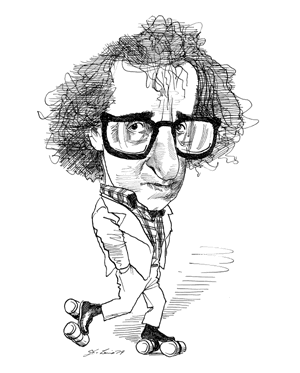
Self-absorption is general, as is self-doubt. In the large coastal cities of the United States this summer many people wanted to be dressed in “real linen,” cut by Calvin Klein to wrinkle, which implies real money. In the large coastal cities of the United States this summer many people wanted to be served the perfect vegetable terrine. It was a summer in which only have-nots wanted a cigarette or a vodka-and-tonic or a charcoal-broiled steak. It was a summer in which the more hopeful members of the society wanted roller skates, and stood in line to see Woody Allen’s Manhattan, a picture in which, toward the end, the Woody Allen character makes a list of reasons to stay alive. “Groucho Marx” is one reason, and “Willie Mays” is another. The second movement of Mozart’s “Jupiter” Symphony. Louis Armstrong’s “Potato Head Blues.” Flaubert’s A Sentimental Education. This list is modishly eclectic, a trace wry, definitely OK with real linen; and notable, as raisons d’être go, in that every experience it evokes is essentially passive. This list of Woody Allen’s is the ultimate consumer report, and the extent to which it has been quoted approvingly suggests a new class in America, a subworld of people rigid with apprehension that they will die wearing the wrong sneaker, naming the wrong symphony, preferring Madame Bovary.
What is arresting about these recent “serious” pictures of Woody Allen’s, about Annie Hall and Interiors as well as Manhattan, is not the way they work as pictures but the way they work with audiences. The people who go to see these pictures, who analyze them and write about them and argue the deeper implications in their texts and subtexts, seem to agree that the world onscreen pretty much mirrors the world as they know it. This is interesting, and rather astonishing, since the peculiar and hermetic self-regard in Annie Hall and Interiors and Manhattan would seem nothing with which large numbers of people would want to identify. The characters in these pictures are, at best, trying. They are morose. They have bad manners. They seem to take long walks and go to smart restaurants only to ask one another hard questions. “Are you serious about Tracy?” the Michael Murphy character asks the Woody Allen character in Manhattan. “Are you still hung up on Yale?” the Woody Allen character asks the Diane Keaton character. “I think I’m still in love with Yale,” she confesses several scenes later. “You are?” he counters, “or you think you are?” All of the characters in Woody Allen pictures not only ask these questions but actually answer them, on camera, and then, usually in another restaurant, listen raptly to third-party analyses of their own questions and answers.
“How come you guys got divorced?” they ask each other with real interest, and, on a more rhetorical level, “why are you so hostile,” and “why can’t you just once in a while consider my needs.” (”I’m sick of your needs” is the way Diane Keaton answers this question in Interiors, one of the few lucid moments in the picture.) What does she say, these people ask incessantly, what does she say and what does he say and, finally, inevitably, “what does your analyst say.” These people have, on certain subjects, extraordinary attention spans. When Natalie Gittelson of The New York Times Magazine recently asked Woody Allen how his own analysis was going after twenty-two years, he answered this way: “It’s very slow…but an hour a day, talking about your emotions, hopes, angers, disappointments, with someone who’s trained to evaluate this material—over a period of years, you’re bound to get more in touch with feelings than someone who makes no effort.”
Well, yes and (apparently) no. Over a period of twenty-two years “you’re bound” only to get older, barring nasty surprises. This notion of oneself as a kind of continuing career—something to work at, work on, “make an effort” for and subject to an hour a day of emotional Nautilus training, all in the interests not of attaining grace but of improving one’s “relationships”—is fairly recent in the world, at least in the world not inhabited entirely by adolescents. In fact the paradigm for the action in these recent Woody Allen movies is high school. The characters in Manhattan and Annie Hall and Interiors are, with one exception, presented as adults, as sentient men and women in the most productive years of their lives, but their concerns and conversations are those of clever children, “class brains,” acting out a yearbook fantasy of adult life. (The one exception is “Tracy,” the Mariel Hemingway part in Manhattan, another kind of adolescent fantasy. Tracy actually is a high-school senior, at the Dalton School, and has perfect skin, perfect wisdom, perfect sex, and no visible family. Tracy’s mother and father are covered in a single line: they are said to be in London, finding Tracy an apartment. When Tracy wants to go to JFK she calls a limo. Tracy put me in mind of an American-International Pictures executive who once advised me, by way of pointing out the absence of adult characters in AIP beach movies, that nobody ever paid $3 to see a parent.)
These faux adults of Woody Allen’s have dinner at Elaine’s, and argue art versus ethics. They share sodas, and wonder “what love is.” They have “interesting” occupations, none of which intrudes in any serious way on their dating. Many characters in these pictures “write,” usually on tape recorders. In Manhattan, Woody Allen quits his job as a television writer and is later seen dictating an “idea” for a short story, an idea which, I am afraid, is also the “idea” for the picture itself: “People in Manhattan are constantly creating these real unnecessary neurotic problems for themselves that keep them from dealing with more terrifying unsolvable problems about the universe.”
In Annie Hall, Diane Keaton sings from time to time, at a place like Reno Sweeney’s. In Interiors she seems to be some kind of celebrity poet. In Manhattan she is a magazine writer, and we actually see her typing once, on a novelization, and talking on the telephone to “Harvey,” who, given the counterfeit “insider” shine to the dialogue, we are meant to understand is Harvey Shapiro, the editor of The New York Times Book Review. (Similarly, we are meant to know that the “Jack and Anjelica” to whom Paul Simon refers in Annie Hall are Jack Nicholson and Anjelica Huston, and to feel somehow flattered by our inclusion in this little joke on those who fail to get it.) A writer in Interiors is said to be “taking his rage out in critical pieces.” “Have you thought any more about having kids?” a wife asks her husband in Manhattan. “I’ve got to get the O’Neill book finished,” the husband answers. “I could talk about my book all night,” one character says. “Viking loved my book,” another says.
These are not possible constructions, but they reflect exactly the false and desperate knowingness of the smartest kid in the class. “When it comes to relationships with women I’m the winner of the August Strindberg Award,” the Woody Allen character tells us in Manhattan; later, in a frequently quoted and admired line, he says, to Diane Keaton, “I’ve never had a relationship with a woman that lasted longer than the one between Hitler and Eva Braun.” These lines are meaningless, and not funny: they are simply “references,” the way Harvey and Jack and Anjelica and A Sentimental Education are references, smart talk meant to convey the message that the speaker knows his way around Lit and History, not to mention Show Biz.
In fact the sense of social reality in these pictures is dim in the extreme, and derives more from show business than from anywhere else. The three sisters in Interiors are named, without comment, “Renata,” “Joey,” and “Flyn.” That “Renata,” “Joey,” and “Flyn” are names from three different parts of town seems not to be a point in the picture, nor does the fact that all the characters, who are presented as overeducated, speak an odd and tortured English. “You implied that a lot,” one says. “Political activity is not my interest.” “Frederick has finished what I’ve already told him is his best work by far.” The particular cadence here is common among actors but not, I think, in the world outside.
“Overeducation” is something Woody Allen seems to discern more often than the rest of us might. …
Read the full article on the Review’s website here.
Many points well-taken, but grouping these three films together is a little unfair. Annie Hall has its flaws but is funny and interesting and saved by Diane Keaton. Manhattan is even more flawed but salvaged by its cinematography—and Mariel Hemingway and Diane Keaton. Interiors is garbage and unsalvageable even by Diane Keaton. Leave it out, Joan Didion.
Did we need this? Right after Woody shown all over the Epstein files? Disgusting.