



On February 19 the Review and the Brooklyn cultural organization Pioneer Works are cohosting the official launch of longtime contributor Dan Chiasson’s new book, Bernie for Burlington: The Rise of the People’s Politician. The event, which is open to the public, will include a conversation with Chiasson and Jamaica Kincaid, as well as a performance by members of Vermont’s storied Bread and Puppet Theater.
In our September 23, 2021, issue, Chiasson wrote about Bread and Puppet, “the anticapitalist troupe founded in 1963”—the same year as the Review—that to this day produces “spectacles of shock and confrontation” with its menagerie of “smirking, wincing, portly, wizened” puppets. As Chiasson wrote, “the puppets make up a vision of humanity in its entirety: heroes, pests, capitalists, sadists, all of them helplessly locked into their assigned natures and motives.”
Peter and Elka Schumann’s Bread and Puppet Theater, the anticapitalist troupe founded in 1963, occupies several buildings on the former Dopp Farm in a remote corner of Vermont. Shanties built from scrap metal and timber dot the landscape, along with some beached flowerchild school buses. When you approach the property through dense forest on a country road, Bread and Puppet at first looks like any other hardscrabble farm here in the Northeast Kingdom, the poorest and most rural part of Vermont. Seeing its weathered structures, you might conclude that there is a phenomenon called time, and that, as it passes, it ravages things. Otherwise, the place seems more or less frozen in 1975, the year the company first arrived. That it had not changed, and might never, was already part of its mystique in the early 1980s, when I first visited the farm. The doors have always been wide open at Bread and Puppet, but an outsider would have an easier time assimilating into an Amish village.
Though it shares the features of a working farm and a commune, Bread and Puppet is an enormous puppet maker’s workshop: a factory devoted to the manufacture of, mainly, human likenesses. There are too many puppets and masks here to house with any semblance of order: they are strewn about the property, tacked to hickories and maples, piled in sheds and under porches, hung up like deer hides in stalls. The company’s ambitious performance schedule means that some of these effigies do get taken down off their pegs and recycled, bestowed again with life and movement; but for many of these poignant souls, the best that can be hoped for is a kind of grimacing retirement in the museum that fills every inch of a large dairy barn on the property.
The Bread and Puppet Museum, where some of the best and most storied puppets are kept, is often deserted. You turn the lights on when you arrive and stuff some cash, if you have it, into the donation box. The gift store also runs on the honor system. Unlike most museum stores, this one sells original works of art: you can buy limited-edition prints, banners, and posters made in the company’s print shop, all for a pittance. These rather primitive woodblock designs, with stenciled, well-worn slogans of defiance (“Rise,” “Courage,” “Resist”), are a fixture of Vermont kitchens and coffee shops, stapled or taped to the walls. I think I have never seen one framed. Down the aisles from the shop, the former stalls of the barn function like shrines in a medieval cathedral or vitrines in a natural history museum, in which retired puppets and sets are crowded into expressive narrative scenarios.
Smirking, wincing, portly, wizened, the puppets make up a vision of humanity in its entirety: heroes, pests, capitalists, sadists, all of them helplessly locked into their assigned natures and motives, unchanged from season to season. In one painted scene, tiny angels or babies rain out of the sky like something from an acid-trip Blake engraving. Many of the scenes and figures are said to have originated in dreams, where they are certainly destined to return. The museum is in fact a kind of collective American unconscious in which our nightmares of guilt and culpability are heightened and accentuated. Bread and Puppet has produced some of the great visual representations of modern American atrocity, from Hiroshima to Vietnam to covert assassinations and environmental terror; yet as a medium for expressing moral and political anger, puppetry, with its innate connections to innocence and childhood, serves also as a powerful ironizing force. Walking through the museum, it is hard to compose and sustain a single response: jest and genocide adjoin, as they do in the national conscience.
Most of the exhibits memorialize shows from the company’s past. In a downstairs corner of the barn, “The White Horse Butcher” presents an anticapitalist tableau with a frightened, pitiful, tormented horse at its center, a pure being surrounded by expressionless white-faced bureaucrats who have come to sacrifice it to the god of money. Upstairs in the loft, the tall rafters frame the company’s distinctive “giants,” presences perhaps forty feet tall, like primitive gods with an eye on the mayhem below. There, the Founding Fathers hang lifeless and slack from thick beams, as though it was finally their turn to be lynched. In one stall, an enormous effigy of Archbishop Óscar Romero, who was assassinated by a CIA-linked group while saying Mass in San Salvador, presides over his last Eucharist. Across the aisle we are faced with the most terrifying exhibit of all, “The Birdcatcher in Hell”: here vivisectionist puppets painted in sickly reds and dark pinks, the color of viscera, oversee the fate of Lieutenant William Calley, the soldier who was charged with 109 counts of murder after the 1968 My Lai massacre.
The company’s uncompromising politics is expressed in spectacles of shock and confrontation, images that “can’t be unseen,” as we say. Decades later it all still has the power to unsettle. But the puppets, mostly made of papier-mâché, cannot really be preserved. And so an extra layer of pathos clings to the museum, a feeling of old battles, old adversities, perhaps even lost causes. A world now vanished, where puppets could serve as countercultural tools, rhetorical weapons, or literal disguises: in 1970 Father Daniel Berrigan, who had been placed on the FBI’s Most Wanted List for evading prosecution for his part in burning hundreds of draft cards with the Catonsville Nine, fled from the authorities inside an enormous Bread and Puppet figure of an apostle.
Elka Schumann died on August 1, of complications following a stroke. According to most accounts, it was Elka who shaped the farm as a working and living environment, with her husband Peter’s mask-making and their bread-making at the nucleus of a system that included, under her supervision, the profitable and thriving printing press, a cider press, a sugarbush with two thousand taps, and a flock of sheep providing wool for the Schumann family and others. The farm blurs the line between forms of work that produce outcomes deemed necessary for survival (bread) and those derided as frivolous (puppets).
Peter Schumann, aged eighty-seven, is the Geppetto behind all these puppets. The civilization that he and Elka have assiduously tended and elaborated here for nearly fifty years includes not only artwork and performances but an austere code of life, a playfully expressed but fierce moral logic, the coaxing of a rather forbidding and harsh landscape into self-expression, and the quiet management of his large stake in an entire region’s cultural life. Peter’s art is collaborative, with a high degree of freedom delegated to his many and various partners, including spur-of-the-moment volunteers.
What he and Elka created is an approach: a distinct visual and performance idiom, the traces of its making inscribed on its surface, with room for innovation. It can be crude enough to be reproducible by hastily trained amateurs and even by young children. It is above all an ethic of cheapness, never betrayed in all its years. I once overheard some members of the company planning to drive to St. Albans, an hour or more away, to pick up a load of old construction scrap. Neighbors drop off their old house paint and worn bedsheets, which Schumann and his collaborators turn into works of art.
Many of the volunteers at Bread and Puppet are paying tribute to their past. At a Bread and Puppet performance, “one is seized by one’s childhood,” as the poet Barry Goldensohn once put it. Archetypes of causation—a puppet-hammer hitting a puppet-nail, a son saying good-bye to a mother—drive deep into the preconscious mind. Generations of Vermonters were taken as babies and toddlers to these performances. I attribute to Bread and Puppet an important role in my first narrative memory, a sequence with movement and sound: this was July 4, 1976, at the Bicentennial celebration in Battery Park, Burlington, Vermont. I was five. I remember shriners, a band, a parade of drummers. A neighbor hoists me up on his shoulders for a view of the concert and, beyond it, of Lake Champlain. But then I see frightening puppets many times my size.
I shut my eyes to protect myself, and then the memory ends. I have played this clip over and over in my mind and written a long poem (“Bicentennial”) that recasts the moment as a confrontation with my estranged father. The trauma of witnessing those huge effigies ends the memory; the imagination has to take over. My subsequent early associations with Bread and Puppet, which turned up often in Burlington to participate in fairs and parades throughout the 1970s, are of something cruel, sordid, and dangerous, the dream version of the town’s countercultural demimonde that, in a household presided over by my grandfather, a decorated World War II veteran who led the Vermont National Guard, was regarded as an insidious and filthy, an un-American, scene—an occupation.
Since the early 1970s, the main event on the summer program has been the company’s Domestic Resurrection Circus, which this summer celebrated its fiftieth performance year. From the beginning it was a throwback, staging shows that were well known from the company’s earlier work doing traveling shows and street theater. It is a powerful form of ritual, summoning and enacting memory for both its performers and its audience, the boundary between those two constituencies, as always, very porous. One arrives at the farm and is directed by performers to the large natural amphitheater—said to be a drained glacial lake—where the performance unfolds. Sideshows and skits, vaudeville acts, weird Shakespearean bits, Chaplinesque comic fiascoes, jug bands, ragtime, mimes, lute players, what have you: these often precede the main event. The “resurrection” of the title is both enacted by the massive puppets and implicit in the event itself.
If you see the Circus week after week, it starts to function both as a news aggregator and a kind of church service. At a performance this August, a call for relief for Haiti, a few days after its catastrophic earthquake, was followed by antics involving a puppet-zebra and some fleeing children who had been, as always, recruited and assembled the afternoon of the performance. Then, emerging from the background, an iconic Archbishop Romero puppet, his gentle face rendered at enormous scale, presided over cutouts of fallen bodies. The appearance of the martyred bishop was one of many solemn details that gestured toward Elka’s recent death, while reminding us—though who needed reminding, with the news from Afghanistan?—that even in a humid meadow in Vermont, we were all in the belly of a brutal and tragic empire.
Read the full article for free on the Review’s website here.
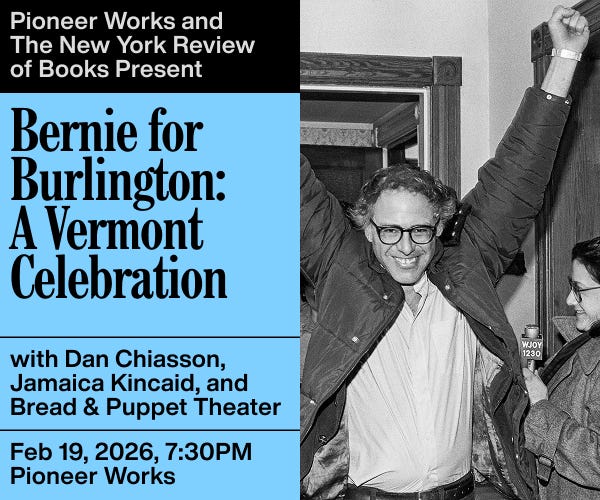
Join Pioneer Works and The New York Review of Books for the official launch of Dan Chiasson’s Bernie for Burlington—an epic account of the early days and rise of the young Bernie Sanders, in a bygone time and place that find, in the New York City of 2026, their thrilling sequel.
Register here.
If you like our Substack, consider subscribing to our magazine by visiting nybooks.com/substack for a special discount on a full subscription.