The first color photograph—as distinct from hand-tinted monochrome photographs—was produced 165 years ago today. The English inventor Thomas Sutton’s image of a tartan ribbon was made using a pioneering three-color process, but due to the expense and difficulty of early technologies, color photography did not become the predominant medium for another hundred years.
On September 5, 2014, Adam Hochschild wrote about the “startling” experience of seeing color photographs of World War I, only a few thousand of which are known to exist: “It feels like looking at a familiar scene through a different pair of eyeglasses, one that allows you to see all sorts of things…that are hard to imagine even now from the many TV documentaries marking the war’s centennial.”
Into the Trenches in Red and Blue
Adam Hochschild
Because of the photography of their day, we tend to think of the world wars in black and white. This is especially true of the first. As a child I pored endlessly through a book of photographs from 1914-1918 on my parents’ bookshelf: grey trenches, blackened ruins of bombed-out buildings, soldiers’ drab uniforms, a corpse on the ground (was that darker spot blood?), with the caption: “Some corner of a foreign field/That is for ever England.”
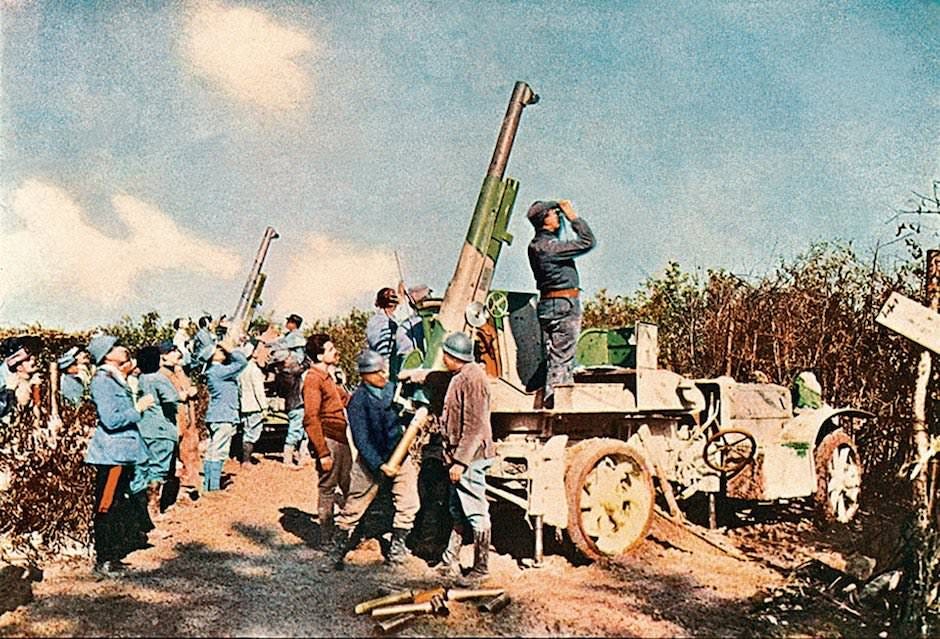
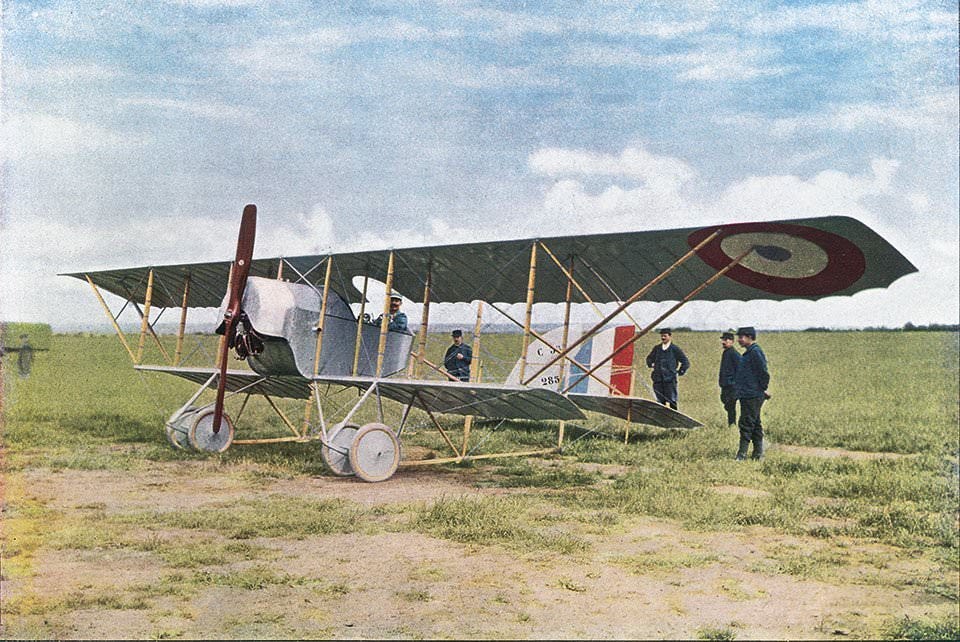
It is startling, therefore, to see the some 320 images in Peter Walther’s The First World War in Colour (Taschen), chosen from the few thousand color photographs of the war that exist. It feels like looking at a familiar scene through a different pair of eyeglasses, one that allows you to see all sorts of things that that six-year-old self of mine couldn’t picture, and that are hard to imagine even now from the many TV documentaries marking the war’s centennial. (One reason these images seem not to have been better known is that they have been dispersed in various archives across Europe and are difficult to access. Some of the more remarkable photographs in the book were not available for reproduction in this post.)
The first thing that stuns you is the brilliant colors of the uniforms. Most of the photos in this book are from France, and the French army of 1914 was the most snappily dressed in Europe. French infantrymen wore bright red trousers, bright blue coats, and bright red caps. And these were combat uniforms, not just dress uniforms. When, at a parliamentary hearing two years before the war, a reformer had suggested doing away at least with the red trousers, the minister of war shouted him down: “Jamais! Le pantalon rouge c’est la France!”
The French were not the only World War I army in love with color. Austro-Hungarian cavalry troopers also went into battle wearing bright red and blue, which they didn’t abandon until 1916, and Scottish infantry had colored tartan bands on their caps. On the uniforms of the colonial troops, too, eye-catching hues abound: red, white, and blue on the Zouaves from French North Africa; gold caps and broad stripes on the red trousers of their French officers; red sashes and high red caps on Moroccan cavalry. Although barely mentioned in most histories of the war, hundreds of thousands of colonial troops were brought to the Western Front by both France and Britain. The great variety of their uniforms constituted a sort of boast about just how much of the world the major colonial powers controlled.
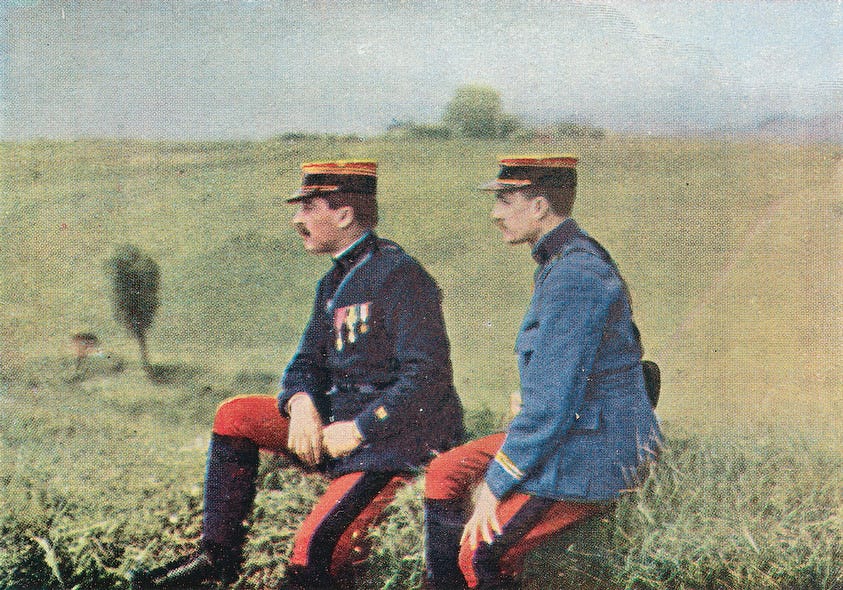
Why such stunning disregard of what would make a soldier so conspicuous a target for an enemy sniper rifle or machine gun? This blitheness about bright colors stemmed from the previous military experience of the Western Front generals—British, French, and German alike—which had been mostly limited to fighting people who lacked sniper rifles or machine guns: poorly-armed rebels against colonial rule in Africa or Asia. The generals knew, of course, that this would no longer hold true for a war in Europe, but there’s always that curious difference between knowing and acting, and never more so than with the military. Huge armies change their ways very slowly. Hundreds of thousands of red-capped French infantry troops and cavalrymen with brilliantly shining breastplates were killed—more than 27,000 died in a single day several weeks after the war began—before new uniforms were distributed to the troops in early 1915.
Color photography in this era was cumbersome: cameras were heavy and film was slow—even in bright sunshine, a subject had to stand still for a full second, and for much longer if it was overcast. Hence there are no color photos of actual combat or of troops under fire. But plenty of civilians were happy to pose for the camera. Particularly haunting are Léon Gimpel’s images of Parisian children in 1915 performing, complete with colored uniforms, their fantasies of combat on the ground and in the air, and even of an execution. German children were surely acting out similar scenes in the streets of Berlin. A quarter-century later, both sets of children would be fully grown and their rifles and airplanes would no longer be toy ones.
Read the full article for free on the Review’s website here.