

‘Idiot Disneyland’
Charlie Lee on John Gregory Dunne

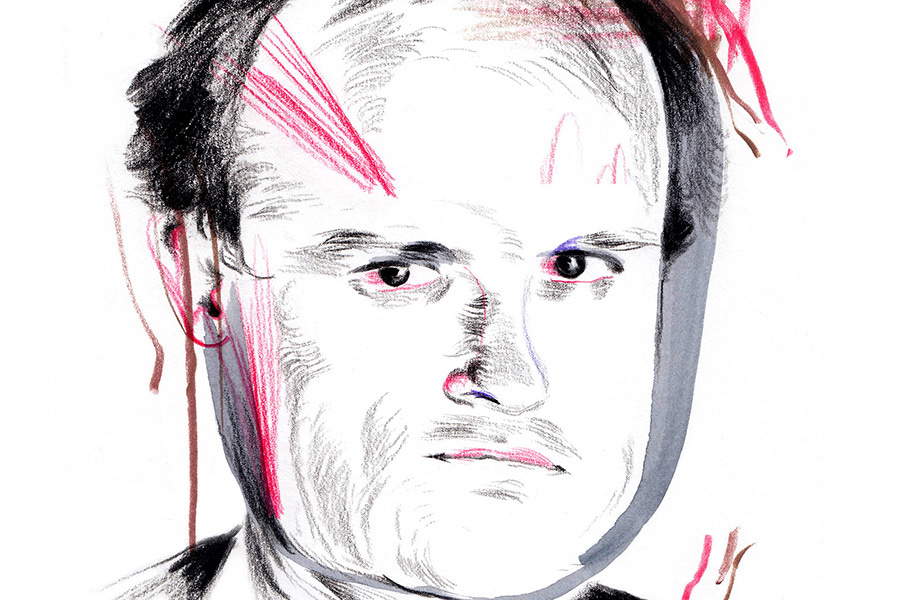
After working at Time magazine for five years, John Gregory Dunne quit and married Joan Didion, “which was,” writes Charlie Lee in our May 28 issue, “possibly the best decision an ambitious young writer and high-society aspirant could have made in the year 1964.” But by the early 1970s, “overtaken by a creeping, directionless despair” and feuding with his wife, Dunne “traveled to Las Vegas with a plan to spend the summer slumming among its seedier denizens and writing a portrait of the city.”
The resulting book, Vegas: A Memoir of a Dark Season—which was reprinted last year with a new introduction—was a fitting assignment. Dunne “was a writer of high taste who delighted in the distasteful, an arch and erudite stylist with the gutter-bound soul of a tabloid hack.” And in Vegas he found the perfect material:
Dice salesmen, exterminators, contraceptive wholesalers, bail bondsmen, toupee stylists, bookies, bellhops, pimps: they all want to talk about money, who has it and who doesn’t, and what you can buy with it, and how to get more of it right now. Dunne haunts the city’s health clubs and steam rooms, eavesdropping on “the dialogue of the used-car tycoon and the parking-lot mogul.”
Below, alongside Lee’s essay, are five of Dunne’s articles about the distasteful and the gutter-bound from our archives.
What Happened in Vegas
Charlie Lee
I defy you to find a writer, a good writer, living or dead, who has talked about money as incessantly and with as much impenitent relish as John Gregory Dunne. He lived, it seems, for the grubby little details: flip through his interviews and you’ll discover a recitation of dollar figures, buyout clauses, basis points. The man rattles off contract terms as a priest recalls the catechism. Here are some snippets from a 1996 interview ostensibly on the “art of screenwriting”:
He paid off our contract at forty cents on the dollar.... To our amazement it sold to some studio, I think it was CBS, which paid us fifty thousand dollars.... We’ve written twenty-three books between us and movies financed nineteen out of the twenty-three.... Six figures a week if you’re any good, hundred grand at the minimum.... Look. It pays a lot and it’s fun.
It does sound like fun.
In Dunne’s actual work—that is, the novels, memoirs, and reported yarns he “financed” by writing movies with his wife, Joan Didion—a great deal of the fun has to do with his exquisite sensitivity to such base particulars. He was a writer of high taste who delighted in the distasteful, an arch and erudite stylist with the gutter-bound soul of a tabloid hack. Reading him is a bit like walking into a mahogany-paneled library only to find smut on the shelves and shag carpet under your feet. Like any worthy gossip he was known to launch into conversations with the phrase “This you will not believe.” And it wasn’t just about money: as a reporter, his other most abiding subjects were the murky, byzantine maneuvers by which people go about getting famous, getting laid, and getting arrested. “I am drawn to the Santa Monica Courthouse,” he confessed, “the way some people are drawn to church.”
Sometimes, if the fates and the whims of magazine editors aligned, he got to cover all those subjects at once—as when, in 1994, he wrote in these pages about the case of O.J. Simpson. He seems to have been less interested in the murders themselves than in what people said about them, in “the facts, the factoids, the allegations, the half-truths, the untruths, the leaks, the smears.” He wanted the jokes, especially the bad ones: “Did you hear that O.J.’s signed a new contract with Hertz... he’s going to be making license plates for them.... The bad news is O.J.’s going to prison, the good news is that Michael Jackson’s taking the kids.” Most of all, he wanted to know who was getting in on the action, and how. Whatever happened inside the courtroom was less revealing, and less delicious, than the fact that a recent girlfriend of O.J.’s had “parlayed her affair with Simpson into a photo feature in the October Playboy,” or that executives at Universal Pictures had plastered an eighteen-wheeler truck with an ad for their latest superhero flick, The Shadow, and parked it outside the courthouse, where it would be sure to appear in the background of all the news coverage. As one executive put it, “What’s a studio to do when they’ve got close to 100 million viewers watching?”
It’s an odd, at times disturbing piece of writing. Dunne has little sympathy for the victims; his fascination with all manner of sleaziness was so totalizing that it could come at the expense of simple decency. But the essay’s failings are revealing in their own way: in Dunne’s telling, the O.J. story was less a tragedy than a farce, and its central, bumbling villains were not the murderer and his entourage but the reporters—himself included—who descended to get it all in print. He found their instincts dubious, to say nothing of their intentions. Before the night of June 12, 1994, he observed, Ron Goldman and Nicole Brown had been “characters of considerable and ambiguous particularity.” That is, they had not spent their painful, messy lives trying to make their deaths an intelligible event. But when one of the most famous men in America was arrested in connection with their murders, “all three lost whatever identity they had in the frantic search to find some larger meaning that would explain the crime,” Dunne wrote. “The story demanded a moral: youth wasted, promise denied, spousal abuse, domestic violence, the race card,” and this the reporters were happy to provide. The story and its moral came together not in the courtroom but in the conversations they had with one another, or with their editors, in bars or restaurants or on the phone after the workday was over, when they could spend their time “refining and polishing a story by accretion, a narrative that may or may not tell the story of what actually happened.”
It’s an idea that shows up often in Dunne’s work and that, in previous decades, had animated some of the best of it: the suspicion that, if you were to examine the soul of a reporter—even one less partial to prurient fare than Dunne—you would find that telling “the story of what actually happened” did not quite number among his highest priorities. The trueborn reporter will keep a little side action going. His darker purpose could be financial, as in most professions; it could be aesthetic; it could be ideological, as Dunne discovered during the five years he spent in the early 1960s working at Time, a magazine he later described as lacking any “pretense to objectivity,” particularly on the subject of Vietnam. Or it could be personal—as I suspect it was for Dunne in the early 1970s, when he traveled to Las Vegas with a plan to spend the summer slumming among its seedier denizens and writing a portrait of the city. He came back instead with Vegas: A Memoir of a Dark Season, which in his typical furtive fashion reads more like a portrait of himself.
Read the full article on the Review’s website here.
From the Archives: John Gregory Dunne (1932–2003)
On working for Time

Love this. I’ve been a Didion fan forever, and until recently hadn’t given a lot of thought to Dunne.
Let's not forget that Didion was his first reader and editor.