


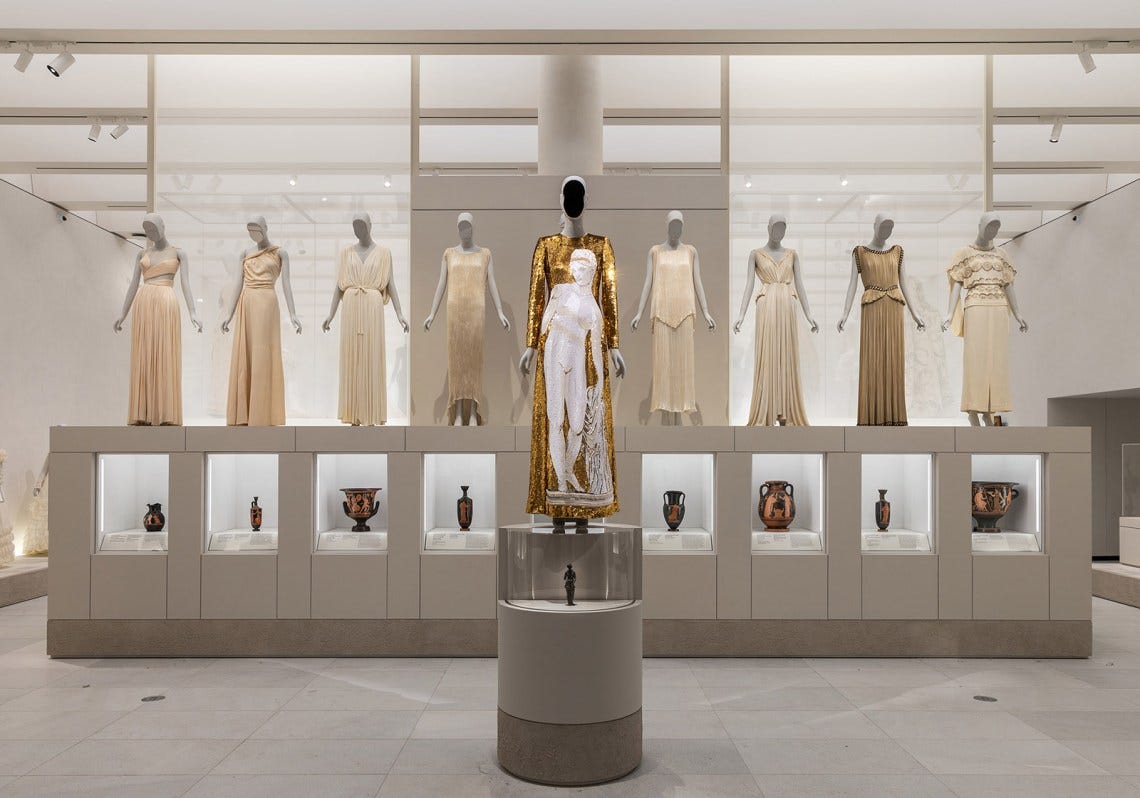
This spring New York’s Metropolitan Museum of Art opened a new permanent space right at the entrance: the 12,000-square-foot Condé M. Nast Galleries, which are dedicated to fashion. “How did rooms focused on fashion become the first galleries visitors now encounter on entering the Met?” asks Jed Perl in the Review’s July 23 issue. “I’m worried about what all of this portends for the future of one of the world’s greatest museums.”
Perl visits the Nast Galleries’ inaugural show, “Costume Art,” which pairs gowns and suits with artwork from the museum’s other departments. This effort to draw out the continuities between clothing and other forms may “offer ways of thinking about art and fashion through the ages,” but ultimately, writes Perl, it “is little more than a show of recent fashion masquerading as a scholarly exhibition about the historical relationship between clothing and the arts more generally…. Behind the fun and games there’s a fashion industry fat with money and prestige and apparently determined to have its way with the Metropolitan Museum of Art.”
Below, alongside Perl’s essay, we have collected seven articles from our archive about fashion and style.
Fashion Forward
Jed Perl
Jean Cocteau opened his 1918 polemic, Cock and Harlequin, with a zinger of an epigram: “Art is science in the flesh.” That’s probably the kind of intellectual provocation that Andrew Bolton, the curator in charge of the Metropolitan Museum of Art’s Costume Institute, was aiming for with “Costume Art,” the show that inaugurates the museum’s Condé M. Nast Galleries. Designed by the Brooklyn-based Peterson Rich Office, these are now the first exhibition spaces visitors encounter after entering the Great Hall.
In the show, items of clothing are juxtaposed with works of art from the museum’s seventeen curatorial departments. “The study of dress,” Bolton explains in the catalog, “offers a privileged vantage point from which to reconsider the history of art itself.” He believes that “the history of aesthetics cannot be disentangled from the history of the body that clothes it.” Even if that’s true—I’m not so sure—“Costume Art” isn’t about the body but about the clothes. It’s an infomercial for the fashion industry.
The Condé M. Nast Galleries have the pale gray walls and crisp architectural details of a Madison Avenue boutique. The show is sterile—a plod. Even fashions that might originally have had some comic pizzazz (a dress by Batsheva Hay emblazoned with the word “HAG” or Jean Paul Gaultier’s jumpsuits ornamented with drawings of old-fashioned tattoos) are presented as if they demand serious consideration. Many of the mannequins loom high above us, an army of chic automatons. They’ve been specially designed in sizes that acknowledge that the world includes people with different physiques, but where their faces would be, there’s a mirror. Someone must have figured that the mirrored faces would encourage museumgoers to bond with the mannequins—la mode, c’est moi. As for the works of art included, they’re generally small and almost invariably overwhelmed by the clothes. A lot of them are tucked away in vitrines that serve as pedestals for dresses by some of the world’s most exclusive designers. An ancient Greek vase, a Dürer print, a sculpture by Jean Arp, and a Meiji-period hanging basket are given perfunctory presentations. They’re giveaways in an ultra-posh swag bag. The clothes are the heroes of the show.
There is much to be said not only about “Costume Art” but also about the Condé M. Nast Galleries, which are going to be dedicated to Costume Institute exhibitions, while occasionally available for other museum projects. How did rooms focused on fashion become the first galleries visitors now encounter on entering the Met? Why is this space being used in this way? I’m worried about what all of this portends for the future of one of the world’s greatest museums. But before grappling with the questions that are raised by the dedication of these premier spaces to fashion, I think it’s worth considering some of the important artistic issues that the show provokes, although it doesn’t do much to answer them. “Were I an art history professor,” Alex Greenberger wrote in ART news in one of the rare critical assessments of Bolton’s work, “I would have no choice but to give this show a failing grade.” Greenberger ascribes that failure to the often arbitrary juxtapositions of clothes and works of art as well as to the vague or poor labeling of many of the objects, but it goes much deeper. Bolton and his collaborators want to celebrate a synergy between fashion and art, which they view as equal partners in the evolution of style, at least when they’re not coming right out and arguing that fashion precipitates art. What’s missing is anything like a lucid account of style as a cultural phenomenon that shapes and is in turn shaped by the work that creative people do.
Read the full article on the Review’s website here.
From the Archives: Fashion Backward
Francine Gray on Coco Chanel’s closet
Alison Lurie on the semiotics of fashion
Anne Hollander on “the language of clothes”
Diane Johnson on trickle-down couture
Hilary Reid on the subjective nature of “vulgar” fashion
David Salle on Rei Kawakubo’s philosophy of beauty
Adam Thirlwell on Karl Lagerfeld’s legacy

Costume and custom share the same Latin root, consuetudo, 'habit'. What we wear is what we habitually do. The essay asks whether the Met has acquired a new one.