Gisèle Pelicot Takes the Stand
Inside our March 12 issue


Elaine Blair
Gaslight
When Gisèle Pelicot first pressed charges against her husband and fifty other men for drugging and raping her repeatedly over the course of a decade, she wanted a closed trial. “It was so clear to me that I hadn’t even discussed it with my lawyers,” she writes in her memoir, A Hymn to Life. “I did not want to be in the spotlight, forever the victim, ‘that poor woman.’” Closed trials keep the press and the public out of the courtroom and have been the norm for rape trials in France even in lower-profile cases, ostensibly to shield the accuser. But a few months before the trial was set to begin, Pelicot, seventy-one at the time, was surprised to find herself
worrying more and more about the closed door of the courtroom, which was supposed to protect me from the prying eyes of the public and the media. I was beginning to realise that a closed hearing meant I would be alone with them…. I kept imagining myself hostage to their gaze, their lies, their cowardice and their contempt…. There would be fifty-one men gathered in the courtroom. Their voices would be louder than mine.
The privacy of the closed courtroom would only isolate her, she realized. Just as the privacy of her house and the privacy of her fifty-year marriage had isolated her and facilitated more than a decade of rape by her husband and the strangers he recruited online. On a long ramble through the woods of Île de Ré, where she had eventually moved after her husband’s arrest, she made up her mind that the trial should be open. “I had the physical sensation that I needed the rest of the world,” she writes. “I didn’t want to be alone any more.”
Read the full article on the Review’s website here.
Carolina Miranda
Poisonous Objects
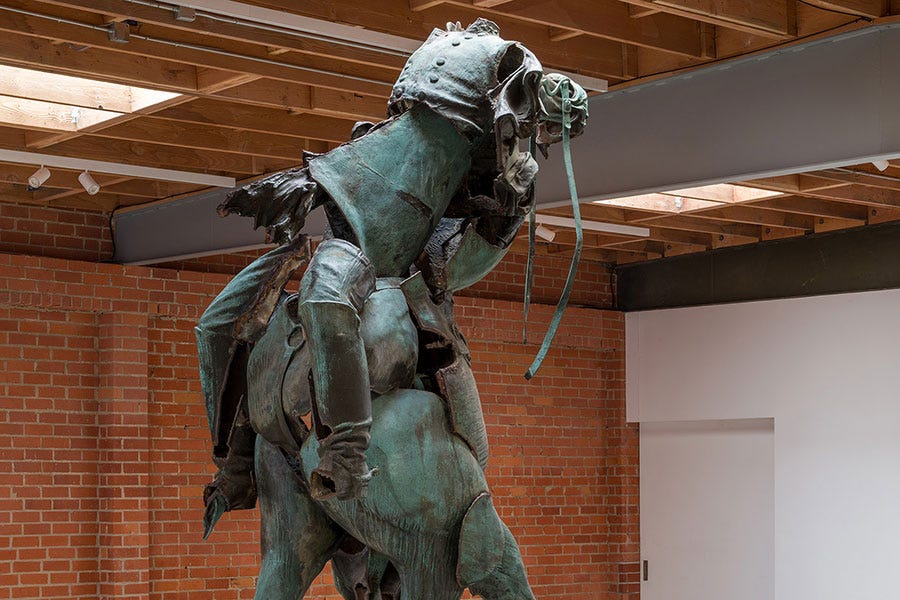
More than eleven feet tall, this uncanny sculpture is as much a work of inventive deformation as it is a feat of creativity. Unmanned Drone began life as a bronze equestrian monument to the Confederate general Stonewall Jackson that commanded a public plaza in Charlottesville, Virginia, for a century until it was decommissioned in 2021. One of the countless Confederate monuments that sprang up around the South during the era of Jim Crow, its ceremonious unveiling featured a parade of five thousand people, including Confederate veterans as well as a troupe of public school students who formed a “living” Confederate flag. The monument showed Jackson riding determinedly into battle, and it was created by the noted sculptor Charles Keck, an artist with a knack for producing heroic figures that retained an air of naturalism. An article published in The New York Times before its installation in 1921 predicted that “it will rank as the best figure of that celebrated warrior in the country.” That celebrated warrior has now been transformed into an aberrant chimera.
Read the full article on the Review’s website here.

David Shulman
Evil in the West Bank
For the last three years or so, the pastoral West Bank village of Ras al-‘Ain was my home away from home, its Bedouin people an extended family. Israeli settlers living in illegal outposts adjacent to the village assaulted it daily throughout these years and have now finally overwhelmed it. All the families have taken apart their houses and left.
Ras al-‘Ain was the last large Palestinian village in the southern Jordan Valley. The others, including the twin village of Mu‘arrajat two miles away, had been destroyed and their people expelled in a highly effective campaign of ethnic cleansing backed by the Israeli government. For many decades roughly a thousand people lived in Ras al-‘Ain. They belonged to three Bedouin tribes—Rashaida, Jahalin, and Ka‘abneh—that united in the hope that together they could withstand settler violence. Most of the villagers were shepherds, surviving in a subsistence economy. On the night of March 7, 2025, dozens of heavily armed settlers under the protection of the police and the army invaded Ras al-‘Ain and stole at least a thousand, and possibly as many as 1,500, of the villagers’ sheep and goats. We have excellent video documentation, taken by two remarkably courageous activists, of that raid. The Palestinian owners submitted a formal complaint to the police, with the video documentation, but—as usual these days—within a few hours the police closed the file on the grounds that there was no supporting evidence. A thousand sheep are worth some two million Israeli shekels. The economic foundation of the village was devastated.
Read the full article on the Review’s website here.

Edward Mendelson
Deeper Than They Thought
In 1924, at twenty-eight, Margaret Kennedy won world fame for her second novel, The Constant Nymph, the story of the unconflicted sexual awakening of Tessa Sanger, the daughter of a bohemian English composer whose legitimate and illegitimate children are scattered across much of Europe, and who lives with some of them, including Tessa, in voluntary exile on a Tyrolean mountaintop. When the father dies, Tessa is banished from her rural Eden and confined to the repressive world of English schools and English middle-class morality. At the end of the book, when she is not yet sixteen, she runs off from London to a pension in Brussels, joined en route by Lewis Dodd, her would-be lover, still legally married to Tessa’s calculating older cousin Florence, who simultaneously hates him and is sexually obsessed with him. Sitting in the same room with Lewis, shortly before he can join her, as she hopes, in what the pension keeper calls “a good bed,” Tessa dies of a congenitally weak heart while struggling to open a window—and propriety is preserved.
Sex and bohemianism made the book an instant success: an advertisement called it “the novel that is being talked about all over London.” What seems to have driven the talk was the book’s clear-sighted account of female sexuality, a subject notoriously simplified or idealized in English fiction. At the time, the most famous British books on the subject were obvious products of authorial fantasy: H.G. Wells’s Ann Veronica (1909), with its heroine’s forthright desire leading to a stable, happy marriage to the older man who represents the author (in real life, Ann’s original left Wells after a disastrously chaotic affair), and Edith Maud Hull’s The Sheik (1919), with its haughty young heroine who, having been kidnapped and kept as the unwilling concubine of the title character, finds that she is passionately in love with him. Tessa, though obviously stylized and fictional, seemed to represent something real.
Read the full article on the Review’s website here.

More from our March 12 issue…
Tim Judah on winter in Ukraine
Thomas Powers on Mayor Bernie
Sophie Pinkham on the perverse humor of a dying Soviet poet
Linda Greenhouse on Justice Anthony Kennedy’s unpredictable power
Magda Teter on the first Torah scholars
Christopher Benfey on Jefferson and Madison’s excellent adventure
Anjan Sundaram on environmental defenders in Mexico
Marina Harss on Alexei Ratmansky’s ballet of peace
Alec Wilkinson on the physicist Luis Alvarez’s solutions to the twentieth century
Colin Grant on a novel about Jamaica’s shadowy history
Poems by Chloe Wilson and Stephanie Burt