From the Horse’s Mouth: An Interview with Lisa Hanawalt
“Punwise, I didn’t feel too reined in on BoJack. If I was champing at the bit to use a joke somewhere, I could usually find a place to trot it out!”

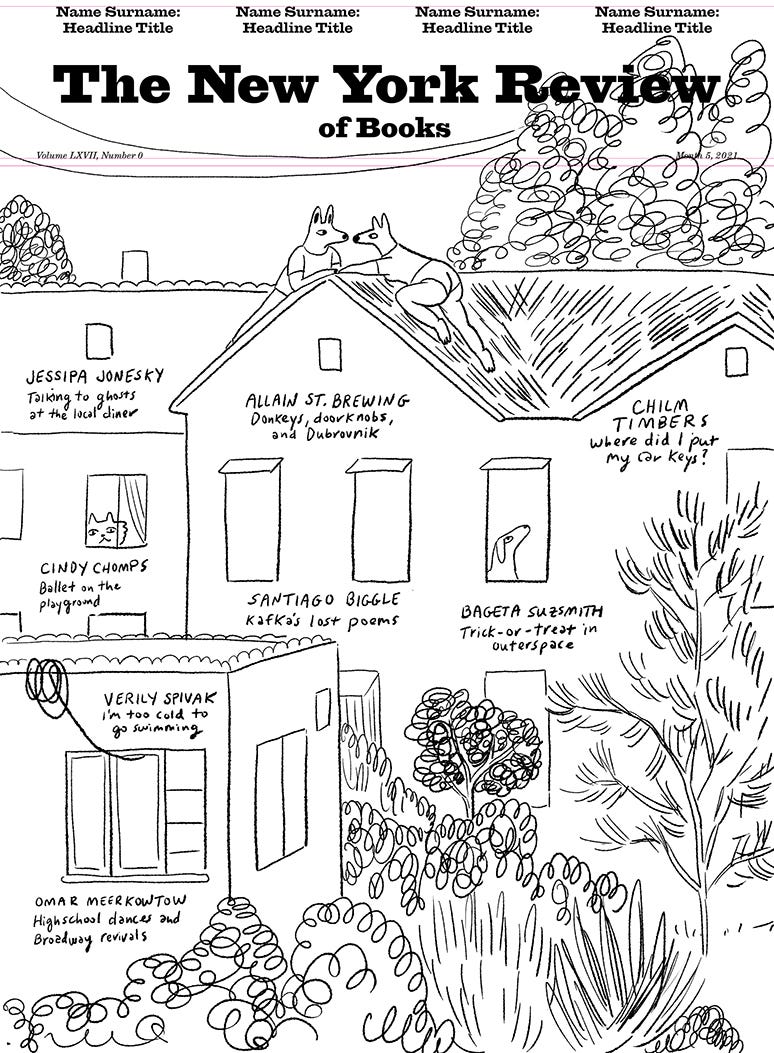
In 2013, shortly after I gave birth to my daughter, the Canadian publisher Drawn and Quarterly sent me a copy of My Dirty Dumb Eyes, by Lisa Hanawalt. Her art and writing made me laugh out loud through the mire of postpartum depression, and I’ve been a devoted fan ever since. So this June I direct-messaged her to ask if she might draw the cover for our Summer Issue; to my delight, she accepted. In an early sketch, Hanawalt included some made-up coverlines, which I wished were real: Jessipa Jonesky: Talking to Ghosts at the Local Diner; Allain St. Brewing: Donkeys, Doorknobs, and Dubrivnik; Chilm Timbers: Where Did I Put My Car Keys?; Cindy Chomps: Ballet on the Playground; Santiago Biggle: Kafka’s Lost Poems; Bageta Suzsmith: Trick-or-Treat in Outerspace; Verily Spivak: I’m Too Cold to Go Swimming; Omar Meerkowtow: High School Dances and Broadway Revivals.
Hanawalt’s genius, I think, is in her evocation of the bodily and disembodied absurdities of being human and animal at the same time. She is best known as the creator of the television series BoJack Horseman (2014–2020), about a depressed horse-man, which Adam Thirlwell called, enthusiastically, “an opioid version” of Ibsen in our August 20, 2020, issue. She followed BoJack with the series Tuca and Bertie (2019–2022), which makes my now teenage daughter crack up. In addition to My Dumb Dirty Eyes, Hanawalt has also written and illustrated the books Hot Dog Taste Test (2016) and Coyote Doggirl (2018), and she illustrated the children’s book Benny’s Brigade (2012).
Hanawalt lives in Los Angeles, where she rides her horse, Juniper. Her graphic memoir, I Can’t Stop Thinking About Horses and Sex, will publish in October. I wrote to her last month to ask about writing, her childhood, and her sense of humor.
Leanne Shapton: What were you like as a child? What did you grow up looking at?
Lisa Hanawalt: I was always daydreaming and drawing during class, fully embodied in my fursonas at all times, afraid to shit, shy, hyper, tomboyish, and crushing on boys. I grew up looking at Bambi, Garfield, Lisa Simpson, and the Guns N’ Roses music video for “November Rain.”
Do you write as much as you draw, or do they happen simultaneously?
I think it’s an even, fifty-fifty split, but I am more confident drawing. With writing, I never quite feel like I’m nailing it.
It’s crazy to hear you say you don’t think you nail your writing. You’re so adept at folly and phrasing and dialogue. What are some books you’ve been reading or rereading?
I’ve been having an attack of bad attention span (self- and Meta-inflicted) and need to lock in, but I’ve been slowly reading Oscar Wilde’s The Picture of Dorian Gray, and it’s a hoot! A gothic hoot! I have also been returning to Laurie Colwin’s books, especially Happy All the Time. I just love how she writes about crabby, weird, horny women.
So where did the image on the Review’s cover come from?
I drew it in my sketchbook, lying on my couch, staring out the window at night, while watching The Truman Show.
Your writing and dialogue tend to be sophisticated and sly—unselfconsciously funny—while at the same time sincere and heartfelt. Where does your sense of humor come from?
My family is funny, I’m drawn to class clowns, and I watch and read a lot of comedy, so by osmosis I’m kinda funny too. Humor is also one of the best, least self-destructive coping mechanisms for pain and depression...not to get too serious.
What comedy have you been watching or reading? For example, I’m curious if you’ve read Tony Tulathimutte’s Rejection.
I loved Rejection so much, I drew some fan art and mailed it to Tony (I never do stuff like that). He’s the king. He also wrote the funniest “Grub Street Diet” entry ever.
Sam Irby recently wrote a blog post called “How to Stay Married” that I can’t stop thinking about.
I saw the comedian Steph Tolev open for Stavros Halkias at the Wiltern, in LA, and my face hurt from laughing, she’s so wildly lewd. Both of them were incredible.
Sandy Honig made a short film, The Weird Guy, last year that is so funny and also gorgeously shot. I also really enjoyed her episode of Caleb Hearon’s podcast So True.
I love watching the improv show Make Some Noise, on the Dropout network.
Brittani Nichols wrote a short substack post about how she doesn’t have writer’s block that made me laugh a lot. (Same here, I don’t have that.)
Is there an animal pun you never found a use for in BoJack that you’d like to put somewhere?
Punwise, I didn’t feel too reined in on BoJack. If I was champing at the bit to use a joke somewhere, I could usually find a place to trot it out! So, to answer your question...neight really.
What traditions (visually and verbally) do you think your work follows, if any?
Storytelling in the oldest sense, like people telling fables around a fire and drawing stuff on cave walls.
What’s your relationship with the publishers Drawn and Quarterly like?
I’ve done five books with them (including the upcoming I Can’t Stop Thinking About Sex and Horses! Out this Fall! Plug!!)—we have a lot of mutual trust and they give me a lot of creative freedom, and because we’ve signed a sacred blood bond. As a young, I didn’t pay much attention to or understand what comics publishers did, and I didn’t know their blood oath rituals required so much blood! (This is a joke, I’m joking)
I’m interested in nonverbal communication. How do you communicate with the horses in your life?
I talk to my horse, smell her breath, and scratch her back until I get manure under my nails. I feel disembodied from spending too much time on the internet, so this helps ground me and lift my mood. Her name is Juniper and I’m basically using her as an SSRI, so maybe I should have named her “Zoloft.”