Doom Curation
Inside the May 14 Art Issue


Art for Our Age of Chaos
Jed Perl
“Whitney Biennial 2026” is an enormous show, with works by more than fifty artists filling much of the Whitney Museum of American Art. “New Humans: Memories of the Future,” the opening exhibition at the New Museum’s greatly expanded quarters on the Bowery, is even bigger, with works by more than a hundred artists filling the entire building. The scale of these exhibitions can feel aggressive, even defiant in a period when nearly all cultural institutions are confronting an increasingly distracted public as well as financial challenges that began long before the current administration came to power in Washington. Although the Biennial aims to take the temperature of contemporary art and “New Humans” is a historical show that explores the moral and philosophical impact of the technological advances of the past hundred years, the layouts of the exhibitions are surprisingly similar. In both of them, works that fill entire rooms are juxtaposed, sometimes uneasily, with offerings that are almost miniature, as if the curators had decided there were only two ways for a work of art to persuade the public: either by shouting or by whispering.
Read the full article on the Review’s website here.

Manet and Morisot: Game On
Susan Tallman
In the spring of 1870, Berthe Morisot was fretting over one of her submissions to that year’s Paris Salon. Still in her twenties, Morisot was a respected painter, best known for her landscapes, and had been tutored by Jean-Baptiste-Camille Corot, the influential Barbizon school painter of fluttery fields and woodlands. She had shown in all but one of the previous six Salons, but the new work was a departure—a double portrait of her beloved sister Edma and their mother, seated together while Mme Morisot reads.
On the advice of the painter Pierre Puvis de Chavannes, Morisot had reworked her mother’s head but was still dissatisfied. Seeking another set of eyes, she turned to Édouard Manet. He and Morisot had become friends—their families ran in the same circles, and she had served as a model (clothes on, with her mother in attendance) for his enigmatic set piece The Balcony (1868–1869). He came round to consult and, Morisot reported, thought her double portrait “very good” with the exception of the lower part of Mme Morisot’s dress. To show how it might be fixed, he grabbed some brushes and added a few accents. Then he kept going. By the time he put the brushes down, hours later, the figure of Mme Morisot had been retouched from hem to head. Berthe was mortified.
Read the full article on the Review’s website here.

‘The Music of What Happens’
Nick Laird
To many, Seamus Heaney is the preeminent Anglophone poet of the latter half of the twentieth century. He’s certainly one of the most celebrated. He was born in County Derry in 1939, and when he died in Dublin in 2013 his death reverberated around the world. It was reported with a huge photograph on the front page of The New York Times—above the fold. “Not even Frank got that!” as a New York cabbie said to a friend of mine.
By the time he died Heaney was much more than an Irish poet, more than the “smiling public man” of his Nobel predecessor Yeats’s later years; he had entered the kind of literary stratosphere where one is not only quoted by emperors and presidents but visited by them.
His first collection, Death of a Naturalist, was published by Faber and Faber in 1966 and was followed by eleven other volumes of poetry, as well as collections of literary criticism, anthologies, translations, and verse plays. The past few years have seen a consolidation of his work: The Translations of Seamus Heaney (2023) was followed by The Letters of Seamus Heaney (2024), and last October came The Poems of Seamus Heaney, comprising the collected work and some two hundred uncollected poems. A full-length biography by Fintan O’Toole is in the works. In 1995 Heaney was awarded the Nobel Prize in Literature for “works of lyrical beauty and ethical depth, which exalt everyday miracles and the living past.”
Is it possible to imagine such a poetic career happening now?
Read the full article on the Review’s website here.

A Vital Unconscious
Coco Fusco
In the middle of the twentieth century the Cuban-born painter Wifredo Lam made the African presence in his homeland the driving force of his oeuvre, in drawings and paintings filled with totemic figures that often float in dark, monochromatic spaces. It has taken a long time for the originality of that aesthetic and political orientation to be fully appreciated in the United States. His most famous painting, La jungla (The Jungle, 1942–1943), was acquired by the Museum of Modern Art in 1945, but for many years it hung by the coatroom in the museum’s entrance. In an infamous essay published in 1988, the critic John Yau called attention to the negative implications of that marginal location. Some four decades later MoMA has finally taken a major step by reconsidering the artist’s relevance to the canon. “When I Don’t Sleep, I Dream” is the most comprehensive survey that Lam has ever had in the US. Thanks to the thoughtful curatorial efforts of Beverly Adams and Christophe Cherix, Lam’s imaginative attempts to capture the beliefs and the spirit of resistance of Black Cubans can finally be seen for what they were: an effort to decolonize European modernism.
Read the full article on the Review’s website here.
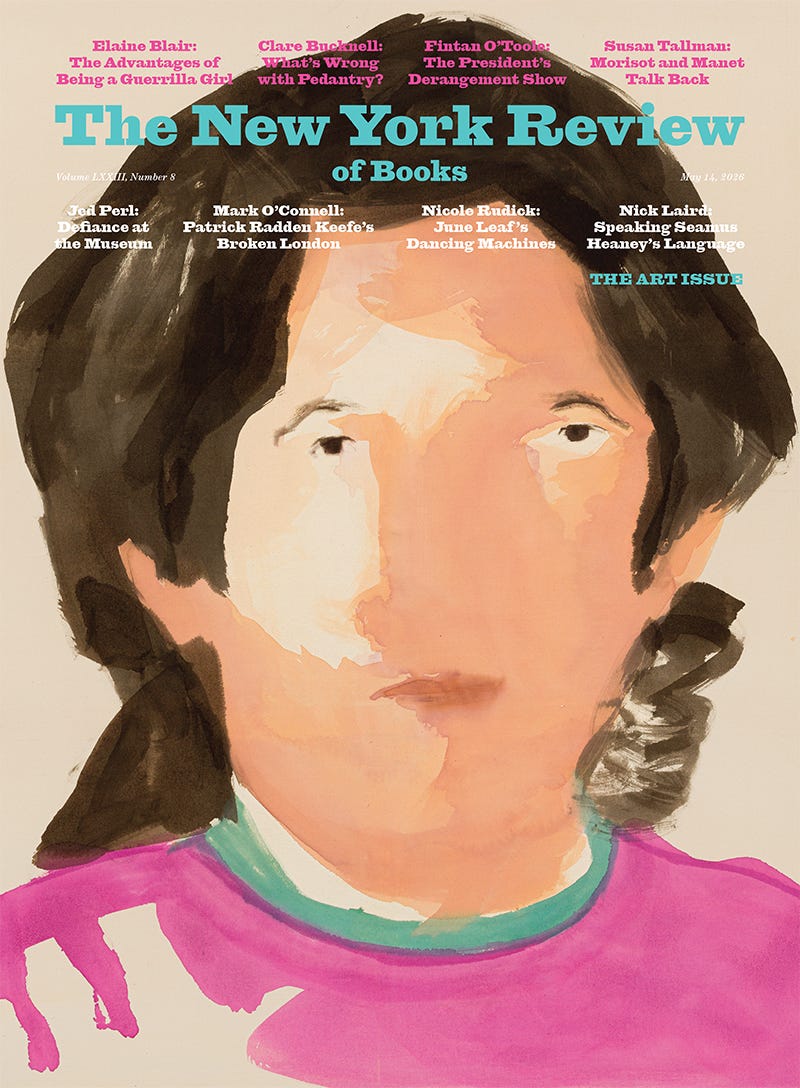
More from The Art Issue…
Clare Bucknell on know-it-alls
Nicole Rudick on June Leaf’s unique vision
Elaine Blair on the Guerrilla Girls
Rosa Lyster on the evaporating salt lakes
Julian Bell on Joseph Wright of Derby
Dennis Lim on low-resolution cinema
Martin Filler on David Adjaye’s demons
Mark O’Connell on a boy’s death in London
Fintan O’Toole on the president’s precarious insanity
Poems by Fiona Sze-Lorrain and Paul Muldoon