Dead Weight Center
Bryce Covert on Joe Manchin

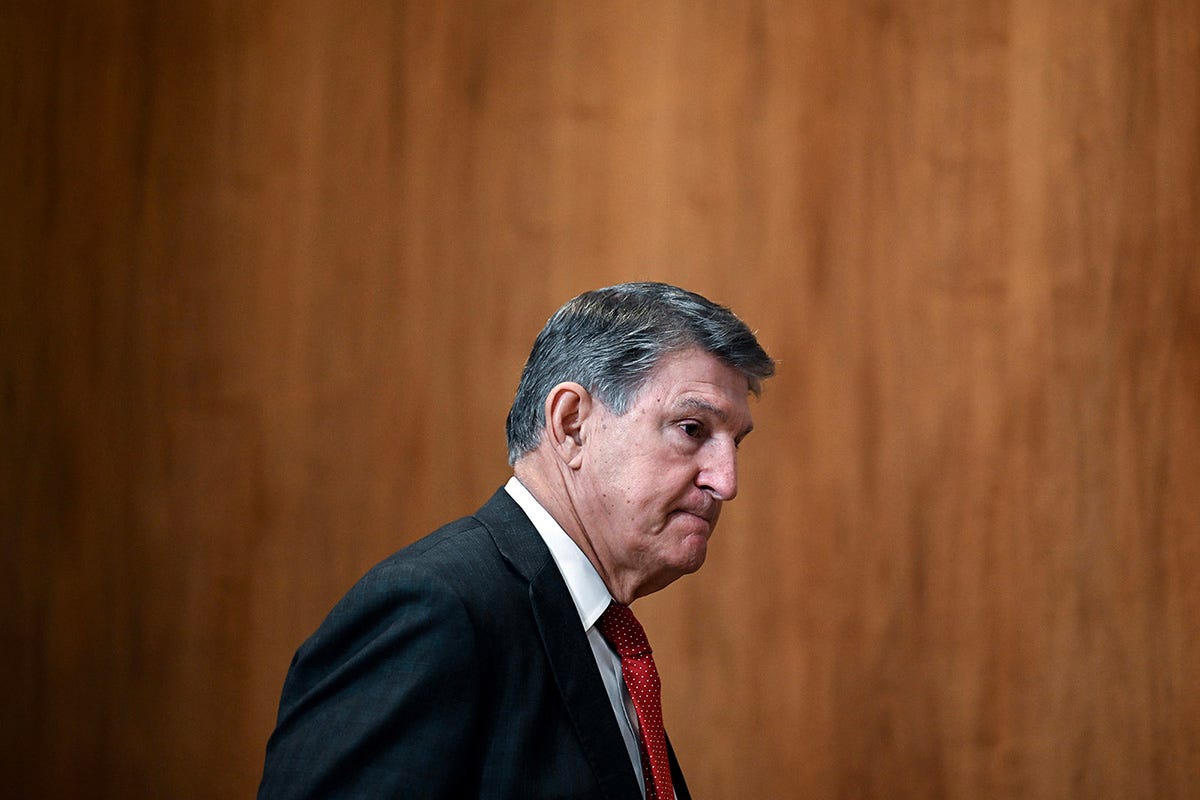
For the Review’s July 23 issue, Bryce Covert reads Dead Center, the unsettlingly titled memoir by former senator and former Democrat Joe Manchin. As Covert writes, the adamant centrist and underminer of his former party’s legislative efforts has written a similarly frustrating book:
It feels as if he’s speaking from an alternate universe, one where the structures of our political system aren’t being torn down and our neighbors aren’t being terrorized before our eyes by authoritarian violence. His book may have nothing to say about the very real dangers we face, but it is starkly revealing of the worldview that got us here.
And part of that worldview? An uncompromising insistence on compromising Democratic priorities:
Manchin sees power as something to be used as a last resort, if at all.… This, to him, is somehow unthinkable—that a party elected on commitments to increase the minimum wage and send out stimulus checks would use the authority voters had handed it to actually do those things.
Below, alongside Covert’s essay, we have collected five articles from our archive about a handful of the country’s more accomplished legislators.
Compromised Values
Bryce Covert
If one were to imagine an alternate timeline in which Kamala Harris won the 2024 election—persuading voters for whom pessimism about the economy was often the dominant issue—perhaps the decisive episode to revisit would be the death of Joe Biden’s Build Back Better legislative package. This, as much as any, may have been the moment when reality forked. Under the plan an estimated 3.4 million Americans would have gained health insurance, families would have saved thousands each year on childcare, and 35 million households would have been able to rely on monthly payments from an enhanced child tax credit, among many other provisions to make life more affordable. Its collapse helped convince voters who wanted solutions to the insecurity created by inflation and the long-simmering crisis of inequality that Democrats lacked the necessary fighting spirit. The legislation passed the House and had support from every Democrat in the Senate—except one.
Joe Manchin opens his memoir, Dead Center, with a meeting in the White House. In stilted reconstructed dialogue, the now retired Democratic senator from West Virginia—who declared himself an independent shortly before the end of his last term—dramatizes his conversation with Biden in the Oval Office on December 14, 2021. The president, calling Build Back Better “my hallmark legislation,” is asking for his vote. Manchin responds that passing the bill would “forever change the psyche of this country to be ‘what more can my country do for me.’” He recounts how, after the meeting, he went on Fox News and announced that he would vote no. “I had just killed Joe Biden’s ‘hallmark legislation,’” Manchin writes, with evident glee.
The tone of this passage is typical of a book that—somewhat incredibly, given the political moment in which it was published—reads like a valedictory address. “The greatest conundrum in politics today is the relentless pressure to align fully with one side or the other,” Manchin writes. The other problems that consume him include the size of the national debt, the possible desecration of the filibuster, and the price tags of various pieces of legislation. It feels as if he’s speaking from an alternate universe, one where the structures of our political system aren’t being torn down and our neighbors aren’t being terrorized before our eyes by authoritarian violence. His book may have nothing to say about the very real dangers we face, but it is starkly revealing of the worldview that got us here.
Read the full article on the Review’s website here.
From the Archives: The Bully Pulpit
Richard H. Rovere on Joseph McCarthy vs. the reds (1965)
Garrett Epps on Jesse Helms vs. the liberal media (1987)
Nicolas Lemann on Huey Long vs. propriety (1992)
Julia Reed on Bob Packwood vs. the Ethics Committee (1996)
Robert G. Kaiser on Mitch McConnell vs. himself (2016)