

City of Angelico
Ingrid D. Rowland on Fra Angelico

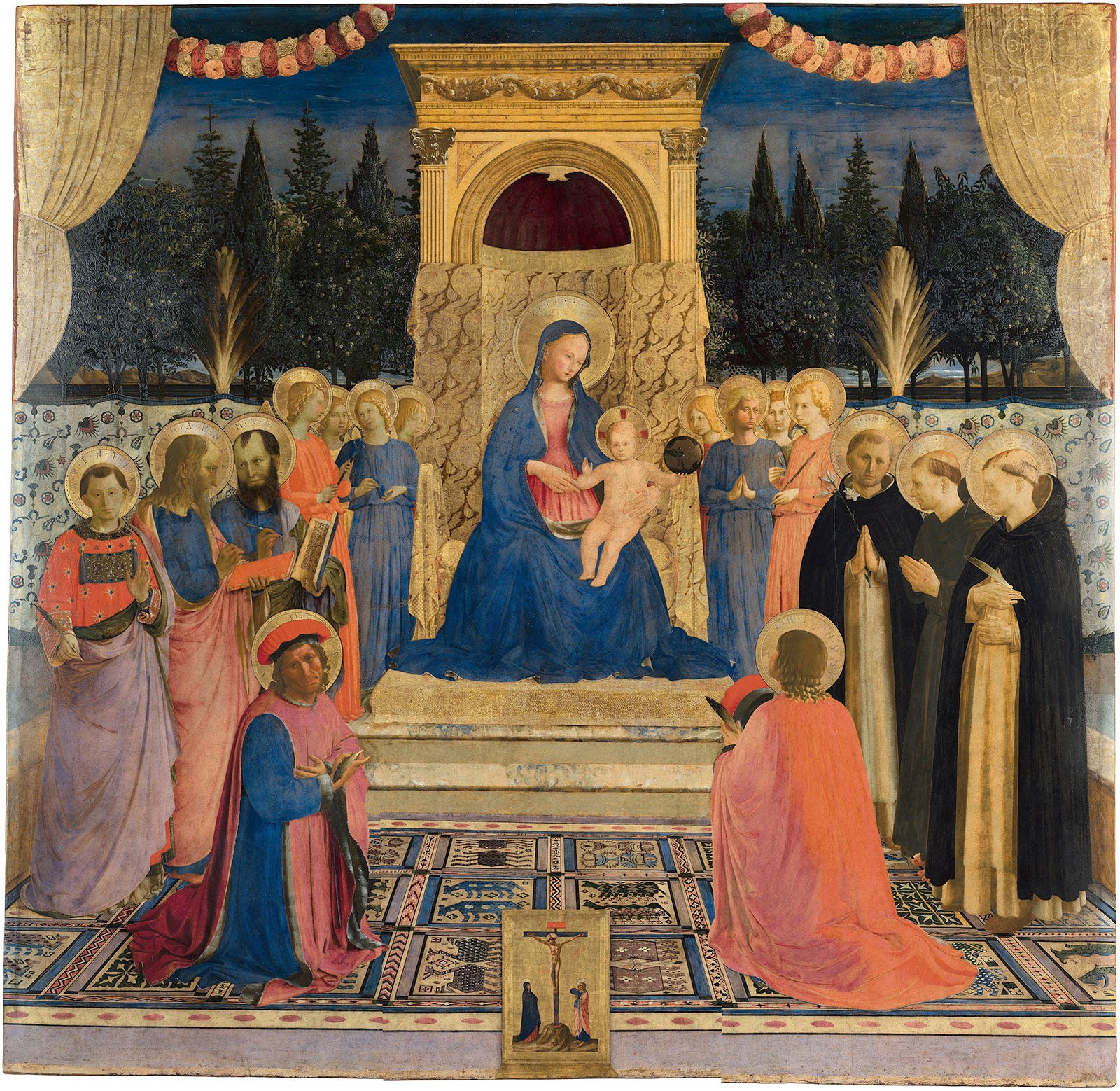
In the Review’s February 26 issue, Ingrid D. Rowland visits a “grand,” “triumphant,” “dazzling” exhibition of Fra Angelico’s paintings, frescoes, and early illuminated manuscripts spread across the Palazzo Strozzi and the Museo di San Marco in Florence.
Below, alongside Rowland’s essay, are five articles from our archives about Renaissance Florentine artists.
In 2006 the city of Florence leased three floors of the Palazzo Strozzi to a private consortium of Tuscan banks for the creation of a public exhibition space. Centrally located near the site of the city’s ancient forum (Florence began life as a Roman military camp), the enormous palazzo was built between 1489 and 1538 for the Strozzi, a dynasty of Renaissance bankers, and designed as a challenge to the Medici, their inveterate enemies. Under its first director, the Anglo-Canadian James Bradburne, the Fondazione Palazzo Strozzi quickly claimed a special place in Florentine cultural life, not least because the irrepressibly imaginative Bradburne threw open its ground floor to anyone passing by.
The idyll ended in 2014, when the institution’s governing body decided to shift its focus, not without input from the former mayor of Florence and newly elected prime minister, Matteo Renzi, then at the crest of his brash popularity. Bradburne’s Italian-born successor, Arturo Galansino, appointed in 2015, has faithfully and competently fulfilled an evident mandate to bring in more contemporary artists, cut costs, and raise funds, but the madcap spirit of the place and, ironically, the connection with Florence went missing in the process. “Contemporary art” mostly means international art, whereas many of Bradburne’s historically oriented exhibitions had tilled, with conspicuous success, the fertile soil of Florentine art, history, and finance, not to mention the persistent impact of these forces on the city’s civic life then and now.
Perhaps this is why, between exhibitions dedicated to the young Georgian artist Andro Eradze and to the Latvian American Mark Rothko, Palazzo Strozzi once again turned its attention backward in time to an artist who began to flourish six hundred years ago. Fra Angelico, as the great Tuscan painter is known in the English-speaking world, has been Beato Angelico in Italian ever since Pope John Paul II pronounced him Beatus—blessed, one step away from Catholic sainthood—on October 3, 1982.
A crucial requirement for beatification is an attested miracle, most often an otherwise inexplicable medical cure obtained by prayer to the candidate, but for this fifteenth-century artist the pontiff declared, reasonably enough, that his paintings, exclusively on religious themes, qualified as miraculous in themselves. And because the largest concentration of those miraculous paintings is now found in Florence, Angelico provided the perfect pretext for an exhibition that would once again tie Palazzo Strozzi to every level of local and national government, from the Commune of Florence to the Region of Tuscany, the Italian Ministry of Culture, and, far from coincidentally, the Catholic Church in the Jubilee Year of 2025. Four years in the making, the exhibition, eventually split between Palazzo Strozzi and the Museo di San Marco, the former Dominican convent where Angelico lived and painted between 1438 and 1450 (the precise dates are unknown), was conceived from the outset as a grand event.
And grand it proved to be, a triumphant display of dazzling color and impeccable, microscopically detailed workmanship. The weighty catalog, edited by the exhibition’s curator, Carl Brandon Strehlke, an American-born resident of Florence, features an international list of contributors. The essays, directed toward fellow specialists, show how little we still know about many phases of the artist’s life, including who taught him; there is much about which the contributors do not agree. Individual entries discuss the adventures worthy of a picaresque novel that many of the paintings on display endured after they were uprooted from their original settings between 1808 and 1810, when Napoleon Bonaparte closed the convents of Tuscany and left residents, buildings, and contents to their fates. These religious establishments fared no better between 1865 and 1870, when Florence served as the capital of the newly created Kingdom of Italy, which was at war with the Papal States of Pope Pius IX. The Dominican convent of San Marco was deconsecrated in the nineteenth century and eventually transformed into the museum that hosted the second half of the Angelico exhibition. Palazzo Strozzi displayed the artist’s more public works; at San Marco we got a bracing glimpse into his austerely disciplined private life.
Read the full article on the Review’s website here.
From the Archives: Be My Florentine
Andrew Butterfield on Donatello
Julian Bell on Piero della Francesca
H.W. Janson on Lucca della Robbia
John Pope-Hennessy on the Pollajuolo brothers
Garry Wills on the “Gates of Paradise” to Florence’s Baptistery of San Giovanni
If you like our Substack, consider subscribing to our magazine by visiting nybooks.com/substack for a special discount on a full subscription.