

Building at the Speed of China
Inside our April 9 issue

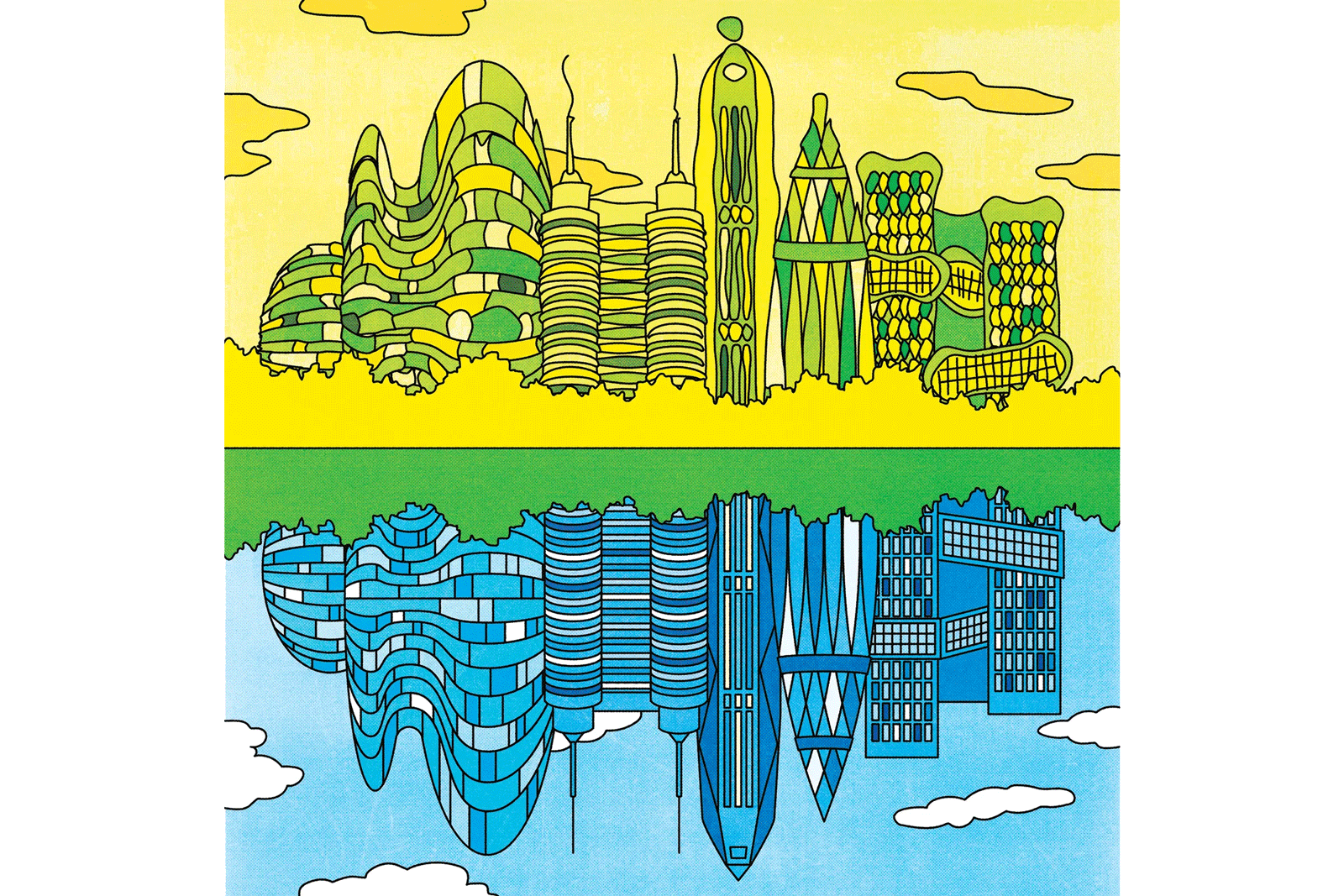
Yi-Ling Liu
Shenzhen Express
China now weighs heavily on the minds of US industrial policy planners, just as the US has long served as a benchmark for China’s development. But comparisons between the two countries have become increasingly simplistic and outdated, burdened by nationalist fervor and moral judgments. While old labels like “autocratic” and “democratic,” “capitalist” and “communist” still have some use, when trying to make sense of both countries today the distinctions often fall apart, as [Dan] Wang writes. How can China be described as a communist state if it offers only a “threadbare social safety net” and bans independent workers’ unions? How can authoritarianism be used to explain both China’s ability to build cars and its capacity to suppress dissent? Wang offers a less ideologically loaded way to make sense of their differences: the China of the last four decades, he argues, is an “engineering state, building big at breakneck speed,” in contrast to the United States, a “lawyerly society, blocking everything it can, good and bad.”
Read the full article on the Review’s website here.

Ben Lerner
Crowds and Lovers
[John] Berger’s novel G. is a field of vibrations—of oscillations, of rapid movements between the instantaneous and the epochal, between the sensuous and the abstract, between the historically particular and the mythological, between realism and the laying bare of the device. Even the moniker “G.” both individuates and deindividuates, only almost giving our protagonist a name. This is fitting for a character who alternates between being a distinct historical person, the son of a candy merchant from Livorno and his English mistress, and a literary trope, a modern variation on Don Juan.
The book follows G.’s amorous career across Europe, from his fascination with an unnamed girl who saves him during the 1898 food riots in Milan—the eleven-year-old G. slipped out of the hotel and into the streets while his parents slept—to those last convulsive days in Trieste, where rioters and soldiers will again face off. (There are often crowds assembling around G.—individuals dissolving into a collective subject—while G. is pursuing what Berger, in another context, called “the shared subjectivity of sex”; the possible relationship between these two modes of intersubjectivity is one of the novel’s organizing questions.) We follow G., but it’s never clear how well we know him.
Read the full article on the Review’s website here.

Miranda Seymour
Deciphering Dame Muriel
Muriel was nineteen and still living at home in 1936 when she met Sydney Oswald Spark, a thirty-two-year-old math teacher, at a local dance hall. A troubled man, his initials later earned him the nickname SOS. Hungry for travel and unaware of his history of mental disturbance—a habit of firing pistols during classes for deaf pupils had impeded his progress in Scottish schools—Muriel agreed to follow him to Southern Rhodesia, where the couple were married the following year.
[Frances] Wilson, notable for the boldness, quicksilver intelligence, and originality of her interpretations of writers as diverse as D.H. Lawrence, Thomas de Quincey, and Dorothy Wordsworth, sees “Ossie” Spark’s surname as having “destined” Muriel to marry him. “The name ‘Muriel’ means ‘sparkle,’” she asserts in a graceful reworking of its origin in the Gaelic muirgheal, meaning “bright sea.” “That, Miss Brodie would say, is its root. Sparkle Spark: nomen omen.”
Read the full article on the Review’s website here.
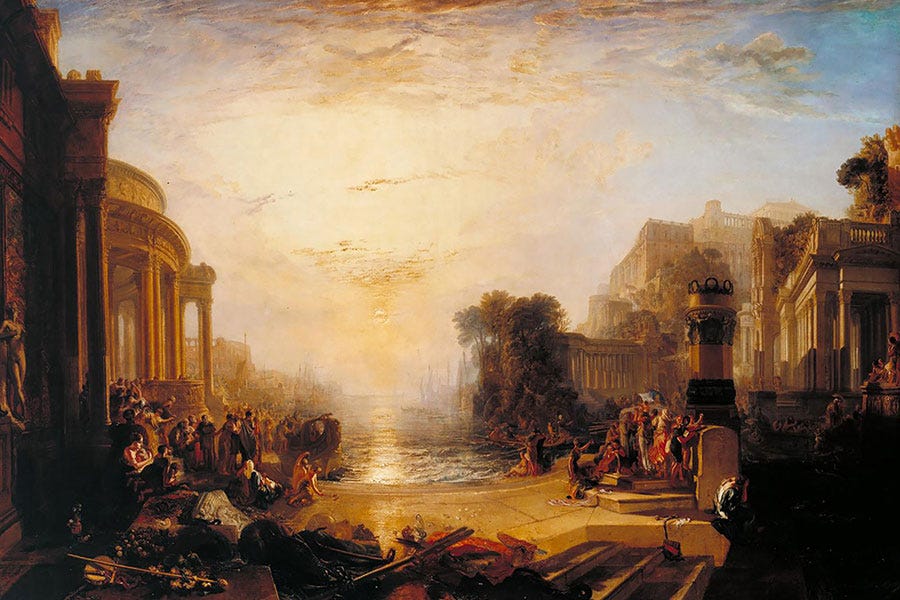
Jenny Uglow
Rivals of the Landscape
J. M. W. Turner and John Constable were born fourteen months apart, Turner in April 1775, Constable in June 1776, and the exhibition “Turner and Constable: Rivals and Originals” at Tate Britain celebrates their 250th birthdays. A friend who was wondering whether to go finally said, “I think I’ll give it a miss—I sort of feel I’ve seen them.” Many of us feel the same. To people growing up in Britain, Turner and Constable seemed to be everywhere: in history texts and guidebooks, on greeting cards, jigsaw puzzles, and biscuit tins, on the walls of pubs and dentists’ waiting rooms. We thought we knew them. But how wrong we were. Far from being familiar or reverential, the Tate show, curated by Amy Concannon, is a revelation. This is partly due to the cumulative power of the works. Dark streams of paint are hurled as rainstorms over mountains, whirling vortices pull the viewer in, sunsets blaze and rainbows arch, so that one almost feels the physical force of Constable’s scumbling brushwork and Turner’s swaths of color. At the same time a sense of intimacy comes from small things clustered among the large: Constable’s sketches of the Cumbrian Mountains, Turner’s rapid notations, Constable’s paint box and sketching chair, Turner’s spectacles and brushes.
Read the full article on the Review’s website here.
More from our April 9 issue…
Pankaj Mishra on India and Iran
Pablo Scheffer on the art of tennis
Joshua Hammer on the hellish firebombing of Tokyo
Dan Rockmore on the allure of algebra
Omari Weekes on Tyriek White’s Brooklyn
Ange Mlinko on költészet
Michael Dirda on The Count of Monte Cristo
Fintan O’Toole on Trump’s meaningless and violent war
Andrew Katzenstein on The Firesign Theatre
David A. Bell on indigenous and enslaved people of colonial France
Robert Pogue Harrison on our stubborn ignorance
Cathleen Schine on Gershom Scholem and the miraculous survival of Kabbalah
James Romm on losing your marbles
a poem by Timothy Donnelly

This is an excellent review of two very good books about China. I don't think we need to worry about Abundance-fans losing their minds over China's manufacturing prowess, which although impressive at times, also he as the ability to destroy millions of lives due to fear and a lack of feedback. I was skeptical about the simple dichotomy between engineers and lawyers, but Dan Wang offers a complex and realistic perspective.