

Becoming Unsupine
The Year in Poetry

Near the end of each December I leaf through the poems we published in the Review since January—an annual audit. With surprising consistency over the years readers have told me, sounding almost confounded, that we seem to have no program when it comes to the poems in our pages: we are not formalist or otherwise, we don’t stick to any one school of enjambment or tone or tempo, we try to publish as much translated work as we can get our hands on. The only real requirement (I don’t usually offer in reply, because I don’t want to start an argument) is that the poems vibrate with some extra charge, the words in their given order gain a valence they don’t or even shouldn’t normally possess—a sort of electrical phenomenon that can be generated in any number of ways and can reach a variety of intensities, some very high, some subtle, some audible only at length, some achieved in tremendous brevity. I don’t mean this to sound like an airy, ahistorical quality, because the vibration depends in part on how the poem’s language relates to the world and political reality and what we call “real life.”
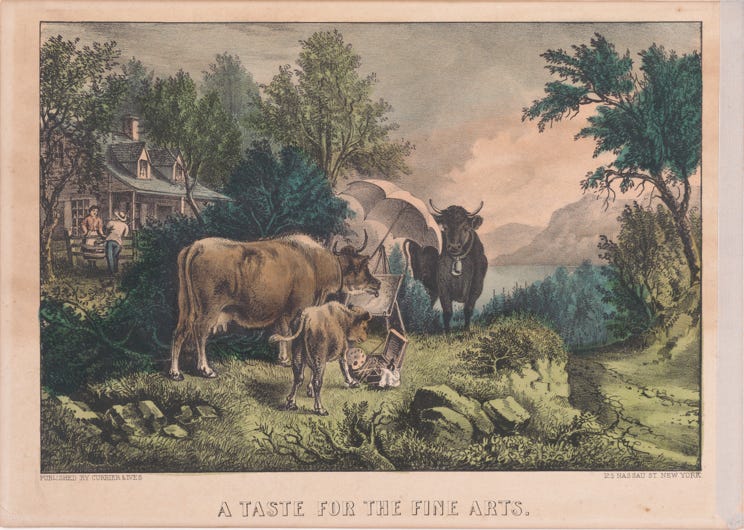
One of the shortest poems in our pages this year was Jane Hirshfield’s “Cows Lying Down,” from the October 9 issue. It’s no disparagement to call it one of the simplest, too. The poem describes a cow (or cows) in the titular position, and then standing up. Yet there is such sly attention paid to their performance of this basic act that by the end—the eighth line—we are made to feel the full weight of meaning inherent in anyone’s becoming “unsupine.” It is, of course, a political poem because it thinks about power—a creature seems (forgive me) utterly not to have it, and then quite naturally yet miraculously exercises it. What might cows know that we don’t?
Ben Lerner’s much longer poem “National Vaccine Injury Compensation Program,” from the May 15 issue, announces its timeliness, its embeddedness in the year’s dismal headlines. Yet as its six stanzas (each of them a considerable nine lines long) flow on, the music of the language and the effect of its collaged phrases melting into each other suggest things altogether deeper than a commentary on RFK Jr.’s latest anti-public-health ukase. Reading this fragmented hymn, with its fleeting punchlines and rain of bitter ironies, becomes its own experience, making you feel anew the experience of everyday life this year, this week:
Why aren’t we in the streets? Well, you’re confused
By the multiethnic nature of the fascist coalitionAgainst the woke mind virus, plus you’re in
And out of town all spring, and air travel is really
Only pretending to play dead, offering weak mint
Inside every white liberal is a tiny, cranky Carl Schmitt…
The Palestinian poet Khaled Juma’s “Just a Loaf” (deftly translated from the Arabic by Tayseer Abu Odeh and Sherah Bloor), from our September 25 issue, uses the most ordinary, conversational language—nothing heightened here except maybe the faint outline of the poem’s form, a sonnet balanced on its head—to communicate an experience of famine that most of our readers will never be unlucky enough to know. The speaker has been looking for a loaf of bread “for ten or so days.” That predicament is noted in the opening six lines, and in the second stanza, the sonnet’s octet, a searing corollary unfolds: we hear the speaker’s children interpret their parent’s inability to feed them. They can’t believe it’s not an intentional punishment, and the helpless parent must feel responsible for that inner injury as well.
Poetry that appears in a magazine of prose is always a little subversive. It brings a different quality of time into our pages, brings different orders of time into contact. Each poem slows the flow of reading and demands a deeper attention. Simultaneously, if all goes well, the poem runs away with you; it ought to be language grabbing you by the lapel, in some sense estranging you from the more transactional language in the prose columns next door. Estranging you and returning you to the page with antennas resensitized, brain more supple. Perish the thought that poetry is “useful,” or that (to borrow Auden) it makes anything happen. Yet a poem might hit you as any real experience does—as a novelty, a bit of a shock, a long denial vaporized. Can novelty be useful? A question with which to greet the New Year.
—Jana Prikryl
A Selection of This Year’s Poetry
Read each poem for free by clicking on the link in the title.
Cows Lying Down
a poem by Jane Hirshfield
A Holstein cow lying down—
it would seem impossible
for such an awkward shape to return to standing. …
National Vaccine Injury Compensation Program
a poem by Ben Lerner
For a variety of reasons they had grown more sensitive
To the presence of birds in their lives as the populations
Declined. Their marriages began to open as parents
Took death into their own hands in Europe and ketamine
Nasal sprays promoted soft focus empathy that lifted…
Just a Loaf
a poem by Khaled Juma, translated from the Arabic by Tayseer Abu Odeh and Sherah Bloor
For ten or so days
I’ve been searching for a loaf,
just a loaf.
They said it vanished from global warehouses.
A child saw it take to the stage,
or was it bombed by a plane. …
Player Piano
a poem by Susan Barba
My face is a case study
in gravity. A face study. A grave.
Effaced, I introduce myself
by name, a quippy
delegate, ceci Susan, …
Bish Bash Falls
a poem by Aaron Poochigian
There is the sheer spectacle of this falls:
it always plummets and it never dies.
But if you close your eyes
the rush recalls…
Barzakh
a poem by Fady Joudah
You scrub from my throat the darkness that sticks to songs
traveling at the speed of light. The songs you play
are all I hear. …
Still
a poem by Laura Kolbe
Tell me about the final day my body—
full as it’ll go without yet changing
size or shape, denser than it ever packed
itself, the last day of Body-Before
—will still not show, when mirror still
won’t mark how underflesh…
Who
a poem by Jorie Graham
can still speak from their cage? It’s been quiet for a while now.
A wind came through &
drowned out the last of the
chatter. It was a terrible chatter.
Then the rain came and we thought it
might clean us. …
Dead Calm
a poem by Carmen Boullosa, translated from the Spanish by Samantha Schnee
Calm in the garden after the night’s wild storm.
Hail’s needle has pierced the flowers, their tender verdure,
embroidering them with death in the darkness;
now all is blind silence. …
The Dybbuk
a poem by Boris Dralyuk
From the parched courtyards of our past
they grope toward us in the night,
the desperate shades of schnooks, outcast
before their debts are paid. One might
be in me as I speak, stuck fast. …
Self-Portrait as Psychology
a poem by Jane Yeh
The straps on my shoes make an X across my feet.
My eyes snap open and shut like a purse. Plink plink.
The way we depart from ourselves when the moon comes out.
The way a cat shows its claws when picked up and held. …
Coyotes
a poem by Karl Kirchwey
Last night I woke to the moonlit field
striped with zigzag bars of shadow
like a destroyer’s flanks, although
it was a hunchback scream that called, …
[To a Strange, Hollow, and Confused Noise, They Heavily Vanish]
a poem by Devon Walker-Figueroa
By now, we’ve all heard,
the worst is over
or like a kingdom
yet to come, the grammar of terracide and Irish
good-byes rinsing our tongues,
which, if we’re being honest, do not wag
with cradle songs the way they used to. …
After a Car Crash
a poem by Milan Děžinský, translated from the Czech by Nathan Fields
The car floated up and flew through
the snow-laden trees.
Later that night when I was coming
back by train from that place
whose name I first heard over
the telephone…
An Untitled Dream Song
a poem by John Berryman
Whereas the moon, the sun, indifferent,
do less than us dream, whereas the troubled store
is looted and fired,
whereas there is continuous taxes and rent
and friend elected, hell swarms on him or
his, whereas one is tired, …
The Swan, No. 20 (Hilma af Klint)
a poem by Victoria Chang
The canvas is flipped from right to left. But the shell is smaller. All morning I thought the shell was the same shell. That it was a seashell. But maybe it’s a snail shell. I knew my placement of the shell on the beach couldn’t have lasted. Now my mind must move. …
No Promises
a poem by Rae Armantrout
If I know you now at all
it’s because I know what not
to say in your presence.
If I remind you of something
you once said or did
you’ll scoff, …
“a cow (or cows) in the titular position” is a nice pun. Or pun-adjacent? Nevertheless, the distinction here between poem title and poem subject is, well, outstanding.
I wish the framework of “power” and “politics” wasn’t the only way of viewing art. And if we are stuck in this lens for another few years, at least let there be something new to say about it.