Back to Black Thursday
Inside our March 26 issue


Jacob Weisberg
Tick, Tick…Boom!
In most episodes of speculative excess, the prevailing mood has been one of denial. From Amsterdam in 1636 to Silicon Valley in 2000, investors have typically insisted they were witnessing not a bubble but a revolution: a new paradigm, the dawn of an era. When challenged on whether prices had become irrational, they reached for the evergreen defense: This time it’s different.
The current boom in artificial intelligence stands apart for its lack of denial. The notion that we are in the frothy, hype-driven phase of technological speculation has become conventional wisdom. Venture capitalists and technologists openly acknowledge that valuations are inflated, expectations are overblown, and vast sums of capital are chasing both promise and illusion. Rather than contesting the bubble’s existence, they embrace it as not only inevitable but perhaps even essential to the breakthroughs ahead. This marks a subtle but significant evolution: where previous bubbles were about believing in the impossible, the current one seems to involve believing in the bubble itself.
Read the full article on the Review’s website here.
Marilynne Robinson
Who Speaks for Us?
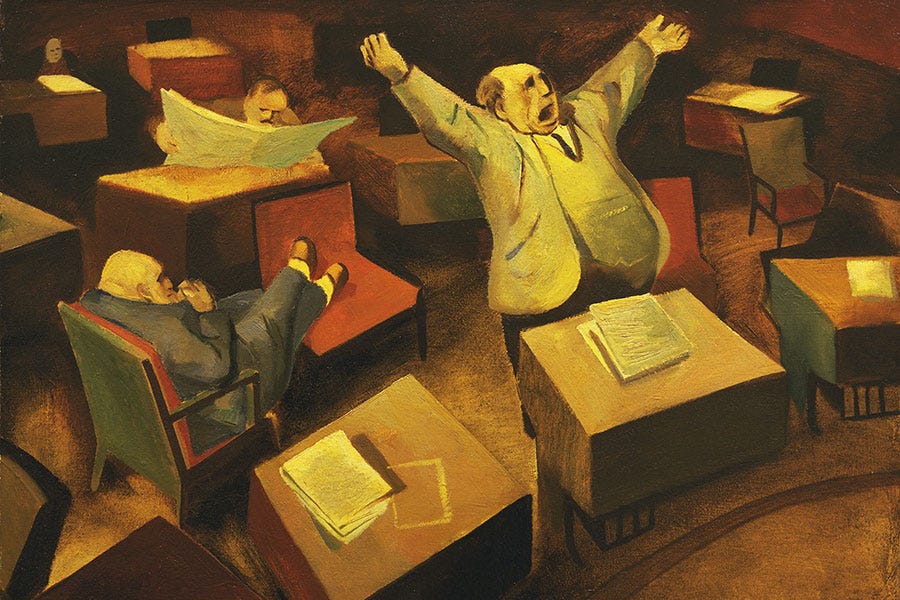
There are too many answers to the question “What went wrong?” I turn to the two-party system because, though it is at present its own worst enemy, there is still hope that it can allow the great public to make decisions about the course of government. It has gone wrong, too, but it can change, almost passively, if it happens to channel the decisions of an impassioned electorate. Insofar as it gives voters power, it is imperiled. It can thwart the intentions of very powerful interests and individuals. This is an assertion of democracy, wonderful or regrettable and benighted, but in any case essential if the historical character of the country is to be preserved.
Read the full article on the Review’s website here.
Ingrid D. Rowland
Artistic License
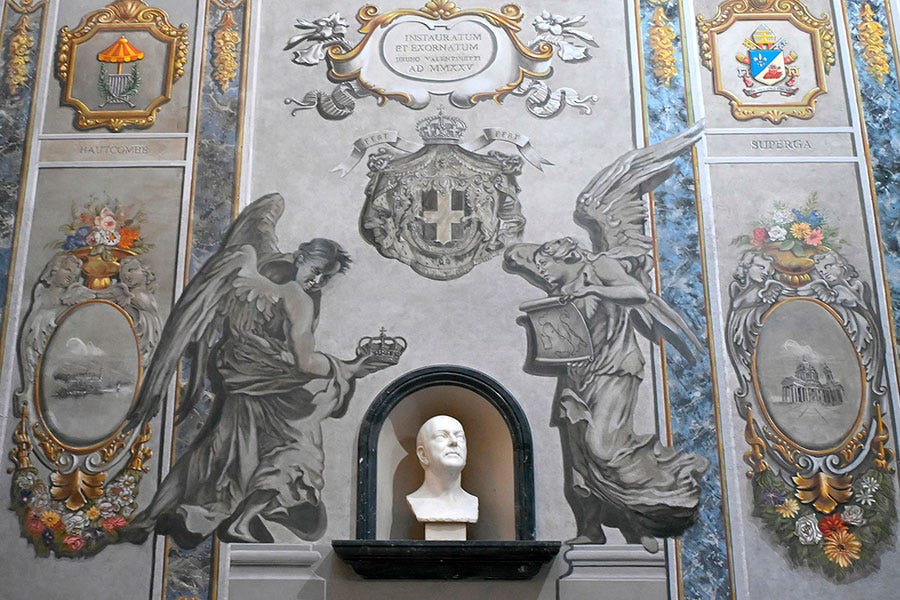
Just after Christmas, as 2025 slipped into 2026, the left-leaning Italian newspaper La Repubblica published a photograph of the restored winged map bearer’s face alongside a photograph of Italian prime minister Giorgia Meloni. The resemblance was beyond denial, from the shape of the figure’s profile to the distinctive shading under the eyes. As the first Italian prime minister since 1946 to come from a neofascist background, Meloni has been a controversial figure throughout her career. Valentinetti turned out to have his own right-wing credentials: in addition to working for Berlusconi, he had also run for city office in Rome in 2008 on the ticket of a coalition of two particularly hardcore neofascist parties, La Destra—Fiamma Tricolore, at the moment when one of Meloni’s longtime fellow travelers in the neofascist Italian Social Movement, Gianni Alemanno, had been elected mayor of Rome. It was easy enough to conclude that Valentinetti’s intervention lent the overtly royalist decorative scheme of the chapel a further layer of political significance, whether he acted on his own initiative, the parish priest’s, the patrons’, or a conjunction of all three.
Read the full article on the Review’s website here.
Meghan O’Gieblyn
The Island That Held Them
In 1914 the Hungarian philosopher Georg Lukács proclaimed the novel “the epic of a world that has been abandoned by God.” As a literary form that arose at a moment when the world was beginning to lose faith in the old myths, the novel dramatizes the tension we now feel between immanence and transcendence—between the subjective meaning of our own lives and the absence of larger meaning in the world.
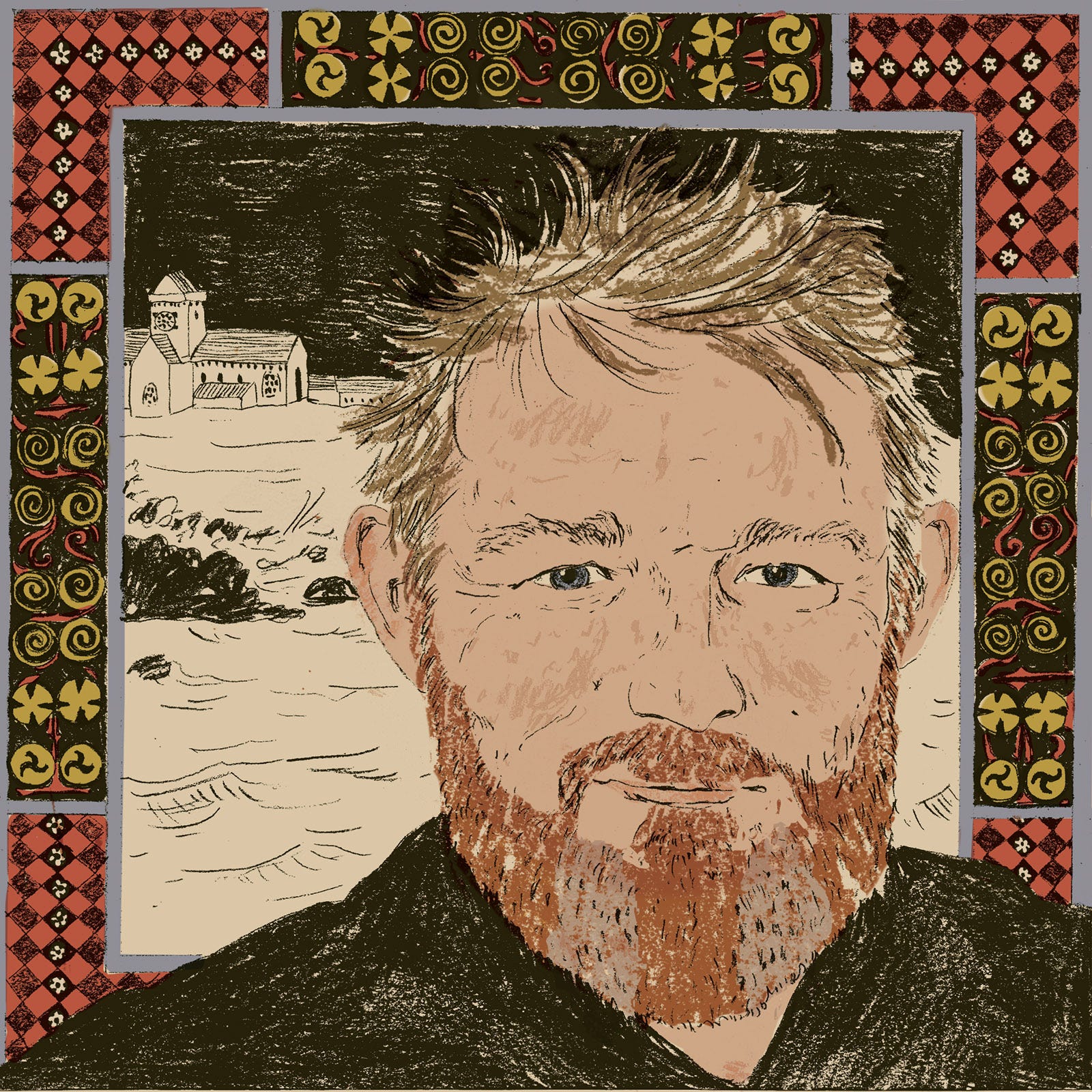
I’ve always found Lukács’s thesis a bit overblown, the frenzied theory of a young Hegelian possessed by the notion that artistic forms could be wedged into a historical dialectic. But I was thinking about it as I read the opening chapter of David Greig’s brilliant and entertaining first novel, The Book of I. The story is set during a period when the old myths were very much alive.
Read the full article on the Review’s website here.
Patricia Lockwood
The Beach Where All Babies Are Born
We mailed ourselves the moonstones home.
Ten pounds of them, a private beach
That cuts and cuts and cuts the feet.
Where all babies are born, but not any of mine.
Read the full poem on the Review’s website here.

More from our March 26 issue…
Robert G. Kaiser on Citizen Bezos
Ruth Bernard Yeazell on Rembrandt
Catherine Nicholson on the first diarist
Nathan Thrall on a lost Hebrew classic about the Nakba
David Cole on the fate of affirmative action
Aaron Matz on the state of satire
Orville Schell on Chiang Kai-shek
Erin Maglaque on radical religious women in early modern England
Mark Lilla on a nineteenth-century protofascist
Anne Enright on a day in the life of Jeffrey Epstein