

Against AI
Inside our June 25 issue


Think for Yourself
Dan Chiasson
April 22, 2026, 5:35 AM
AI has made contemporaneous self-reflexivity almost a necessary precondition for anyone who tries to write about it, now that, from behind the blinking cursor marking my every pause and hesitation in writing this sentence, a serpent waits to strike. I would prefer not to write sentences that track their own emergence from thought; I don’t like the kind of faddish writing that does this, this very thing that I am doing; but now that I feel I must actively preserve thinking as the medium in which language is generated, against Google’s satanic offer to “Help Me Write,” I also feel I should think about what it is I’m preserving, and who, exactly, the tempter is, and why they are so eager to “help me” surrender the pleasure of making the next associative or logical leap on my own, from hints and insinuations found inside a brain that can never fully know itself, or—sorry if this seems vain—tire of trying.
Read the full article on the Review’s website here.

‘We Did Our Best!’
Meghan O’Gieblyn
Years ago, in the early days of the deep learning revolution, a friend asked whether the whole field of AI research, which is roughly 70 percent male, existed because men were jealous of women’s ability to create life. It was not the kind of question that required a reply; the answer was obviously yes. My friend had just had her first child and was possessed of that slightly terrifying primal authority I’d noticed in so many devout feminists who’d recently become mothers.
Privately, I was not entirely convinced. I was writing a book that year about AI, and while I’d come across plenty of researchers who appeared confused about the line between product and progeny, this delusion was not by any means limited to men. If anything, it seemed that the women in the field were prone to speaking of their machines as children they were raising, or even to confessing that they experienced maternal impulses toward them. There was Fei-Fei Li, the so-called godmother of AI, who traced her breakthrough in AI vision to an insight about childhood development. “No one tells a child how to see, especially in the early years,” she said in her 2015 TED Talk. “They learn this through real-world experiences and examples.” As she paced the stage, a photo of her son, Leo, loomed on the enormous screen behind her.
Read the full article on the Review’s website here.

Labour’s Love Lost
Geoffrey Wheatcroft
On the Fourth of July Americans will celebrate their country’s semiquincentennial, no doubt with varying degrees of enthusiasm as they contrast the founders of the republic with their present-day successors. For Sir Keir Starmer, July 4 will also bring mixed feelings. It will be two years to the day since he led the Labour Party to a landslide victory in the 2024 general election, winning 411 of 650 parliamentary seats, while the Conservatives, who had been in office for fourteen years, collapsed, winning only 121. As I observed then, the scale of the Labour victory was deceptive: Starmer gained that huge majority with barely 34 percent of the popular vote. Since the turnout was just below 60 percent—a sharp fall from 67 percent at the previous election in December 2019—that meant only about one British elector in five had voted Labour.
Even so, few of us guessed just how tenuous Starmer’s position would prove or how quickly his authority would shrivel. For more than a year now, voting-intention polls have found that support for Labour is below 25 percent, and Starmer’s approval ratings have been at rock bottom. That was confirmed on May 7 when local elections were held in many parts of England, as were elections for the devolved assemblies in Scotland and Wales. In the English elections Labour lost 1,498 council seats and won only 17 percent of the vote, the same as the Conservatives.
Read the full article on the Review’s website here.

Their Own Private Genesis
Erin Maglaque
They were debating the nature of original sin in an apotheca in Naples. “We discussed a lot of things,” Giovanni Casaburo told the inquisitors in 1598 when they asked him what exactly was said in the apothecary’s shop. “Among them that if Adam hadn’t sinned, eating the forbidden fruit, we wouldn’t have sinned as well.” So far, so orthodox. But then the apothecary Marcello Impicciato joined in. “What apple?” he asked. “Adam and Eve fucked in the ass, and that’s why they were rejected from Paradise.”
What apple? In 1588 Violante Scaglione testified: “Adam’s apple was Eve’s butt, not the pit of the fruit that got stuck in his throat when he was called by God.” They debated it in a tobacconist’s shop in Tuscany in 1702. Did Adam eat an apple, or was it a fig, or a pear? Giuseppe Cinatti said it was no fruit at all—Adam’s sin was “sticking it [his penis] into her ass” instead of “putting it into her cunt,” as God had commanded. One French philosopher phrased it more delicately: “The apple which tempted our first father was the symbol of the rear parts of woman, which very well represents an apple split in half.” An anonymous seventeenth-century student’s notebook records his lecturer’s conclusions: “There were two trees in paradise. Eve ate from one, i.e., was fucked by it, i.e., by Adam’s dick, which was the forbidden fruit.” Italian peasants, apothecaries, friars; French libertines, Dutch philosophers—all believed that Adam sodomized Eve in the Garden of Eden.
Read the full article on the Review’s website here.
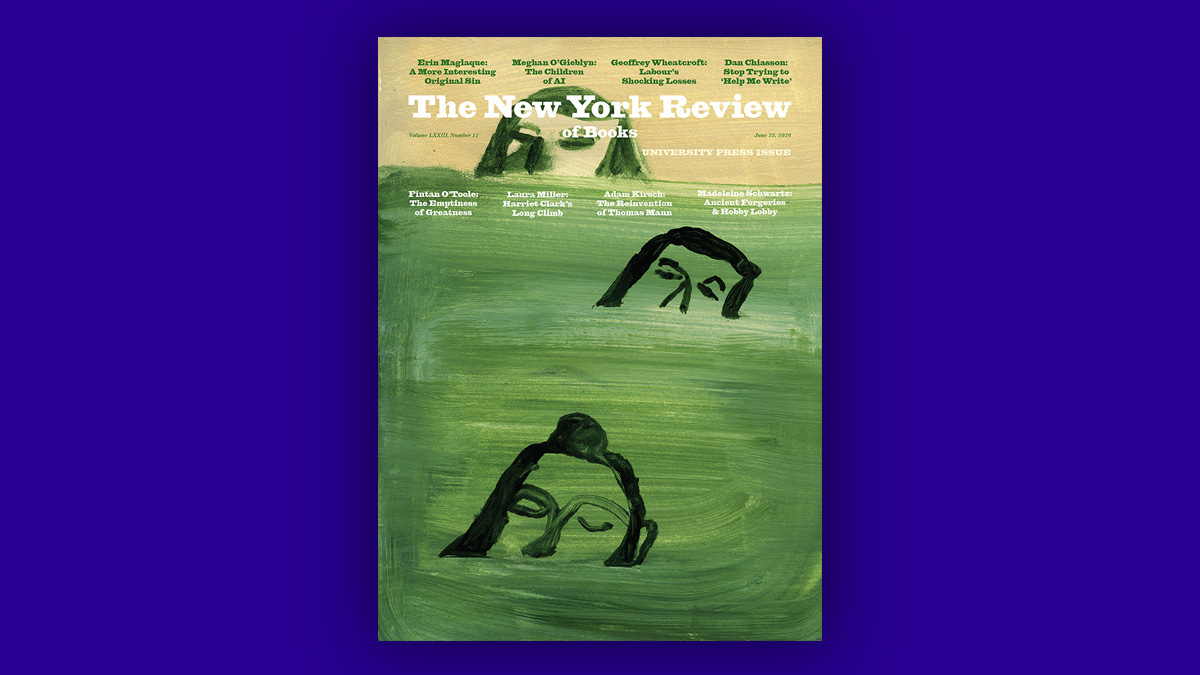
More from our June 25 issue…
Laura Miller on Harriet Clark’s debut novel The Hill
Michael Gorra on the task of the literary agent
Andrew Katzenstein on loving the Mets
Madeleine Schwartz on the purloined papyrus
Gary Saul Morson on Mikhail Bakhtin
Andrew Arsan on democracy and the Middle East
Fintan O’Toole on the president’s empty promise of greatness
Joe Dunthorne on the New York School poets
Adam Kirsch on Thomas Mann’s “sympathy for death”
David S. Reynolds on antebellum America’s rage for pictures
Arya Roshanian on Vincenzo Bellini’s exacting melodies
Magda Teter on the missing Jews of Salonica
At the Galleries with Lovia Gyarkye and Nicole Rudick
Poems by Sandra Lim and D. Nurkse

What is the truth about artificial intelligence? Look at who created it or uses it—the wicked or the righteous—to know what to expect: harm or benefit. (The practical maxim is this: No unexamined artificial intelligence is worthy of your trust or distrust.) That is the truth. (To grasp the truth, proceed like Hector Macdonald: consider all the sides to the story.)
PS Do not be against artificial intelligence in general if harm happens, but against its miscreation or misuse.
https://philosophr.substack.com/p/artificial-intelligence-through-the