

A Devastating, Meaningless War
Fintan O’Toole on Iran

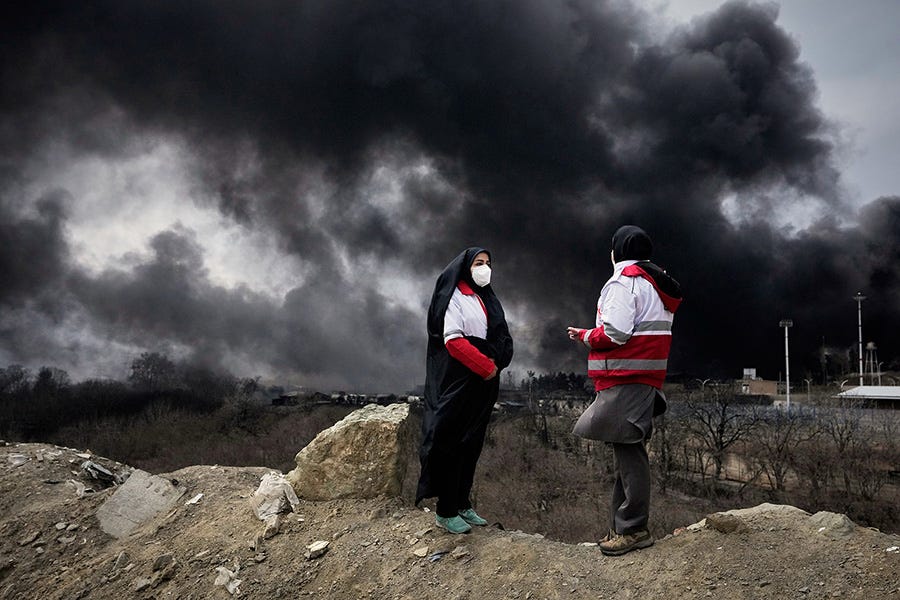
It has now been two and a half weeks since Donald Trump and Benjamin Netanyahu started a war in Iran for a shifting and contradictory set of reasons, which seem to elude the president in any case. Other than murdering hundreds of Iranian civilians and bringing another Khamenei into power, Fintan O’Toole wonders in the Review’s March 13 issue, what is the point of this violence?
In Donald Trump’s war on Iran, everything is meta except the bombs. At the point of impact, where buildings shatter and flesh is shredded, the war inhabits the material world of awful human consequences. But up to that point, as it exists in Trump’s mind, it seems to be a crazy historical pageant in which disconnected scenes from past American imperial misadventures are randomly reenacted.
And in the NYR Online this week, Amir Ahmadi Arian and Orly Noy write about those awful human consequences, and about watching powerlessly from afar—from the United States and Israel, respectively—as their homeland is devastated by cruel imperial whims.
Signifying Absolutely Nothing
Fintan O’Toole
e point of impact, where buildings shatter and flesh is shredded, the war inhabits the material world of awful human consequences. But up to that point, as it exists in Trump’s mind, it seems to be a crazy historical pageant in which disconnected scenes from past American imperial misadventures are randomly reenacted.
It is apt that Trump’s declaration of war was disembodied: a prerecorded video message announcing a major combat operation that had yet to begin. Time in that video is completely distorted; events that are about to happen are referred to in the past tense. Throughout it gives the feeling of being in a time warp: Trump cited as a casus belli “the marine barracks bombing in Beirut that killed 241 American military personnel” in 1983. The forty-three-year gap between provocation and retaliation is a void between cause and effect into which all temporal logic vanishes.
In that eight-minute video, Trump performed what could be regarded as unconscious parodies of three different scenes from past wars. First, he defined his objective “to defend the American people by eliminating imminent threats from the Iranian regime.” This replays, of course, the buildup to the invasion of Iraq in 2003. The George W. Bush administration carefully avoided the word “imminent,” but its rhetoric projected the illusion of clear and present danger. The UK government of Bush’s ally Tony Blair produced an infamous dossier claiming that Iraq could deploy chemical and biological weapons against the West within forty-five minutes of an order from Saddam Hussein.
The second parody was Trump’s message to Iran’s Revolutionary Guard and armed forces: “I say tonight that you must lay down your weapons and have complete immunity. Or in the alternative, face certain death. So, lay down your arms.” This echoes Bush’s warning in 2003: “I urge every member of the Iraqi military and intelligence services, if war comes, do not fight for a dying regime that is not worth your own life.” The film running in Trump’s head is a newsreel of Iraqi conscripts surrendering in droves to American forces, having decided that a rotten regime was not worth dying for.
Third, Trump evoked the idea of a mass insurrection by the Iranian people in the aftermath of a bombing campaign by the US and Israel: “When we are finished, take over your government. It will be yours to take. This will be probably your only chance for generations.” This too was an act of mimicry. In February 1991, during the first Gulf War, President George H.W. Bush urged “the Iraqi military and the Iraqi people to take matters into their own hands and force Saddam Hussein, the dictator, to step aside.” Aircraft from a coalition of countries led by the US dropped leaflets calling on Iraqi soldiers and civilians to “fill the streets and alleys and bring down Saddam Hussein and his aides.”
To say that these are reruns is not to deny the novel elements in Trump’s warmongering. His boldest innovation is to invoke not past glories but past disasters, summoning the ghosts of the United States’ catastrophic interventions in Iraq. In the Republican primary debate in December 2015, Trump declared American and Iraqi deaths in that conflict to have been pointless:
We have done a tremendous disservice, not only to Middle East [sic], we’ve done a tremendous disservice to humanity. The people that have been killed, the people that have wiped away [sic], and for what? It’s not like we had victory.
It is hard to think of any precedent for a leader stirring the memories of a war he regards as a colossal waste in order to justify starting a new one.
More profoundly, Trump’s rhetoric diverges from its Iraq War templates in signifying absolutely nothing. It is in itself (though of course not in its consequences) entirely free of external referents in the real world. Trump, with that strange honesty of his, indicated this himself by the manner of his declaration of war. Such announcements have an established visual language of solemnity and moral magnitude: the live address to the nation and the world from the White House, the rows of five-star generals in the Situation Room, the military briefings, the sense of historic moment. Trump’s video and his schmoozing of guests at Mar-a-Lago on the night of Friday, February 27 (“Have a good time, everybody.... I gotta go to work,” he told the attendees), seemed as deliberately flippant as his dismissal of the likely deaths of Americans: “We may have casualties. That often happens in war.” (“That’s the way it is,” he said later, after the first US soldiers were killed.)
The word “important” was used the following evening: Trump’s press secretary, Karoline Leavitt, described the MAGA fundraiser that Trump attended on Saturday night as “more important than ever.” It was certainly more important than providing any rationale to the American people for their embarkation on another war. This is a war of choice, but it was presented to the American people more as a war of caprice, initiated in the festive atmosphere of a Florida resort and announced in cut-and-paste phrases from half-remembered conflicts.
The casual nature of the declaration of war matched the unmoored nature of Trump’s imperial cosplay. The rhetoric he seemed vaguely to be recalling had relationships to actual events. The “imminent threat” motif was, in 2003, a reckless and dishonest exaggeration. But there was at least the truth that Saddam had previously developed and used chemical weapons. The idea of enemy soldiers surrendering en masse was not fanciful—it happened in both Gulf Wars. The call for the people to rise up against their oppressors in 1991 had some substance: Kurdish and Shia opponents of Saddam had rebelled in the recent past and did so again.
But what recurs now is pure linguistic gesture—the second time as empty effigy. The idea that Iran poses an imminent threat to the US is not merely not credible—credibility is entirely irrelevant. In 2003 the Bush administration went through the motions of presenting a case that Saddam might have weapons of mass destruction and might wish to use them against the US. It was a bad case, concocted to provide the pretext for putting into action a preconceived plan: violent regime change in Iraq. But some people in the American and British administrations at least half believed it, and more importantly, they wanted other people—their own citizens and foreign governments—to believe it too. Some effort at persuasion seemed to be an accepted precondition for war.
This time, Trump can’t be bothered to lie, if by lying we mean stating a claim that is intended to deceive. No one in his administration believes in the imminent threat, and no one outside it is expected to believe in it either. “Imminent threats” here functions like a TV trope, a corny catchphrase—it might as well be “Follow that car!” or (in words Trump has actually used, in his belligerent demands that Greenland be ceded to him) “The easy way” or “the hard way!” It signals only that Trump is going through the motions of wartime leadership and that, at best, his followers should likewise go through the motions of being led into war.
Read the full article on the Review’s website here.
Also in the Review: War in Iran
Amir Ahmadi Arian on living through war
Orly Noy on the view from Israel
Pankaj Mishra on US attacks on vessels in the Indian Ocean
Arang Keshavarzian on the fight inside Iran
David Cole on Trump’s ungovernable “morality”
Joost Hiltermann on America’s unfathomable motives in Iran

You can rely on Fintan O'Toole to tell it like it is 👌👍
During my stay in Iran (2019), I noticed that the society felt culturally much closer to the Western world than many Arabic countries I went. In Tehran, I also asked many people what they thought of Israel. I received very thoughtful responses. Most people denied sense of conflict with Israel, a country with which Iran didn't even border, suggesting that both governments needed this conflict as distraction from their own indolence and incompetence.
https://substack.com/home/post/p-191117219