

A Chicken in Every Pot
Ian Frazier on Poultry

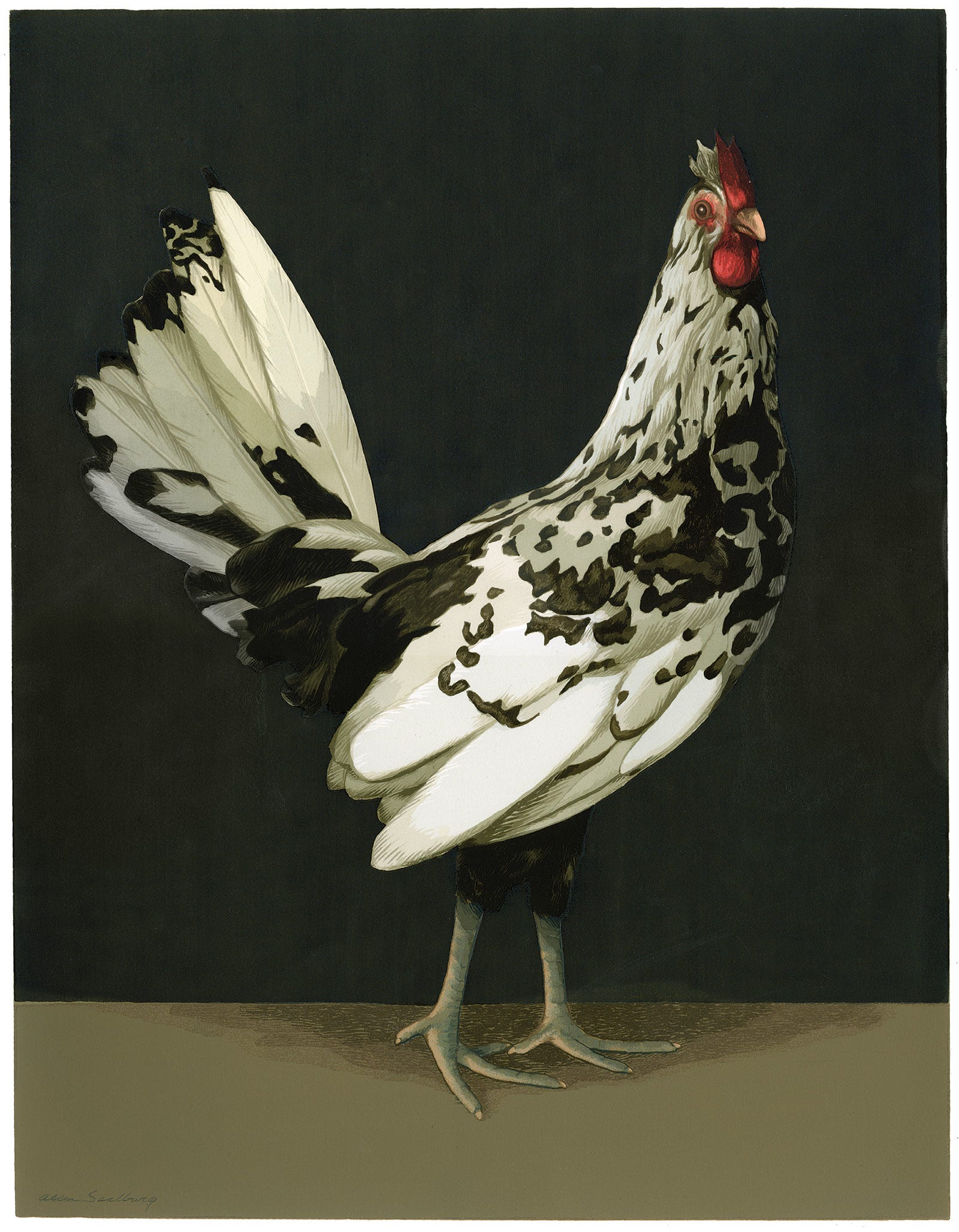
In our February 12 issue, Ian Frazier helpfully dispenses with a durable riddle: “According to people knowledgeable about chickens, the egg came first.” With that matter settled, he proceeds to tell the story of modern chickens, which as recently as 1940 barely featured in the average diet but are now “the most populous terrestrial vertebrate”—comprising “70 percent of all birds by weight” and “45 percent of all the meat that Americans eat.”
Frazier surveys the history of poultry, from their ancestor the red jungle fowl to “a craze called Hen Fever” that swept Boston in the nineteenth century to the contemporary fashion for raising backyard chickens and finally to the industrial farm, “a Dantean hellscape.”
Below, alongside Frazier’s essay, are five articles from our archives about birds.
There was an actual, historic chicken that ran around like a chicken with its head cut off. In the 1940s Mike, a Colorado rooster on his way to the dinner table, survived an incomplete decapitation that left enough of his brain stem intact that he remained partly functional and could run around. During the eighteen months he lived in this condition, his owner toured the United States and exhibited him as a sideshow attraction. In Under the Henfluence: Inside the World of Backyard Chickens and the People Who Love Them, Tove Danovich describes Mike sympathetically but says that he “wasn’t great for the reputation of the chicken.”
She says that chickens are smart and soulful, and she regrets that people make fun of them. Philip Levy, the author of Yard Birds: The Lives and Times of America’s Urban Chickens, feels the same. He says, “One of my goals is to make people think twice before laughing at chickens.” Some immutable principles of humor work against this goal, however, because chickens are humor, in a sense, and even their long overuse to get a laugh will not discourage people from using them to get one. And in fairness to comedy, some chickens were bred for it. One of Danovich’s chickens is a Salmon Faverolle, a breed with “a large, fluffy white beard that would impress any mall Santa.... People often refer to [this] breed as ‘barnyard comedians.’” Another backyard chicken keeper, Gina G. Warren, says in her book Hatched: Dispatches from the Backyard Chicken Movement that Silkies, a popular breed, are too small for eating, have head feathers like “spherical halos,” “are unreliable egg producers,” “run like drunk dinosaurs and are infinitely more hilarious than useful.”
According to people knowledgeable about chickens, the egg came first. An animal not very much like a chicken produced an egg containing an offspring more chicken-like than its parents, and by mutation the process kept happening through the ages until an egg emerged containing something that was indisputably a chicken—ergo, the primacy of the egg. Humans domesticated some of these animals 3,000 or 3,500 years ago. The red jungle fowl, the chicken’s ancestor, still lives in the wild in Southeast Asia. After having been caught (the hard part), chickens are readily portable, and humans in their wanderings took them all over. They were in Jerusalem two thousand years ago, making the story about the rooster crowing after Peter’s third betrayal of Jesus at least not physically impossible. A pope ordered that churches put images of roosters at their highest point as a reminder of our frailty—hence the rooster weather vane.
Through crossbreeding, many chickens lost their original jungle-camo colorations and became white or white-and-black checked. This is the color scheme of the Plymouth Rock and the Dominique, popular barnyard breeds in the US in the early 1800s. Then in the 1850s a craze called Hen Fever hit Boston. The city’s whaling fleet was bringing back from the South Seas colorful breeds of chickens that this hemisphere had never seen—Malays, Bengallers, and Chittaprats. A breed called the Shanghai (now known as the Brahma) stood taller than other chickens and had thick fur-like feathers, even down its legs to the ends of its toes. Herman Melville described the Shanghai as like an “oriental king in some magnificent Italian opera.”
Fashionable Bostonians lived in houses with yards where they could keep the new exotics. Acquisitiveness set in. Hen Fever spread to other cities, raising chickens in backyards caught on, and cities allowed it within their limits. When the fad died down, wandering chickens became associated with poor and immigrant city neighborhoods, where people kept them for the eggs. After scientists discovered that diseases were caused by germs, urban dwellers worried about sanitation and saw chickens as part of the problem. In the late nineteenth and early twentieth centuries, city after city passed ordinances against keeping them.
Read the full article on the Review’s website here.
From the Archives: Wings of Desire
Tim Flannery on the search for the last great auk
Daniel M. Lavery on Jacques Pépin’s (roasted) chickens
Robert O. Paxton on the science of bird migration
Peter Singer on chicken liberation
Elizabeth Kolbert on hunting the passenger pigeon into extinction

If you like our Substack, consider subscribing to our magazine by visiting nybooks.com/substack for a special discount on a full subscription.