“A Blast from the Country of the Dead”
Geoffrey O’Brien on Bridey Murphy

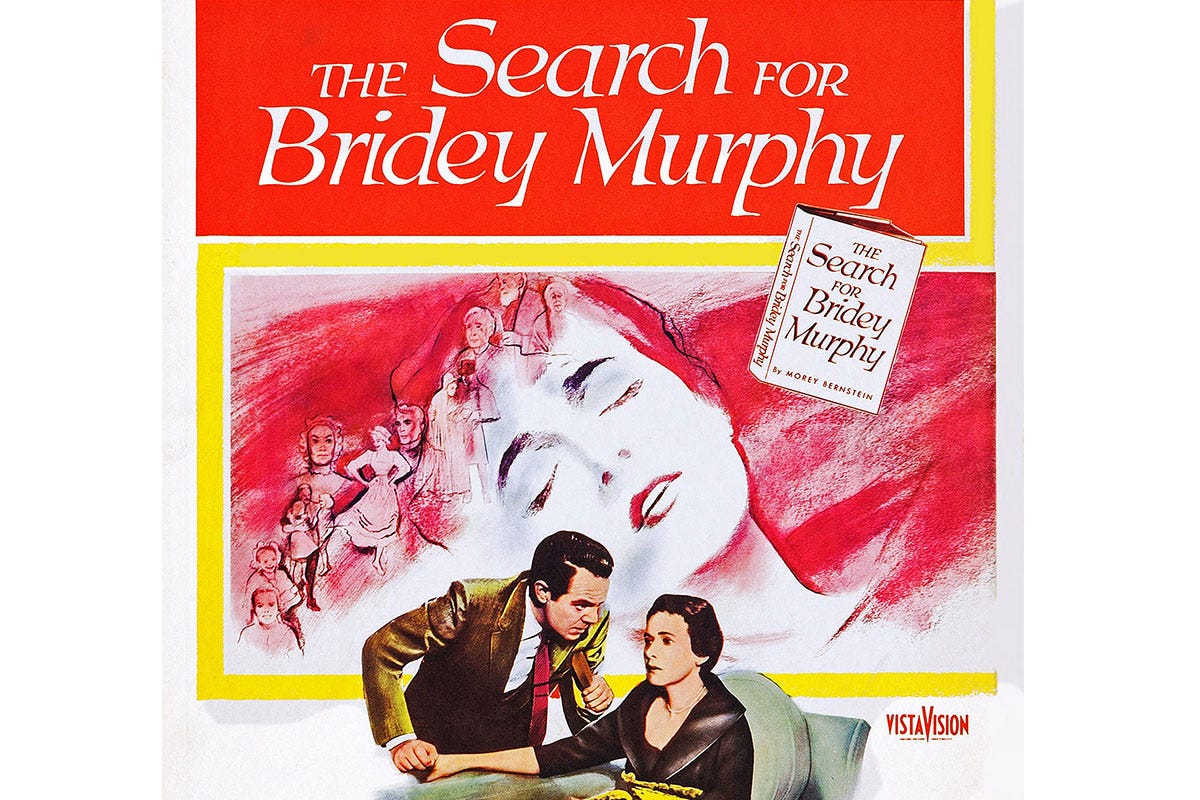
In the Review’s Summer Issue, Geoffrey O’Brien writes about Virginia Tighe, a housewife in 1950s Colorado; Morey Bernstein, an amateur hypnotist; and Bridey Murphy, a nineteenth-century Irishwoman who, apparently, had been reincarnated as Tighe and could be coaxed out while her twentieth-century body was under Bernstein’s mesmeric ministrations. For a few months in 1956—a time, O’Brien writes, “grounded in practicalities, reassured by material things that functioned: fuse boxes, automobile engines, lawn mowers, power drills, reel-to-reel tape recorders”—the United States was captivated by the story of “a blast from the country of the dead” that had blown into “a world brightly lit and logically organized”:
The phenomenon of Bridey Murphy—a gust of wind from another world—for a moment nudged aside communism, juvenile delinquency, and the ascendancy of Elvis Presley. Hypnotists were suddenly much in demand, and a good many readers lined up to uncover their own past lives.
Below, alongside O’Brien’s essay, are five articles from our archive about spiritualists, theosophists, past lives, and Shirley MacLaine.
A Gust from Another World
Geoffrey O’Brien
It was at the lowest of decibels that the voice of Bridey Murphy—muffled, groggily articulated—leaked into America. Bridey first made herself heard on the night of November 29, 1952, in a living room in Pueblo, Colorado, elicited from Virginia “Ginni” Tighe through the ministrations of Morey Bernstein, an amateur hypnotist. Ginni was the twenty-nine-year-old wife of a local Oldsmobile dealer; Morey, when not engaged with his hobby, ran a profitable family business specializing in heavy equipment for farms and ranches.
He had been enthralled with hypnosis for a decade. At first applying it to the treatment of headaches, insomnia, and stuttering, he was drawn gradually into uncharted realms: precognition, telepathy, clairvoyance, and finally reincarnation, something he had once regarded as “preposterous” but was now eager to investigate and, if possible, document. He had tried his hand at hypnotic age regression and was confident that he had taken subjects back to early childhood. Now he wondered whether the process could be pushed further, perhaps into a previous existence. Ginni, a casual acquaintance, seemed an ideal candidate for the experiment. In a few earlier sessions he had been struck by “how quickly and deeply she had become entranced.... Furthermore, she had remembered absolutely nothing afterward.... She was, in short, a somnambulistic subject.”* Ginni had agreed to hypnosis as a treatment for allergies and had no interest in revisiting past lives.
With his tape recorder running, Morey led her “back through time and space, just like turning back in the pages of a book,” all the way to age one, before venturing “over the hump,” as he later described it (using the World War II term for the trans-Himalayan route from India to China), instructing her that “there are other scenes from faraway lands and distant places in your memory...and when I talk to you again you will tell me about it.” Within moments she identified herself as what sounded at first like “Friday Murphy,” a small child living in Cork in Ireland in “eighteen something...1806.” Her hair was red; her father was a barrister; her younger brother had died of “some kind of black something”; she had muffins and jam for breakfast; her husband’s favorite dish was boiled beef with onions. So it went on, for this and five further sessions, as Morey teased out details of Bridey’s fairly uneventful life one fragment at a time: her childhood amusements, her marriage, her relocation from Cork to Belfast, her death in 1864 after a fall down the stairs (“Seems I broke some bones in my hip too”), her funeral (“I watched them ditch my body”), her lingering in the house alongside her husband, who couldn’t see or hear her, her subsequent stay in a place where time “doesn’t mean anything...no night or no day.”
Shared at first among acquaintances for whom Morey was eager to play the tapes, news of the sessions spread to a wider audience through a series of articles in The Denver Post. When his own account, The Search for Bridey Murphy, was published with great fanfare in January 1956, it quickly became the best-selling book in America. The paperback edition, rushed into print soon after, splashed across its cover the question “DOES THIS BOOK PROVE LIFE AFTER DEATH?”
The details about Bridey that Morey had elicited were not very exciting—in fact they were unrelievedly drab, pieces of an obscure life without great drama and with only minor pleasures, in a country more monochrome and sullen than the Ireland of movies. This made the book all the more plausible. Its most devoted readers were women, whose interest in prenatal regression, Morey noted, “is definitely keener than that of men.” Some may have found comfort in the idea that a life so enclosed and frustrated was not the end but merely a prelude to something better: something perhaps like Ginni’s as a reasonably affluent housewife in the Sun Belt whose weekly round of bridge games and cocktail parties may have seemed as much a fantasy as her phantasmal former existence.
Read the full article on the Review’s website here.
From the Archives: Out on a Limb
Max Nelson on mesmerism in America (2019)
Nell Stevens on getting the dead’s permission to write about them (2018)
Frederick C. Crews on the magic-minded Madame Blavatasky (1996)
Jonathan Miller on Franz Anton Mesmer’s magnetic salons (1995)
Martin Gardner on Shirley MacLaine and that “cosmic glue called love” (1987)
Now Available:
Unrequited Love
A New Seminar Series from Daniel Mendelsohn
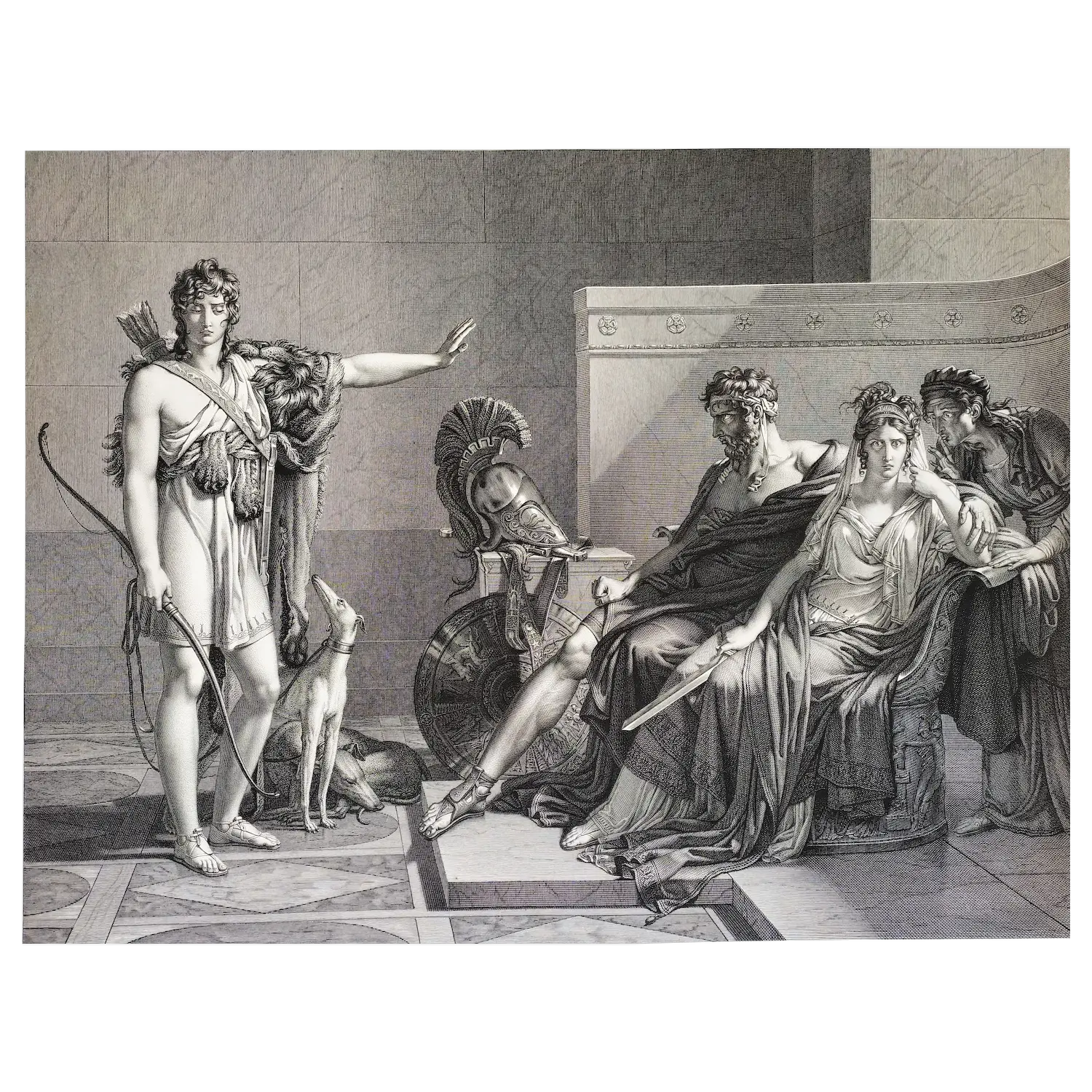
Author, critic, and translator Daniel Mendelsohn follows the theme of unrequited love in works by Homer, Sappho, Dante, Goethe, Jane Austen, W. Somerset Maugham, Marcel Proust, and more.
“Thou lov'st me not, / And never wilt! Love dwells not in our will. / Nor can I blame thee, though it be my lot, / To strongly, wrongly, vainly love thee still." So Lord Byron in Love and Death, describing a phenomenon that (alas!) most of us have experienced—and, more to the point, that has inspired some of the most brilliant and wrenching works of literature. In this five-part NYRSeminars season, we will be examining the phenomenon of unrequited love throughout its evolution as a subject in Western literature. We will begin with the classics, examining texts by Homer, Sappho, the tragedians and the Latin love elegists, and then move to the Middle Ages and early modern period, reading works by Dante, Petrarch, and Shakespeare in which the poets address themselves to cruelly unresponsive women. From there we will segue to the novel, which takes over as the preeminent vehicle for examining hopeless love: from Goethe and Jane Austen to Somerset Maugham and Marcel Proust.